Five congressmen and UOC: why a letter to Zelensky is no сoincidence
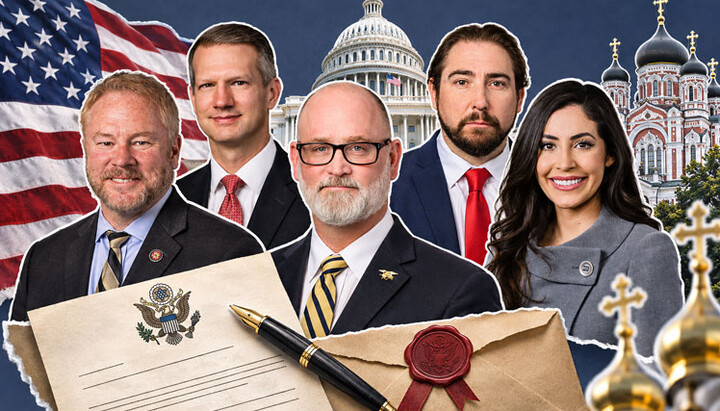
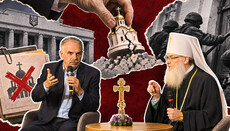
The appeal by five Republicans to Zelensky is part of a campaign to defend the UOC that has been ongoing for several years. And it has already achieved tangible results.
In December 2025, Orthodox Americans demanded that the Capitol secure the release of Metropolitan Arseniy of Sviatohirsk. Two months later, His Eminence was transferred from pretrial detention to house arrest. In May, Congresswoman Anna Paulina Luna reported that her office had been working on this issue with Ukrainian officials.
Now Luna and four other Republicans from the House of Representatives – Derrick Van Orden, Riley Moore, Warren Davidson, and Elijah Crane – have sent a letter to Volodymyr Zelensky. It was published on November 19, 2026.
The congressmen state that Law No. 3894 "raises significant concerns under Ukraine’s Сonstitution and international human rights commitments." And they formulate quite specific demands:
"We urge your government to halt enforcement of Law No. 3894, cease transfers of religious property, end detention and forced conscription of clergy, and ensure that all Ukrainians may worship freely and peacefully."
At the same time, the authors of the letter affirm their support for Ukraine's independence and security. They recall that the UOC condemned the Russian invasion, proclaimed its independence from the Moscow Patriarchate in May 2022, and that its clergy and parishioners help the Armed Forces of Ukraine and defend the country.
The congressmen separately address the principle of individual responsibility: "Democratic systems address unlawful
conduct through individualized accountability grounded in fair judicial process." In other words, if someone has committed a crime, they should be held accountable under the law. But what does the entire Church and its millions of faithful have to do with it?
This letter is not a sudden revelation on the part of five American politicians. It has a backstory.
From speeches to demands
In November 2025, representatives of the American Orthodox clergy discussed with Luna the situation of imprisoned UOC clergymen.
On December 16, 2025, a rally in defense of the UOC took place in Washington. The Orthodox faithful of various church jurisdictions met with American lawmakers and demanded the repeal of Law No. 3894, the release of Metropolitan Arseniy, and an end to the deployment of priests to the front line. Among the lawmakers who took part in the meetings were three of the current signatories of the letter: Luna, Crane, and Van Orden. In the same month, Riley Moore also met with representatives of Orthodox organizations.
The same demands are contained in the current letter to the President of Ukraine.
In January 2026, Luna reported an appeal to the Vatican, and in May she spoke out against the forced deployment of clergy to combat positions. That is, this is not a one-time action, but the systematic work of American politicians in defense of freedom of conscience in Ukraine.
It can be asserted that at least four of the five signatories had addressed this topic before. And outside Congress, the conversation about violations of believers' rights in Ukraine began long before.
Warnings that went unheard
In November 2023, Bishop of Leeds Nick Baines, a member of the British House of Lords and a hierarch of the Church of England, called on Kyiv to withdraw Bill No. 8371. He described the document as discriminatory and warned of the threat of collective punishment of a religious community. The bill later became the basis for Law No. 3894.
In April 2024, then-Senator J. D. Vance, now Vice President of the United States, criticized the attempt to ban the UOC over its alleged closeness to Russia.
On August 24, 2024, the World Council of Churches (WCC), while condemning Russian aggression and recognizing Ukraine's right to defend itself, warned against "unjust collective punishment of an entire religious community".
The following day, Pope Francis called for "no Christian Church to be banned, directly or indirectly" and highlighted the right of a person to pray in the Church they considers their own.
On September 3, Patriarch Theophilos III of Jerusalem called for the repeal of Law No. 3894.
On October 7, the U.S. Representative to the OSCE, Michael Kozak, warned of the risk of collective punishment of believers and called for compliance with international obligations in the sphere of religious freedom. Note that this was still under the Biden administration.
On October 30, Human Rights Watch described Law No. 3894 as too broad, warned of possible violations of freedom of religion, and proposed suspending its application pending an independent review.
On December 31, 2024, the Office of the United Nations High Commissioner for Human Rights (OHCHR) pointed to the disproportionate nature of the restrictions on believers and the lack of sufficient justification for their necessity.
In May 2025, seven independent UN experts sent Kyiv a letter with questions about discrimination against the UOC, the criminal prosecution of clergy, and pressure on journalists and human rights defenders.
In December 2025, the OHCHR once again reminded that historical or canonical ties with a foreign center alone are not sufficient grounds for banning a religious organization.
The list turned out to be quite impressive: the Roman Pope, the Patriarch of Jerusalem, an Anglican bishop, the WCC, Vance, the American mission to the OSCE, human rights organizations, the UN. There is neither political nor confessional unity among them. Yet their demand is the same: if someone is guilty of a crime, try him. But why should many millions of other parishioners answer for it?
When letters bring results
It would be wrong to claim that international protests have already changed the situation of the UOC as a whole. Law No. 3894 remains in force, and the lawsuit seeking to terminate the activity of the Kyiv Metropolia is still pending in court. But there are some individual results.
Metropolitan Arseniy spent a year and ten months in a pretrial detention center. On February 25, 2026, the court changed his preventive measure to round-the-clock house arrest. UOC lawyer Robert Amsterdam thanked the participants of the American campaign for their help in defending His Eminence.
On May 31, Luna stated that her office had worked with Ukrainian officials to seek a change in the situation of the hierarch, who needed heart surgery. "I want to thank the Ukrainian officials with whom we worked on this matter," she said.
And on June 11, round-the-clock house arrest was replaced with a nighttime one: from 6:00 a.m. to 10:00 p.m., His Eminence may move about freely.
These are no longer mere words of support from across the ocean: the congresswoman directly confirms that she worked with Ukrainian officials. At the same time, the hierarch is still under nighttime house arrest, and the case against him has not been closed.
There is also other testimony. Catherine Whiteford, a leader of the Young Republicans, said that in 2024 she passed to Vice President Vance letters from UJO journalists who were in custody. About three months later, they were released. A connection between the appeal and the court's decision has not been documented, but it may be assumed that these efforts were not in vain.
Finally, the UOC's complaints are no longer merely a domestic Ukrainian issue. They are now reflected in UN and human rights organizations' documents, and questions about them are being put to the Ukrainian government. This is not yet a victory, but it is certainly not insignificant.
"Freedom" for export
Viktor Yelensky, head of the State Service of Ukraine for Ethnopolitics and Freedom of Conscience (DESS), has a different view of the situation. As early as January 2024, he called Ukraine a model of religious freedom. Similar rhetoric is still heard today.
When questions began to be raised abroad, so-called advocacy efforts came into play. Delegations of the Ukrainian Council of Churches and Religious Organizations (UCCRO), acting at the government's behest, assured their foreign partners that there were allegedly no violations of religious freedom in Ukraine. In February 2026, Yelensky discussed plans for further trips with members of the Council.
Catholic Bishop Vitaliy Kryvytsky described how participants in such trips respond to accusations of persecution: "As the Ukrainian Council of Churches and Religious Organizations, we say: today in Ukraine there are no signs of persecution precisely for faith." At the same time, Kryvytsky did not deny the existence of court cases and problems facing the UOC, but asserted that they have exclusively political, not religious, causes.
And the head of the UGCC, Sviatoslav Shevchuk, admitted that after the adoption of the law, religious leaders "had to explain to the whole world that freedom of conscience is in no way being curtailed in Ukraine".
A paradoxical picture emerges: the World Council of Churches warns of the risk of violations of religious freedom, while the Ukrainian Council of Churches persuades foreigners that there is no persecution. Incidentally, there was no place for the UOC on these trips. And on June 30, 2026, its membership in the UCCRO was suspended altogether.
In the end, everyone speaks about the situation of UOC believers except the UOC believers themselves.
What comes after the letter
Five signatures cannot replace a decision by the US Congress, and the letter itself will not repeal Ukrainian law. We do not know what steps the signatories will take next. But they have effective tools at their disposal: appeals to the State Department, initiating congressional hearings, inquiries into individual criminal cases, and discussions about religious freedom in connection with US assistance to Ukraine.
Time will tell whether these tools are used and how the Ukrainian authorities respond to the letter. But let us be honest: the fate of the Church depends not so much on American congressmen, or even on the Ukrainian authorities, as on Ukrainian believers themselves – on their willingness to defend their Church and remain faithful to it.
And in Ukraine there are people who do not wait for Washington's efforts to bear fruit but act on their own. Here are a few examples.
In March 2026, parishioners raised bail in less than a day to secure the release from custody of Archpriest Vitaly Agafonov, who is accused of desertion after refusing combat duties on religious grounds.
On April 27, hundreds of believers, together with Metropolitan Longin, gathered outside the Territorial Recruitment Center (TRC) building in Chernivtsi, demanding the release of Archimandrite Serhiy, who had been detained. The clergyman was released.
Some raise money for legal representation, others stand up to defend their churches, and many continue to pray wherever they can hold services after losing their church buildings. Help from abroad is needed, and the story of Metropolitan Arseniy shows that it can be effective. But the most important thing is the believers' faithfulness to Christ and His Church.