Why Uniates go cap in hand to Taras Shevchenko
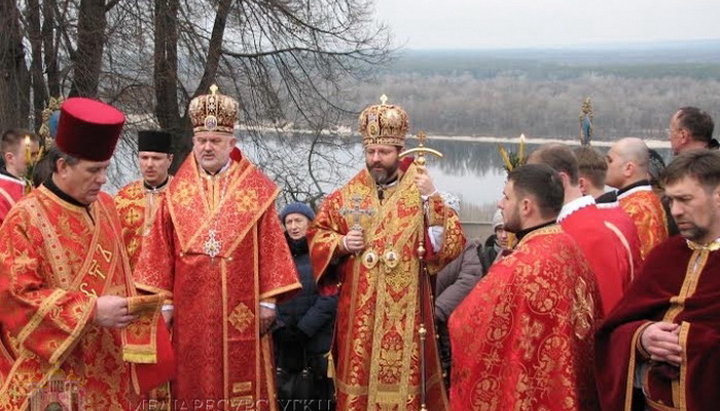
Head of the UGCC in Kanev
Why do Uniates pay homage to the man who believed Uniatism the biggest evil for Ukraine and never kept this truth back?
An event program:
11.20 - Meeting of guests (the Church of the Intercession of the Virgin, the western foot of Taras Mountain);
12.00 - Hierarchical Divine Liturgy;
13.30 - Solemn procession to Taras Hill;
13.50 - Ceremony of laying flowers at the grave of Taras Shevchenko;
14.00 - A requiem for the repose of the soul of Taras Shevchenko and all those who fell for freedom of Ukraine (on the grave of Taras Shevchenko);
14.30 - Examination of the exhibit of Taras Shevchenko museum.
Press Service of the Kiev Archdiocese
As we can see, the event is very solemn and lasting. Ukrainian Greek Catholics will pray for the repose of the soul of T. Shevchenko and show him their special respect. There is only one question in this respect: will not the Great Kobzar turn over in his coffin from such a prayer?
There are different points of view as for the religious worldview of T. Shevchenko, but one thing is certain: he considered Uniatism a great evil and spoke about this very frankly.
”When we were Cossacks
And there was no union at all,
We used to enjoy our life!
...Until by the name of Christ
Catholic priests came and burnt
Our quiet paradise. And poured
Extensive sea of tears and blood,
And orphans by the name of Christ
Were murdered and crucified.
Cossacks are crestfallen
With their heads bent
like trodden grass.
Ukraine is crying and groaning!
Its people are falling dead beneath.
Torturers are ferocious,
And Catholic priests are crying out madly
“Te deum! Hallelujah!”
(Orsk fortress — 1850, Orenburg)
Another fragment shows how Taras Shevchenko spoke about the Pope, actual leader of the UGCC:
”Around us is falsehood and captivity,
The tormented folks keep silent,
While the Holy See
Is occupied by the well-fed Catholic monk…
Who is shedding people’s blood
And letting Paradise on lease…”
(Heretic, 1845)
Professor Ivan Ogienko writes in his book "The Religiosity of Taras Shevchenko": "When Shevchenko remembers old times and tells how Ukraine was oppressed by Poles, Catholics and Uniates, he loses composure and the most serious accusations break out of his mouth." And he makes a very categorical conclusion: "In our literature there are no such cruel and fiery speeches against the Pope, the Poles, Catholics and Uniates, as Taras Shevchenko made."
Why, then, these same Uniates headed by Sviatoslav Shevchuk go to such a harsh exposer of Uniates like Taras Shevchenko to bow and praise him in every possible way. And the rector of the Uniate church of St. Nicholas on Askold's grave, priest Igor Onishkevich, in 2008, said that his parishioners in prayers turned to Taras Shevchenko as a saint. This was reported by the Kiev newspaper Khreshchatyk.
All is explained simply: the end justifies the means. since T.Shevchenko is now in the trend, since he is considered the most outstanding son of the Ukrainian people, why not hype on the dates of his birth and death (respectively, 9th and 10th of March). After all, to honor the Great Kobzar is very fashionable and patriotic. So is it worth losing the opportunity to collect additional image points because of such a trifle as the opinion of T.Shevchenko himself about the Uniates? So Sviatoslav Shevchuk went to Kanev to the Chernecha Mountain and in a jaunty voice told about how outstanding Shevchenko was and how correctly Greek Catholics do. Is it hypocrisy or Sviatoslav Shevchuk did not read Shevchenko's verses?
But here's another misfortune. The reverence of T. Shevchenko on a national scale was initiated by none other than Vladimir Lenin. In the framework of the Leninist program of monumental propaganda, which was recognized as the most important propaganda tool for the revolution and communist ideology, on April 12, 1918, the Decree of the Council of People's Commissars of the RSFSR was signed "On the Monuments of the Republic" (Shevchenko is 16th on the list – Ed.)
According to this decision, two monuments of Shevchenko were established in Kiev and one each in Moscow and Leningrad. And in 1919 by the decision of the Soviet authorities Bibikovsky Boulevard was renamed into the boulevard of Taras Shevchenko. Another wave of veneration of Kobzar took place under Stalin’s rule in 1939. Then the name of Shevchenko was awarded to the University of Kiev and the park in front of it. And at Shevchenko's grave in Kanev, in the same year of 1939, a museum and a memorial complex was built together with a monument to which Sviatoslav Shevchuk went to worship.
As we see, neither de-communization nor what Shevchenko himself considered Uniatism to be the greatest evil for Ukraine and its people does not stop the Uniates. They turn a blind eye on this, because they need to reach out to the hearts of ordinary Ukrainians who must believe that they – Uniates – are the most kind and patriotic. However, Shevchenko thought otherwise.
Read also
Yelensky’s plan: Why is DESS demanding what the UOC has already done?
DESS is demanding that the UOC take steps it has already taken, while offering no assurance that further demands will not follow. What is behind Yelensky’s ultimatum?
Why OCU hierarchy lacks canonical ordination: what Local Churches say
The OCU head refuses to address invalidity of his ordinations. But almost all Local Churches speak of it – even those that recognized the OCU.
Why nation-first advocates do not call for peace
Ukraine’s population is declining by nearly one million people a year, and experts are warning of the nation’s demographic extinction. Yet the leaders of the Orthodox Church of Ukraine (OCU) and the Ukrainian Greek Catholic Church (UGCC) continue to call for war and mobilization.
The deception that decided the fate of the Tomos
In 2008, the "Filaret problem" derailed Yushchenko's plan. In 2018, Poroshenko solved it in just one hour – with a police escort for the Greeks and verbal promises to Filaret.
Lawyers in the crosshairs: How UOC is being stripped of its right to defense
Activists harass UOC lawyers outside courthouses, call them “traitors” on air, and promise them a “warm welcome” at hearings. The Church’s right to a legal defense is at stake.
How to respond to persecution: Lessons from St. Silouan the Athonite
The Church can and should be defended, but without malice. Why love for persecutors is not weakness but the only way to preserve the Spirit of Christ in the midst of the struggle.