Lawlessness with Kokhanovska: There's no law in power and never will for UOC
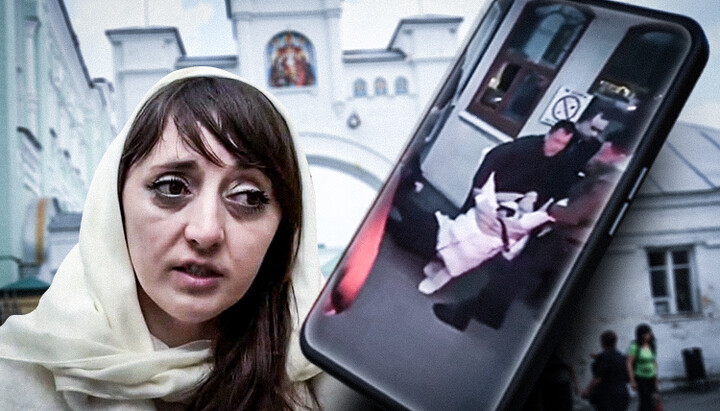
The police abducted and took away the human rights activist V. Kokhanovska. Photo: UOJ
On the evening of April 19, 2023, near the entrance to the Lower Lavra, certain people attacked human rights activist Viktoria Kokhanovska, pushed her into a police car and took her away. And the word "attacked" is not an exaggeration at all. The footage shows Kokhanovska lying on the ground unconscious, although a few seconds ago she was fine and broadcasting live on Facebook.
It is not known what the law enforcement officers did to her. But people don't collapse just like that. This is what the kidnappers themselves said in the car: “She f*ck her (Kokhanovska – Ed.) began fighting back, so I pulled her. She pretended to have fainted away there. I pushed her into the f*cking car, and we’re on our way.”
However, how could this happen at all? How in a democratic country can policemen suddenly attack a woman like this, drag her unconscious on the asphalt and, in fact, kidnap her? Is Kokhanovska a criminal dangerous to society, who can be detained only by brute force? Not at all.
Viktoria Kokhanovska has been protecting the Church for a long time, but she always adheres to the law. She has never refused responsibility for her actions. But, again, according to the law. She was already summoned for questioning on April 10. As long as it was in line with the law, Kokhanovska herself got into the car and drove to the SBU. But when it was illegal, Kokhanovska read aloud the rules of the law to the law enforcement officers. What happened this time?
On the morning of April 19, employees of the Ministry of Culture illegally sealed one of the buildings of the Kyiv-Pechersk Lavra, blocking the monastery's brethren and parishioners inside. Why is it illegal?
The Ukrainian Orthodox Church has had an indefinite lease agreement for the premises of the Kyiv Caves Lavra since 2013. Now the authorities have suddenly decided to terminate it and expel the Church. The monastery filed a lawsuit, the trial is slated for April 26. That is, before the trial, the Ministry of Culture did not have the right to close or seal anything. And even more so – to lock people inside. That is why a group of believers, including Kokhanovska, unblocked the building. Now the authorities are accusing these people of hooliganism, and the police have already informed them of suspicion.
Lavra's lawyer Nikita Chekman said that the norm of Article 208 of the Criminal Procedure Code of Ukraine was allegedly applied to Kokhanovska, whereby a criminal can be detained with the use of force.
By law, this happens if:
- The offender is detained at the scene of the crime,
- If there are witnesses or signs that this person is a criminal.
But even in this case, the law enforcement officer must inform the detainee of the grounds for detention, of what crime he or she is suspected of committing, and also explain his or her rights: to have a lawyer, receive medical assistance, and so on.
Have we seen something similar in the case of Kochanovska? No. We saw a bandit assault by a group of men on a defenseless woman, because of which she lost consciousness. What does it mean?
It only means that the government could not detain Kokhanovska according to the law – there were no reasons for this. If there were, Viktoria herself would calmly get into the car, as she did before.
There is only one explanation for everything that occurred on the evening of April 19 – the believers were shown that there is no law for them in the country today. Rather, there is the law of force, the law of the whip. Just like it was with Chekists 100 years ago.
Well, all the talk of our government, as if Ukraine is a state of law, seems more and more like a funny joke. But in our case, this joke is sad.
Read also
Yelensky’s plan: Why is DESS demanding what the UOC has already done?
DESS is demanding that the UOC take steps it has already taken, while offering no assurance that further demands will not follow. What is behind Yelensky’s ultimatum?
Why OCU hierarchy lacks canonical ordination: what Local Churches say
The OCU head refuses to address invalidity of his ordinations. But almost all Local Churches speak of it – even those that recognized the OCU.
Why nation-first advocates do not call for peace
Ukraine’s population is declining by nearly one million people a year, and experts are warning of the nation’s demographic extinction. Yet the leaders of the Orthodox Church of Ukraine (OCU) and the Ukrainian Greek Catholic Church (UGCC) continue to call for war and mobilization.
The deception that decided the fate of the Tomos
In 2008, the "Filaret problem" derailed Yushchenko's plan. In 2018, Poroshenko solved it in just one hour – with a police escort for the Greeks and verbal promises to Filaret.
Lawyers in the crosshairs: How UOC is being stripped of its right to defense
Activists harass UOC lawyers outside courthouses, call them “traitors” on air, and promise them a “warm welcome” at hearings. The Church’s right to a legal defense is at stake.
How to respond to persecution: Lessons from St. Silouan the Athonite
The Church can and should be defended, but without malice. Why love for persecutors is not weakness but the only way to preserve the Spirit of Christ in the midst of the struggle.