Should the Church be "with the people" or with God?
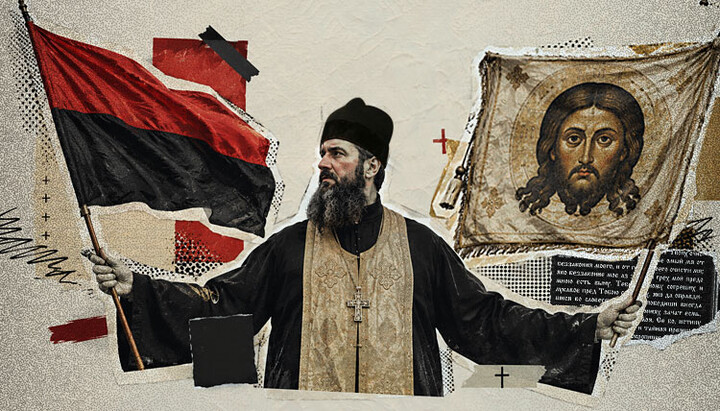
With whom should the Church be? Photo: UOJ
In recent years, we have seen how some resources and spokespeople of the Ukrainian Orthodox Church trying by every possible means to prove their patriotism to the Ukrainian authorities. They readily talk about how much has been raised for the needs of the army, what letters of appreciation they have received from the military, and which state events they have been invited to attend. And behind all this one can hear a hope: if loyalty to the Motherland is proven through actions and spoken aloud – “we are one of you, we are patriots, we support the front” – then the authorities’ attitude will change.
But this is an illusion. A very dangerous one.
The authorities, which are methodically destroying the Church, do not care whether we are patriots or not. What they need are obedient people, those who are willing to adapt to the official line, repeat the required formulations, and avoid asking unnecessary questions. Patriotism has nothing to do with it.
Therefore, proving it is pointless: it is like trying to present a proof of income at passport control – the document is genuine and the information in it is truthful, but something entirely different is being checked.
When miracles do not convince
Let us recall the Gospel. After the raising of Lazarus, it became absolutely clear: Jesus Christ was the Messiah promised by the prophets; He was doing what no ordinary person could do. He was not merely speaking beautiful words, but bringing the dead back to life, healing the sick, and giving sight to the blind. It would seem that even the most stubborn opponents should have stopped and reflected: could this be the One they had been waiting for for so many centuries? But the chief priests and Pharisees decided otherwise: they convened a council and resolved to put both Him and Lazarus to death. The reason was simple: in their view, Christ was threatening their authority, and a Man with a direct connection to God did not fit into the well-established system that brought them many very earthly benefits.
Miracles did not convince the persecutors of the first centuries either. Fire would not burn the martyrs, beasts refused to tear them apart, wounds from torture healed before one's eyes — it is hard to imagine more vivid testimony. Did that stop the persecutors? No, more often it only enraged them. Because Rome was not seeking proof of God's truth. It demanded something else: to bow before the emperor, to burn incense before his statue, to declare aloud that his earthly power is above all else – "above everything."
It is the same today. One may collect as much as one likes for the army, publish photographs with soldiers, and display commendations from battalion commanders. For those who make decisions about the Church, this means nothing. They do not look at real assistance to the army or society, but at something else: whether the Church is ready to support the rhetoric of the country's top officials, to broadcast the required narratives, and to praise or condemn whomever they are told to.
And almost always this is justified by the thesis: "The Church must be with the people." For the sake of the people – hate the enemy; for the sake of the people – support mobilization; for the sake of the people – unite into a single "Ukrainian church." It is precisely "for the sake of the people" that we are urged to make "quite small, insignificant" concessions. They say: do as you are told, and you will immediately begin to live in peace and harmony with the state.
But scratch the surface just a little, and the manipulative nature of the phrase about "the Church and the people" becomes obvious. In reality, the Church is not being called to be with the people at all — it is being required to serve the authorities.
The parallel with the first centuries is not accidental. Back then, too, there were those who urged people not to anger the authorities: just place a pinch of incense on the altar before the emperor’s statue – it is merely a mechanical gesture, it does not mean renouncing God. One insignificant concession, and everyone is satisfied. But the martyrs refused to do so. It was precisely because they would not perform this “trivial” gesture that they were executed.
What the authorities actually want from the Church
Look at the structures that today enjoy the full support of the authorities, and you will see that very incense rising before the emperor's statue. They make "correct" statements, defend the official position of the state abroad, request weapons, and lie that no one in Ukraine is persecuting the UOC faithful.
In essence, the majority of religious organizations belonging to the All-Ukrainian Council of Churches and Religious Organizations function as yet another ministry – only with crosses, cassocks, and clerical collars.
This is not patriotism. It is service, and a very specific service: to support the authorities and legitimize their decisions. In return, such structures receive protection, draft exemptions, and various privileges.
The Ukrainian Orthodox Church does not fit into this scheme. Not because it is "unpatriotic," but because it refuses to be fully controlled. It lives by its own internal rules, preserves canonical ties, and does not compromise the Gospel. For the authorities, these are the chief signs of unreliability.
Therefore, any proof of patriotism amounts to speaking into a void. The authorities do not hear "we love Ukraine," but rather "we are still not entirely yours." And they respond accordingly.
The lesson of the Soviet decades
The history of the Church in the 20th century offers a harsh and clear lesson on this subject.
Lev Regelson, in his book The Tragedy of the Russian Church, examines in detail how the hierarchy's attempts to prove its loyalty to the Soviet authorities ended.
After the revolution, the Church found itself under total pressure. Churches were closed, priests were arrested, and property was confiscated. Patriarch Tikhon and many bishops tried to find a formula that would allow the Church to survive and somehow coexist with the godless regime. They declared their readiness to recognize the new authority, called on the faithful to be law-abiding, and emphasized that the Church does not engage in politics. During the famine in the Volga region, they handed over church valuables to aid the starving. In other words, they did everything that citizens who love their country ought to do. One would think: what more could be demanded?
But this was not enough for the authorities. They needed not merely civic loyalty, but a readiness to become part of the state system. They wanted the Church not simply to "coexist" with Soviet power, but to regard its successes as its own successes and its failures as its own failures. They wanted the spirit of the Church to merge with the spirit of the "world revolution."
In 1927, Metropolitan Sergius (Stragorodsky) did what no one before him had dared to do – he issued the "Declaration" in which he stated: we acknowledge the Soviet Union as our civic homeland, whose joys and successes are our joys and successes, and whose failures are our failures. Formally, this appeared to be a logical continuation of the loyalty line. In reality, as Regelson shows, these words sounded as an expression of spiritual and moral solidarity with an ideology that openly aimed at the destruction of the Church.
What did the Church receive in return? A temporary "legalization" of one of the administrative centers, the opportunity to serve as a showcase – look, they said, there is no religious persecution in the USSR – for "Western partners," and nothing more. But the price paid was enormous: internal schism, the loss of trust among a significant portion of the faithful and clergy, confusion and disarray. And, most importantly, the persecutions did not stop.
Regelson cites telling figures: "Metropolitan Sergius was unable to prevent the destruction of the Church through any compromises or concessions. If by the end of 1929 (precisely the period when the "Declaration" was issued – Ed.) he had approximately 30,000 parishes under his authority, ten years later only a few hundred remained: such was the result of two 'godless five-year plans.'"
As we can see, the "Declaration" of loyalty to the Bolsheviks gave the Church nothing positive whatsoever and saved no one. One might ask: why?
Because the authorities saw the threat not in the absence of patriotic statements from the Church. They saw the threat in the very desire of the Church to live by its own laws, to preserve its inner freedom, and in its refusal to merge with state ideology.
It was precisely this merger that the Soviet authorities demanded. Today we see such a merger in modern Russia. And the Ukrainian authorities are following an identical path.
Why proving patriotism is a trap
When the Church begins to zealously prove its usefulness and patriotism, it accepts the rules of someone else's game. It agrees that its value is measured by the number of vehicles sent to the front, the area of camouflage netting produced, and the tonnage of humanitarian aid delivered.
But the Church does not exist for this. Its purpose is to lead a person toward union with God, toward salvation. It performs the Sacraments, preaches the Gospel, preserves the faith, and remains the conscience of the people even when that conscience says what the authorities dislike.
As soon as the Church begins to measure itself by someone else’s standards, it loses. Because in this game, the authorities will always demand something more. Today it is enough to raise funds for the army; tomorrow they will demand that "wrong" hierarchs be publicly condemned; the day after, that prayer texts be changed; then that LGBT rights be supported for the sake of European integration; and that eucharistic communion with other Churches be broken. There is no endpoint to this chain of demands, because its goal is not patriotism but complete control.
Imagine a hospital where a cardiac surgeon, instead of performing operations, travels from one city administration to another and explains how many trench candles his nurses have made and how actively the hospital supports government initiatives. Meanwhile, surgeries are hardly being performed, and patients are dying. Would anyone say with admiration: "What a wonderful clinic and surgeon – such patriots"?
In the case of the Church, many people for some reason believe that this is exactly how it should be: that a priest or bishop is obliged to devote his energy to proving his loyalty rather than to preaching, prayer, and caring for his flock. That the Church’s main task is not faithfulness to Christ and the Gospel but maintaining excellent relations with those in power.
It always ends the same way. The institutional framework may hold together for a while, but the evangelical spirit gradually fades away, and in its place remain only words about "the aggressor," "war," and "national interests."
Does this mean that the Church should demonstratively ignore the needs of the country and its people? Helping those who suffer, supporting those at the front, praying for peace and for salvation – these are an important part of Christian life. But all of this ceases to be a Christian act precisely when it turns into a political gesture aimed at winning the favor of those in power.
Our common cause
We cannot change politicians. We can show them an example of Christian life, preach the Gospel, and call them to the Kingdom of Heaven. Whether they hear or not is no longer our responsibility.
But whether the Church will remain the Church – that responsibility rests entirely with us. And it is not decided in offices or in public statements. It is decided where a priest chooses what to say in a sermon and what to leave unsaid. Where a bishop considers whether to put his signature to yet another appeal. Where a parishioner remains in his church, understanding what consequences this may bring for him.
The Church survived the Soviet decades not because of the “Declaration.” It was preserved by those who continued to serve in the remaining churches, baptize children, and perform funerals for the departed, expecting no gratitude from the authorities.
The same will be required of us.
Read also
Why OCU hierarchy lacks canonical ordination: what Local Churches say
The OCU head refuses to address invalidity of his ordinations. But almost all Local Churches speak of it – even those that recognized the OCU.
Why nation-first advocates do not call for peace
Ukraine’s population is declining by nearly one million people a year, and experts are warning of the nation’s demographic extinction. Yet the leaders of the Orthodox Church of Ukraine (OCU) and the Ukrainian Greek Catholic Church (UGCC) continue to call for war and mobilization.
The deception that decided the fate of the Tomos
In 2008, the "Filaret problem" derailed Yushchenko's plan. In 2018, Poroshenko solved it in just one hour – with a police escort for the Greeks and verbal promises to Filaret.
Lawyers in the crosshairs: How UOC is being stripped of its right to defense
Activists harass UOC lawyers outside courthouses, call them “traitors” on air, and promise them a “warm welcome” at hearings. The Church’s right to a legal defense is at stake.
How to respond to persecution: Lessons from St. Silouan the Athonite
The Church can and should be defended, but without malice. Why love for persecutors is not weakness but the only way to preserve the Spirit of Christ in the midst of the struggle.
Where the Spirit of the Lord is, there is freedom
Reflections on the controversies surrounding the creation of the OCU.