
Where the Spirit of the Lord is, there is freedom

Reflections on the controversies surrounding the creation of the OCU.
Church history knows many documents whose authors wrote not for posterity but for their contemporaries. Such texts are valuable precisely because they were never intended to be polished for history: people simply recorded what they saw, as they saw it. The recently published report by a Constantinople cleric on the events of December 2018 in Kyiv is one such document. It was written for a single reader – Patriarch Bartholomew – and recounts, day by day, the week in which the structure now known as the “Orthodox Church of Ukraine” was created.
Nearly eight years have passed. The OCU exists; it has been recognized by four of the 15 Local Churches; and the Ukrainian authorities continue to transfer churches to it after, as a rule, falsifying documents and forcibly taking them from those who built and sustained them – the parishioners of the Ukrainian Orthodox Church. And it is this newly created structure that is presented to the world as the “united Church of the Ukrainian people.”
But now that we have before us an eyewitness account of how this structure actually came into being, we should ask a question that matters to every Christian. It is not a political question, nor even a canonical one, but a spiritual question: where, in all of this, is the Holy Spirit?
Signs of the Spirit – and signs of His absence
The Church has always known the signs by which the presence of God is recognized. The Apostolic Council in Jerusalem concluded with the words, “It seemed good to the Holy Ghost, and to us” (Acts 15:28). As we remember, this was a gathering of people who met freely, without coercion, debated openly, and ultimately reached a decision in unity of mind.
On the day of Pentecost, the Holy Spirit descended upon the apostles as they were “all with one accord in one place” (Acts 2:1), and the first fruit of His descent was that people of different nations began to understand one another. The Apostle Paul names the fruits of the Spirit: “love, joy, peace, longsuffering, gentleness, goodness, faith, meekness, temperance” (Gal. 5:22–23). And where the Spirit of the Lord is, he also writes, “there is liberty” (2 Cor. 3:17).
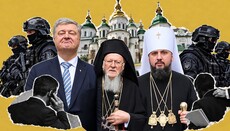
Now let us look at what is described in the document published by the American edition of UOJ. According to the report, the exarchs of the Patriarchate of Constantinople were under considerable pressure from the Ukrainian state. Security officers came to them with reports about which bishops of the canonical Church “secretly wished” to join the newly created structure, while negotiations over its charter were conducted in the presence of government representatives.
More than that, the exarchs feared that their phones were being tapped and therefore decided to communicate through handwritten notes because, as the document puts it, “any discussion between us would be disrupted by the constant surveillance.” In the middle of the night, the head of the Constantinople delegation was summoned to the President’s office, where, in addition to the head of state, the chief of the security service was also present.
The following day, the delegation was taken to the presidential residence under police escort, its members’ phones were confiscated, they were searched, and they were informed that they were “detained and prohibited from leaving the country.” The author of the report himself admits that during those hours he “unconsciously kept writing the prayer ‘O Theotokos and Virgin, Rejoice’ on a piece of paper over and over again,” because there was nothing else he could do.
What do we see? Fear, suspicion, surveillance, pressure, sleepless nights, handwritten notes instead of spoken words. One would hardly say that this resembles the Council of the Apostles described in the Book of Acts.
Let us also recall the words of the holy Apostle John the Theologian: “There is no fear in love; but perfect love casteth out fear: because fear hath torment” (1 John 4:18). Where everyone fears everyone else, there is neither love nor freedom, much less the Holy Spirit, Who blows where He wills, not where He is directed to blow. In other words, all of this can only be described as the very opposite of love.
And so we return to the question: can we accept that this is the atmosphere in which a Church is supposed to be born?
The answer is simple. Administratively, diplomatically, and politically, anything can be recognized. But recognition of this kind does not confer the grace of the Holy Spirit. Grace is bestowed by God, not by directives from government officials or security services.
Autocephaly granted to those who were “not ready”
Perhaps the most troubling passage in the report is the account of the telephone conversation between the Patriarch and the President.
The Patriarch says: “The behavior of one single person proves that you are not ready for autocephaly.” Significantly, the President responds not with an argument about faith, but with an argument about war: if the Council does not take place, military intervention may follow.
And the very next day, “autocephaly” is granted.
The Church has never believed that gifts of grace should be bestowed “before it is too late.” The apostles in Jerusalem did not rush; they “considered” the matter (Acts 15:7). The Holy Fathers at the Councils debated individual words for months because they knew that a decision made in haste and under pressure does not come from the Holy Spirit.
When, however, a Council is convened under pressure from secular authorities, and the argument for it is not the good of the Church but political expediency, this in itself is the clearest indication of just how prepared the participants in that gathering actually were to receive the much-discussed autocephaly.
The desire to build a tower reaching to heaven by one’s own strength, without waiting for the will of God, leads to the confusion of tongues (Gen. 11:4), not to the triumph of truth. Pentecost, by contrast, began with patient, prayerful waiting for the Holy Spirit.
A conversation with the ambassador that all Local Churches should know about
The report contains an episode that goes far beyond the “Ukrainian question,” and it cannot be ignored because it concerns every Local Church.
The Patriarchate’s delegation visits the Turkish ambassador. The ambassador explains that the Local Churches are not equal: there are five “principal” Churches, while the others, “much younger,” “originate from the jurisdiction of the Ecumenical Patriarchate” and therefore cannot be regarded as equals. He then adds that the time has come for the Patriarchate “to demonstrate its true position throughout Orthodoxy.”
According to the report, the delegation “admired the ambassador’s precise ecclesiological knowledge and acknowledged the correctness of his words.”
Once again, it is important to emphasize that warnings about the danger of so-called “Eastern papism,” in which the Patriarch of Constantinople is regarded as “first without equals,” have come not only from representatives of the Ukrainian Orthodox Church. They have been voiced in Serbia, Bulgaria, Antioch, Poland, the Czech Lands and Slovakia, and on the Holy Mountain. Theologians, bishops, and monks have spoken about it. They have warned that the doctrine of a “first without equals” replaces the Church’s conciliarity with a form of one-man rule that Orthodoxy has never known.
They were told that this was an exaggeration, that no one was challenging the equal dignity of the autocephalous Churches.
And now we read that representatives of Constantinople agreed that there are no equals.
How, then, should we understand this agreement – as a “diplomatic” maneuver or as the position of the Phanar itself? It would be good to hear an answer to that question. It is also worth asking whose geopolitical interests the Turkish ambassador was expressing through his “ecclesiological” views, given that he is not an Orthodox Christian.
But until such an answer is given, let us remember that Orthodox ecclesiology is born not of diplomacy but of the Gospel, where the Lord says to His disciples as they argue over primacy: “Whosoever will be chief among you, let him be your servant” (Matt. 20:26).
All Local Churches, ancient and young alike, possess equal dignity not because someone negotiated it, but because in each of them the same Eucharist is celebrated and the same Christ abides. If this begins to be disputed or called into question, then it is not merely the situation in Ukraine that is at stake, but the very structure of Orthodoxy itself.
“Baptized anew”
The report also contains words addressed not to hierarchs or Churches, but to the entire Orthodox people of Ukraine, regardless of the jurisdiction to which they belong.
The day after the Council, one of the exarchs, serving at St. Michael’s Monastery, says that the Mother Church had “baptized the Ukrainian people anew.” The author of the report presents this as a particularly apt phrase.
However lofty the Greek rhetoric may be, there are limits that must not be crossed. The Church confesses in the Creed “one baptism for the remission of sins,” and the Apostle says: “One Lord, one faith, one baptism” (Eph. 4:5).
Our people received Baptism in the waters of the Dnipro more than a thousand years ago, and since then no saint, no Council, and no Patriarch has ever called that Baptism into question. To speak of the people’s “second baptism” means either failing to understand one’s own words or regarding everything that came before oneself as meaningless.
In the same report, a representative of the Patriarchate tells UOC-KP spokesman Eustratiy Zoria that the Mother Church – meaning Constantinople – “teaches, and you learn; we are not negotiating as equals.”
A little later, he writes of his “hidden calculation”: to secure the dissolution of the Ukrainian schismatic structures – the UOC-KP and UAOC – before the “Unification Council,” so that the Ukrainian side would have no “way to retreat” and would be “bound.”
These words were written not about opponents, but about those who were being received into communion, those who had been promised the Tomos, and those who were proclaimed in the square to be the “united Church of the Ukrainian people.”
Can the edifice of the Church be built on such guile? Let each person answer that question for himself.
On silence
It should be noted that several days have passed since the report was published, and the Patriarchate of Constantinople remains silent. So does the hierarch to whom the document is attributed.
That silence speaks more loudly than any denial, and it cannot be ignored.
At the same time, it is difficult not to notice that this is not the first silence of the Phanar that our Church has had to endure.
For eight years, we have waited for even a single word about seized churches, anti-Church laws, beaten parishioners, priests put on trial, monks mobilized into the army, and believers told that they belong to the “wrong” Church.
Not one word of condemnation has been heard.
Our faithful experience this silence very painfully.
And now it has been joined by silence over how Ukraine’s “correct” church structure was actually created.
The Lord said: “For nothing is secret, that shall not be made manifest; neither any thing hid, that shall not be known and come abroad” (Luke 8:17). And now we see that what was hidden has come to light.
But the Gospel tells us something else as well: “For every one that doeth evil hateth the light, neither cometh to the light, lest his deeds should be reproved” (John 3:20).
In other words, silence in the face of the light is itself a retreat from the light.
A response could be given in a single word. And until that word is spoken, all other words about the “love of the Mother Church” for the Ukrainian people lose their meaning.
What remains
The report to Patriarch Bartholomew changes nothing about the position of the Ukrainian Orthodox Church. Our Church continues to face pressure from every side; the courts continue to hear the case seeking its prohibition; churches continue to be taken away.
We do not expect that the publication of this document will cause anyone to return what has been taken from us or ask for forgiveness. That is not what we are talking about.
We are saying that the Church cannot be created by a government decision, just as it cannot be destroyed by a court ruling. She is the mystical Body of Christ the Savior, Who was crucified for our salvation.
The Church is built by the Holy Spirit where there is love, freedom, and unity of mind. She is not built where there is fear, suspicion, and calculation. This is not our opinion; it is the testimony of Scripture and two thousand years of Church history.
And so we appeal to all the Local Churches – both those that have recognized the structure created at that time and those that have not – with one request: read this document not as journalists and not as diplomats, but as Christians. Ask yourselves whether you recognize in what it describes the work of the Spirit of God. And if you do not, then let this become the beginning of the open, pan-Orthodox conversation that everyone has been waiting for, but which has never taken place.
But let it be a conversation based not on political expediency, not on geopolitical agendas, and not on the assertion of new papal ambitions. Let it instead seek the genuine healing not merely of a wound, but of what has already become an ulcer, a tumor whose metastases may spread to other members of the body of universal Orthodoxy.
And to our faithful, clergy, and monastics, we say what we have said throughout these years: do not repay evil with evil. Pray for those who persecute and curse you. Preserve unity, and do not seek the salvation of the Church by departing from the truth and the Church canons.
God’s truth does not need our efforts in order to triumph. It asks only that we do not abandon it.
And therefore our hope lies not in human strength, not in political circumstances, and not in the decisions of earthly authorities, but in our Lord Jesus Christ Himself, Who said: “I am with you alway, even unto the end of the world” (Matt. 28:20).