Pentarchy: Why the Phanar meeting could become a talk about Ukraine
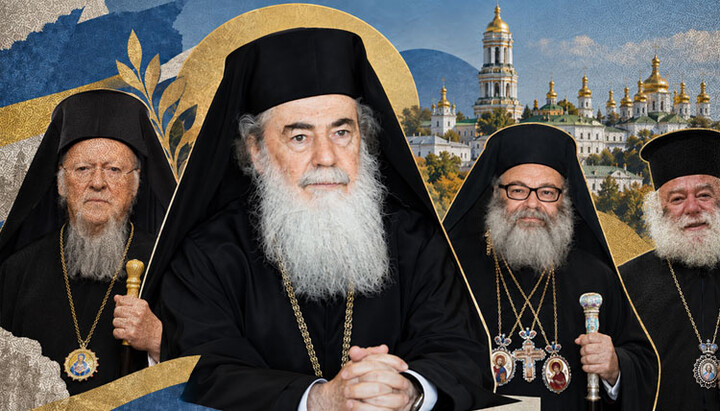
Will the "Ukrainian issue" be considered at the pentarchy meeting? Photo: UOJ
On September 4 in Budapest, addressing participants at a congress of the Society for the Law of the Eastern Churches, Patriarch Bartholomew announced that he had invited the Primates of the Churches of Alexandria, Antioch, and Jerusalem to meet at the Phanar on the feast day of St. Andrew the First-Called. The stated purpose was broad and lofty: the four “remaining ancient Apostolic Thrones” are to “reflect synodally on the challenges facing the people of God today in a rapidly changing world.” In the same speech, the Patriarch spoke at length about the pentarchy – the ancient system of the five principal sees of the Christian world, the “five-stringed lyre” that performed a conciliar role during the first millennium.
However, today this "five-stringed lyre" may serve entirely different purposes. We have already written about the dangers of this idea: the pentarchy, in its current interpretation, easily becomes a mechanism allowing "ancient" Churches to decide the fate of "newer" ones.
In other words, there is a danger that some Churches, acting together, could assume authority over others. Those concerns have not gone away. Yet despite our disagreement with the way Constantinople handled the “Ukrainian issue,” one thing should be acknowledged: the initiative to bring the four sees together is, in itself, a good one. For the first time in years, Primates with a vast number of unresolved issues and problems between them will sit down at the same table. And when we look at who exactly will be sitting there, it becomes clear that an attempt to revive the pentarchy could become not a trial of anyone, not a tribunal, and not simply another governing body, but something the Orthodox world has lacked since at least 2018 – a place for normal, open, and sincere dialogue.
Who will go to the Phanar
Of the three invited Primates, two have not recognized the OCU. Antiochian Patriarch John does not commemorate Epifaniy and from the very beginning insisted that the Ukrainian question should have been resolved conciliarly. This is not a one-time reaction – the Antiochian Church, third in the diptychs, has been demanding since Crete that all contentious topics be brought to pan-Orthodox discussion.
Patriarch Theophilos of Jerusalem not only declined to recognize the OCU but also attempted in 2020 to bring together in Amman those who disagreed with the Phanar’s decisions on Ukraine.
Patriarch Theodoros of Alexandria recognized Epifaniy in the fall of 2019 – just a year after urging the faithful in Odesa to remain with Metropolitan Onuphry. And he paid a higher price for that recognition than anyone else, losing part of his flock in Africa. It would therefore surprise no one to learn that attitudes toward the Ukrainian issue within the Church of Alexandria remain considerably more restrained than its official statements might suggest.
So, at the negotiating table will be Constantinople, which issued the Tomos to the OCU, and three Churches for each of which Ukraine presents a serious problem. It is reasonable to cautiously suggest that, in such circumstances, the pentarchy could evolve from an instrument of judgment or governance into what it originally was: a council in which no single voice is decisive.
Incidentally, this is precisely what Patriarch Bartholomew spoke about in Budapest – conciliarity. On that point, it is difficult to disagree with him. The only question is whether someone will be willing to say the word “Ukraine” first. And there is every reason to believe that someone will.
The Year of Jerusalem
If one looks at the diplomatic activity of Jerusalem Patriarch Theophilos in 2026, his meetings add up to something greater than merely a set of protocol events.
On June 4, Donald Trump received him in the Oval Office. They spoke for nearly an hour about Christians in the Middle East, the status quo of the Holy Sites, and Israeli authorities having closed the Old City even to clergy in the spring. But according to the official statement of the Patriarchate, the conversation concluded with a discussion of the Russian-Ukrainian war and the Patriarch's offer to help in its resolution. All of this was said in the context of the Patriarch's planned visit to Moscow.
Two days later, the Primate of the Jerusalem Church was already in Athens, where he held several meetings – with the president, the prime minister, and ministers. Greek officials spoke openly of a "new spiritual channel" for resolving the war. Earlier, in November 2025, the Jerusalem Patriarch received the Order of Friendship in Moscow, and at the Russian embassy in Israel he spoke about attacks on UOC clergy and the seizure of churches in Ukraine – that is, about what the UOC has been declaring for years.
All of this was accompanied by work to strengthen relations with the governments of Orthodox countries. Thus, the Greek Foreign Ministry in September signed a ten-year memorandum with the Patriarchate, providing for funding of one million euros per year. Cyprus funds Jerusalem's projects through its special representative for religious freedoms in the Middle East. On September 15, Patriarch Theophilos received the mayor of Nicosia and established a commission on Cypriot affairs headed by Metropolitan Timotheos of Bostra – formally it deals with the real estate of the Exarchate of the Holy Sepulchre, but the Patriarchate's very desire to put all its affairs in order, from land to diplomacy, is telling. And this week in Jerusalem, a visit by Bulgarian Patriarch Daniel was announced – yet another Primate who has not recognized the OCU.
In the Ukrainian segment of the internet, Patriarch Theophilos has been dubbed a “Schröder in a cassock” and, predictably, accused of “working for Moscow.” Short-sighted Ukrainian “patriots” who reproach the Patriarch for being “pro-Russian” somehow overlook the fact that he is received in Washington while the Greek government allocates millions to the Jerusalem Patriarchate.
Yes, Patriarch Theophilos meets officials in both Moscow and Sofia. But that points to one thing: in an Orthodox world where Primates can go years without meeting one another, he remains the one figure whom everyone continues to receive – Church leaders and politicians from very different camps alike.
A mediator is not someone everyone likes. A mediator is someone everyone receives and is willing to talk to.
And on November 30, the Patriarch of Jerusalem will be in a place where people will listen to him.
Position on the UOC
To understand the position Jerusalem will bring to the table, there is no need to speculate. It is enough to listen to Metropolitan Timotheos of Bostra, Exarch of the Jerusalem Patriarchate. A Greek from Patras, he has headed the Exarchate of the Holy Sepulchre in Nicosia since 2005, and throughout those years his position on Ukraine has remained consistent.
For example, in September 2018, when the Tomos was still only being prepared, he stated that Metropolitan Onuphry is the only canonical Primate of Orthodox Ukraine recognized by all the Churches, and that Jerusalem's stance on this matter would remain unchanged.
In the summer of 2019, when the Tomos had already been signed, he addressed the faithful of Ukraine with a call to remain in the Church under the omophorion of Metropolitan Onuphry and added words that today sound like a program for the meeting at the Phanar: "We pray for pan-Orthodox unity, but for the right kind of unity – unity around the canonical Church. We want the Ukrainian Orthodox Church to continue its salvific work without political interference."
And at the end of August 2026, when monk Varsonofiy was killed at the Holy Dormition Sviatohirsk Lavra, the Exarch of the Holy Sepulchre was among the first outside Ukraine to call things by their proper names. "A society that kills monks is defenseless," Greek publications headlined his statement.
The hierarch wrote that he had been following what was happening to the UOC for years and had hoped matters would never reach this point – but they had. He called for the investigation to be pursued to the end and urged that political expediency not be allowed to determine its course. As for the cause of the tragedy, he spoke plainly: years of harsh rhetoric against the UOC had accustomed society to hostility, and once hostility becomes habitual, the boundaries of what is considered acceptable become increasingly difficult to maintain.
It is worth emphasizing that these words come not from an outside observer, but from a hierarch of the Church that ranks fourth in the diptychs, has its own position on the “Ukrainian issue,” and can afford to speak plainly.
It is equally telling that Metropolitan Timotheos says these things from Cyprus – an island whose Church has recognized the OCU. He concelebrates with Cypriot bishops, preaches in Cypriot monasteries, and at the same time makes no secret of his position on Ukraine.
This means that the Jerusalem Patriarchate is indeed capable of speaking with others – without scandal, but with weight and authority.
How the pentarchy could help
It must be acknowledged that, coming from the Phanar, the idea of the pentarchy sounds like a claim to special rights for the ancient sees. And this claim is difficult to accept, because in Orthodoxy there are no Churches of "first and second rank."
But the idea has another, far more important dimension.
The pentarchy of the first millennium worked not because the five sees were "superior" to others, but because none of them could decide anything on its own, without consulting the rest.
Rome could not act without Constantinople, Constantinople without Alexandria and Antioch, while Jerusalem, the smallest of them, had the same voice as the most powerful Churches. It was a system of mutual restraint, not a hierarchy of supremacy. That is precisely the mechanism that was missing in 2018.
The “Ukrainian issue” was decided by one see, without consultation. The result is known to everyone: the schism only deepened and has now divided not only Ukraine but the entire Orthodox world.
So if Patriarch Bartholomew genuinely intends to bring the ancient sees back to a conciliar consideration of today’s challenges – and his words in Budapest give grounds for hoping that he does – then there is no need to search far for the principal challenge.
It is not ecology or the “rapidly changing world.” It is a Church that, in the first nine months of this year alone, has seen nearly a hundred of its priests taken away by TRCs; a Church whose monasteries and churches are being seized with the involvement of state authorities; a Church whose monk was killed outside the walls of his monastery.
Four sees, two of which have never regarded the “Ukrainian issue” as settled – this is precisely the kind of council that was missing eight years ago.
A pentarchy conceived as an instrument against some could become an instrument for the defense of others.
But only to the extent that the participants themselves want it to.
What we expect from the meeting
Let us recall that errors in the history of the Church have been corrected not by anathemas but by councils. And the meeting of four Primates at the Phanar – for all the caution with which it should be approached – is the first opportunity in many years to speak about the error of the OCU Tomos.
Obviously, none of us expects the Tomos to be revoked on November 30. But we are entitled to expect that the “Ukrainian issue” will at least be discussed.
Jerusalem has everything it needs for this: the authority of the Mother of Churches, the experience of Amman, and a Patriarch who is received at the White House, in Athens, Constantinople, and Moscow.
It is precisely Patriarch Theophilos who can become a mediator in this painful and difficult question for all of us.
And if the Orthodox world ever returns to a conciliar conversation about Ukraine, that conversation may begin where four Churches sit down together and remember that they are one Body, in which “if one member suffers, all the members suffer with it.”
We believe that on November 30, such an opportunity will arise.
And we believe that someone will seize it – the Patriarch of Jerusalem.
Read also
Lawyers in the crosshairs: How UOC is being stripped of its right to defense
Activists harass UOC lawyers outside courthouses, call them “traitors” on air, and promise them a “warm welcome” at hearings. The Church’s right to a legal defense is at stake.
How to respond to persecution: Lessons from St. Silouan the Athonite
The Church can and should be defended, but without malice. Why love for persecutors is not weakness but the only way to preserve the Spirit of Christ in the midst of the struggle.
Where the Spirit of the Lord is, there is freedom
Reflections on the controversies surrounding the creation of the OCU.
Pentarchy with Rome: A return to the roots or a new schism?
Patriarch Bartholomew wants to revive a council of five patriarchates, including Rome. What would reunion with Catholics look like, and what role would be left for the other Churches?
Concubine or daughter? On words that cannot be used about the Church
An archon of the Church of Constantinople likened the UOC to Moscow’s “concubine.” But for St. Epiphanius of Cyprus, “concubines” are heresies.
Shameful chronicle of one week: how the OCU was born
Exarchs under escort, a call from the operations room, and 36 votes for Epifaniy: what a member of the Phanar delegation revealed about the 2018 "Council".