
Pentarchy with Rome: A return to the roots or a new schism?
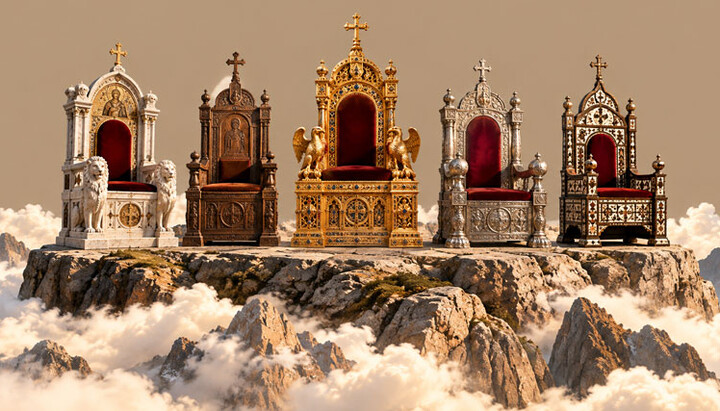
Patriarch Bartholomew wants to revive a council of five patriarchates, including Rome. What would reunion with Catholics look like, and what role would be left for the other Churches?
In early September 2026, Ecumenical Patriarch Bartholomew spoke in Budapest at the 27th International Congress of the Society for the Law of the Eastern Churches, devoted to the place of the Bishop of Rome in the Catholic and Orthodox traditions. In his address, he spoke about the significance of the ancient Pentarchy – the system of Church governance by five sees: Rome, Constantinople, Alexandria, Antioch, and Jerusalem. It existed roughly from the sixth to the mid-11th century – only about 500 years out of the Church’s 2,000-year history. He called these five sees the “five-stringed lyre” of the Universal Church, which should once again sound in the fullness of its ancient harmony.
To this end, he invited the primates of the Alexandrian, Antiochian and Jerusalem patriarchates to a meeting on November 30 at the Phanar.
About the fifth see (or, rather, the first) he declared: “We hope <…> for the restoration of full communion with the Church of Rome <…> so that the Pentarchy may once again be whole”.
With which Rome does Patriarch Bartholomew intend to reunite?
As is well known, the break with the Church of Rome is traditionally dated to 1054. By that time, two teachings had become established in Western Christianity that Orthodoxy regards as heretical: the procession of the Holy Spirit from the Father and the Son – the Filioque – and the supremacy of the Roman pontiff over all Christians. Moreover, this supremacy in the first millennium differed quite substantially from what it is today, or at least was understood differently.
In his Budapest address, Patriarch Bartholomew presented Rome’s primacy as a ministry within the five sees and the Roman pope as first among equals. In other words, judging by his rhetoric, the Patriarch is proposing a return to the Church order of the first millennium. Yet it would not be the Rome of the first millennium returning, but modern Rome. And today’s Catholic Church is far from what it was a thousand years ago. Over the intervening centuries, it has formulated a whole series of dogmas and doctrinal teachings that Orthodoxy cannot accept.
The most obvious example is papal authority. The current Code of Canon Law of the Catholic Church does not grant the Roman pontiff merely primacy among equals, but “supreme, full, immediate and universal” power (Canon 331). Added to this is the dogma of papal infallibility in matters of faith and morals.
Catholicism has no intention of abandoning either the dogma of papal authority or other doctrines – the Immaculate Conception of the Virgin Mary, purgatory, and others.
Full Eucharistic communion presupposes unity of faith. Catholics have no intention of departing from their faith. Is Patriarch Bartholomew ready to abandon his? Or is he proposing simply to turn a blind eye to all of this?
So far, he has given no answer.
But dogma is not the only thing dividing Catholics and Orthodox Christians today. Over the centuries, East and West have also developed significantly different spiritual cultures.
A telling example is the understanding of salvation. In Catholicism, there is the juridical model formulated in the 11th century by Anselm of Canterbury: sin is an offense against God’s honor requiring satisfaction. The practice of indulgences, which so discredited Christianity in the late Middle Ages, is also connected with this logic. And although the abuses of that period are no longer practiced today, the modern Catholic Catechism still defines an indulgence as remission of the “temporal punishment” due for sins already forgiven and speaks of the “treasury of the satisfactions of Christ and the saints.”

The culture of piety itself also differs. During the second millennium, the West developed devotions to the Sacred Heart of Jesus and Divine Mercy, a particular fascination with stigmata, private revelations, and the highly emotional mysticism of a number of saints. In 2024, for example, Pope Francis devoted an entire encyclical, Dilexit Nos, to devotion to the Sacred Heart of Jesus. In it, he quotes at length from the visions of Margaret Mary Alacoque in the 17th century: Christ shows her His burning heart and immerses her own heart in it until it becomes “like a tiny atom consumed in a burning furnace.”
The Orthodox mystical tradition, by contrast, calls for spiritual sobriety, a critical attitude toward visions, and careful vigilance against spiritual delusion.
Reuniting Catholics and Orthodox Christians, therefore, is far more complicated than simply restoring the Bishop of Rome to first place in the ancient diptychs.
The pentarchy as a product of the Middle Ages
This system of Church governance took shape relatively late, around the sixth century, against the backdrop of the geopolitical conditions of the time. Christians of the first centuries knew no such system.
The document Synodality and Primacy During the First Millennium, adopted by the Joint International Commission for Theological Dialogue Between the Catholic Church and the Orthodox Church in September 2016, states explicitly: “From the fourth to the seventh century, the order of the five patriarchal sees came to be recognized.”
Formally, the Pentarchy came to an end in 1054 following the rupture between Rome and Constantinople. But even earlier, around the seventh century, after the Muslim conquests of Palestine, Syria, Egypt, and North Africa, it had already undergone major changes. Christian communities under Muslim rule became poorer and declined significantly in number. Life for Christians – especially hierarchs – in a Muslim environment became unsafe.
In subsequent periods, the patriarchs of Antioch, Jerusalem, and Alexandria often resided for long stretches in Constantinople. They were heavily dependent on the Patriarch of Constantinople and the Byzantine emperor – and, after 1453, on the Ottoman sultan – who appointed and supported them. They often governed their own ecclesiastical structures only nominally. Even then, the Pentarchy had essentially become a façade. After the Moscow Church became a patriarchate in 1589, the idea emerged of a kind of new pentarchy in which Moscow would take the place of the fifth Eastern see. Yet this arrangement never became a restoration of the ancient Pentarchy in the proper sense.
Particularly revealing is the explanation for why Constantinople was included among these five patriarchal sees in the first place. The canons of the Second and Fourth Ecumenical Councils explain its status primarily in political terms: the city was the “New Rome” and the “city of the emperor and senate” – that is, the imperial capital, where the emperor and senate were based. Today, as we know, there is no empire and no emperor. Constantinople has long ceased to be a capital, has a completely different name – Istanbul – and has almost no Christians left. Yet despite the fairly explicit rationale given by the Ecumenical Councils, the head of the Patriarchate of Constantinople now claims to be “first without equals” throughout Orthodoxy.
Do Church hierarchs understand that trying to revive forms of Church governance that existed a thousand years ago would turn today’s Church into a monument to the Middle Ages?
Apparently they do, although they express this understanding in very diplomatic terms.
Even Orthodox-Catholic dialogue does not propose mechanically reproducing the ancient system. In June 2023, at the 15th plenary session of the same International Commission in Alexandria, the document Synodality and Primacy in the Second Millennium and Today was adopted. It states: “In the new circumstances, a new and proper application of the same underlying principle is required.”
Yet the central question surrounding any revival of the ancient Pentarchy is different: are the other Local Churches to become second-class Churches? Must they unquestioningly accept decisions made by the five sees? Or is some other role envisioned for them?
What about with the other Local Churches?
Patriarch Bartholomew has already raised the idea of reviving the Pentarchy. On September 1–3, 2011, he convened at the Phanar the primates of the ancient patriarchates of Alexandria, Jerusalem, and Antioch, with the Patriarch of Antioch represented by Bishop Isaac of Apamea. The primate of the Church of Cyprus also took part. The UOJ later explicitly described the format of that meeting as an attempt to revive a “neo-Pentarchy.”
The outcome of that meeting, however, is highly revealing. After their discussions, the participants proposed that Bartholomew convene a “Synaxis of the Patriarchs and Primates of the Orthodox Autocephalous Churches.” In other words, they did not assume the authority to speak on behalf of all Orthodoxy.
Such a Synaxis of primates was held on March 6–9, 2014, and was presented as an important stage in preparations for the Council of Crete, which Patriarch Bartholomew envisioned as pan-Orthodox. The Council took place in 2016, but because four Local Churches declined to participate, it was not, in practice, pan-Orthodox.
At the 2014 Synaxis, Patriarch Bartholomew’s rhetoric was quite different. He spoke positively of the existing system of autocephalous Local Churches and said that it prevented the emergence of the concept of the “universal authority” of one Local Church or its primate, an idea foreign to Orthodox ecclesiology. In his words, “the Orthodox Church constitutes a communion of autocephalous and self-governing Orthodox Churches.”
Speaking of the future Council of Crete – pan-Orthodox in the Phanar’s understanding – Patriarch Bartholomew recalled the ancient Pentarchy but immediately drew a different conclusion: because new patriarchates and autocephalous Churches had emerged during the second millennium, “all recognized autocephalous Churches must be represented.”
An interesting picture emerges: in 2011, Patriarch Bartholomew advocated reviving the Pentarchy; in 2014, he spoke about the importance of all the Local Churches; and in 2026, he is once again calling for the “five-stringed lyre” of the Pentarchy to sound. But what happens to all the other strings?
Of course, no one intends to abolish the autocephaly of the Serbian, Romanian, or Georgian Churches. But if only five Churches bear “special responsibility for the fate of Orthodoxy,” what are the others supposed to do? In that case, they would effectively be excluded from making the most important decisions. Yet they would still be expected to carry those decisions out, simply trusting in the “wisdom” of the members of the Pentarchy – or, until reunion with the Catholics takes place, the four patriarchates.
But how much wiser are they than everyone else? Obviously, there is no instrument for measuring the “wisdom” of ecclesiastical sees. Still, some statistics are worth considering: according to various estimates, the four patriarchates together have between 5,000 and 8,000 parishes, while the other Local Churches have between 70,000 and 76,000. Thus, even at the upper estimate, the four patriarchates represent only about 10 percent of all Orthodox communities. The four patriarchates have between 300 and 350 monasteries, compared with 2,200 to 2,600 in all the other Churches. They have between 10 and 15 theological schools, compared with 110 to 130 in the other Churches.
In other words, what is being proposed is that the most important decisions for the entire Church be made by just one-tenth of it. And a closer look at the present situation of these four patriarchates makes the picture even more complicated.
The present situation of the four ancient patriarchates
The longstanding and close relationship between the Patriarchate of Constantinople and the U.S. State Department, as well as the American establishment more broadly, is well known. The UOJ website has published several analyses of these ties.
The extent of this relationship can be seen in statements made by the late Patriarch Athenagoras (Spyrou), who remains highly revered today and after whom a prestigious award presented by the archons of the Patriarchate of Constantinople is named.
In 1948, for example, he told a reporter for the American newspaper Evening Independent: “I shall always promote America and American interests, live the American ideals and preach them.” In 1957, he told U.S. Consul General Robert Miner that “he and his institution [the Patriarchate of Constantinople – Ed.] are always at the disposal of the Department of State to further in every possible way the foreign policy objectives of the United States Government.”
The Patriarchate of Jerusalem is facing enormous pressure from Zionist groups, as well as financial difficulties. Not long ago it secured funding from the Greek government for restoration and research work.
And Jerusalem is not the only patriarchate receiving assistance from Greece. The Patriarchate of Alexandria receives even more substantial and systematic support. Greece funds staff positions, salaries, insurance, and pensions for some clergy of the ancient patriarchates, while officials in Athens openly describe this assistance as a means of ensuring the stability of the patriarchates and preserving their Greek Orthodox character.
The Patriarchate of Antioch is perhaps in the most difficult position of all the ancient Eastern sees. Its canonical territory consists primarily of Syria and Lebanon, countries that have endured war, economic crisis, and political instability. Since the beginning of the Syrian war, the country’s Christian population has reportedly fallen by about 80 percent, and following the change of government in December 2024, the patriarchate has had to rebuild relations with Syria’s new leadership and seek guarantees of security and equal rights for Christians.
In other words, special responsibility for the fate of Orthodoxy is being entrusted to Local Churches that are heavily dependent on secular governments – and, in the cases of the Patriarchates of Antioch and Constantinople, on the authorities of Muslim-majority countries.
Conclusions
The desire for Christian unity is, in itself, unquestionably a good thing. The thousand-year division between East and West is a tragedy that everyone would like to overcome. But Church unity must be based on unity of faith, not agreements between ecclesiastical diplomats. Yet it is precisely the question of faith that seems to have been pushed to the margins of the discussion. Instead, the focus is on questions of primacy, as though Christ Himself had not already addressed them: “If anyone desires to be first, he shall be last of all and servant of all” (Mark 9:35).
Placing the Roman pope back in his place within the Pentarchy will not make the Catholic dogmas formulated in the second millennium disappear, nor will it erase the differences between Catholic and Orthodox theological and spiritual traditions.
The attempt to restore an administrative structure of the Christian empire in a completely different world looks no less strange. For several centuries, the Pentarchy was an important form of life in the ancient Church. On the whole, it corresponded to the geopolitical realities of its time – empire, monarchy, an estate-based society, and so on. Without restoring those conditions, reviving the Pentarchy would look like a comical anachronism.
Today, Patriarch Bartholomew dreams of hearing the “five-stringed lyre” sound again. It is a beautiful image, but over the past fifteen centuries Orthodoxy has acquired other strings as well. And if, for the sake of the ancient “five strings,” those others are told to fall silent or play only softly, the Pentarchy will become not an instrument of Church unity, but yet another cause of division.