
Divine maths by Elder Paisios: How zeros can become millions

A winter meeting in the Panagouda cell. Why we count our sins and successes according to the laws of human bookkeeping, while God counts according to the laws of love, where 2 + 2 does not always equal 4.
December is the most merciless time of the year. The air smells not only of mandarins and pine needles, but also of a heavy sense of guilt. We open our planners, the lists of goals we wrote a year ago, and feel like crying. “Quit smoking,” “read a chapter of the Gospel a day,” “not get irritated with the children,” “help volunteers”.
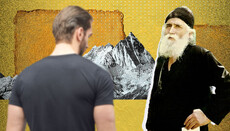
We look at this list and see the red ink of unfulfilled hopes. The year has flown by, and we remain the same: fussy, lazy, and weak.
We feel like spiritual bankrupts.
We seem to be “managers of salvation” who have failed the annual report, and now a harsh reprimand from the General Director awaits us. With this heavy backpack of failures, we mentally board a ferry and sail to winter Mount Athos.
A backpack with stones
On the Holy Mountain, it is now damp. The cold penetrates to the bones, the fog clings to the tops of the cypresses. We climb the soggy clay path to the Panaguda cell. Our feet slip, but the burden we carry in our souls is heavier than the physical ascent.
We knock on the wire gate. Elder Paisios comes out to us in a knitted cap and a worn cassock. He sees not our faces but our heaviness. He doesn’t ask «How are you?» because he already knows. He seats us on wooden stools near the stove, pours hot tea, and offers us loukoum.
We take out our "annual report". We are ready to repent and justify ourselves.
– Geronda, we say, lowering our eyes, the year was wasted. We didn’t manage to do anything. We planned feats, but slipped into fuss. We wanted to become saints but remained ordinary sinners. Surely, God is very disappointed in us.
We expect the elder to frown and say: "Yes, it’s bad. You need to fast more." But Paisios smiles. Mischievous sparks shine in his eyes, which do not match our tragedy at all. He takes a twig and draws something in the ash by the stove.
– You are counting in a human way, he says gently. – In your mind it’s all about accounts: "I did this, so I’m doing well. I didn’t do it, so I’m nothing." But God has a different kind of arithmetic.
Theory of zeros and ones
The elder looks at us and speaks words that turn everything inside out. He reminds us of how important it is to correctly assess our place in the world. The saint explains this principle through a simple mathematical allegory:
"People are zeros. I am a zero, and you are a zero. If we realize that we are zeros and put a one – Christ – in front of us, we will become something valuable. One zero with a one makes ten. Two zeros make a hundred. The more zeros there are (that is, the more we humble ourselves), the greater the number becomes."
Suddenly, we begin to understand our main mistake. All this year we tried to be "strong ones". We puffed up, made plans, relied on our iron will. We said: "I can do it," "I will do it." And God delicately stepped aside so as not to interfere with us playing superheroes.
Our failures, our current helplessness – this is the very moment when we finally turned into zeros. We stopped relying on ourselves. And right now, at this point of collapse, Christ can stand in front. It turns out that our "failure" is not the end, but the beginning of the right mathematics.
Not the result but "bruised knees"
– But Geronda, we persist. – We really were lazy. Doesn’t God need a result? Doesn’t He care if we have completely overcome the passion or not?
The elder throws logs into the stove. The fire flares up, and the cell becomes quite warm. He explains that God is not a strict boss who pays only for completed KPIs. God looks deeper.
The venerable elder often used the concept of "philotimo" – a zealous attitude towards good. He speaks of how God values not so much success as our sincere desire to work. Abba comforts us:
"God does not demand from us what is beyond our strength. He rejoices in our small effort. If a child tries to lift a heavy stone to help his father but cannot, the father will still hug him and say: 'Well done, my child,' because he sees his effort."
This thought is liberating. It means that God has seen how all year long we tried to struggle with our own character. How we stumbled, cried, but got back up again. To Him, our “bruised knees” are more precious than if we had gone through the year with our heads held high, never stumbling, and become self-satisfied Pharisees. Our effort is already a victory, even if there is no visible result yet.
Divine truth versus human
It's getting dark outside the cell window. The Athonite night covers the mountains, and in the silence, only the crackling of logs can be heard.
– You judge yourself by human truth, the elder says quietly. – Human truth says: "You sinned – you must be punished." But there is Divine truth.
He looks at us with infinite kindness. In his understanding, Divine justice is not strict equality but love that defies earthly logic. The elder explained this law as follows: Divine truth is when you give others not what they deserve, but what they need. God seeks the slightest reason to justify us.
The elder asserts:
"God casts His grace where the scales tip down from our humility, not from our deeds."
We are used to thinking that we must "earn" God’s love with our feats. But the elder breaks this market scheme. God is ready to give us a "million", even if we have earned a penny provided that we do not attribute this penny to ourselves.
– There is no need to play successful people before God, as if reading our thoughts, the elder says. –Come to Him as you are. Broken, imperfect, with a pile of "loose ends". Say: "Lord, I couldn’t accomplish anything on my own. All my hope is in You." And this will be the best prayer of the year.
Silence of Christmas
We finish our tea. The sweetness of the loukoum and the warmth of the stove do their job. That leaden backpack with which we came here suddenly disappears. Not because we corrected all the mistakes. But because we understood: God does not need our "success reports". He needs us – humbled and trusting.
We get up to leave. Elder Paisios sees us to the gate. The cold wind no longer seems so prickly.
The elder gives his blessing:
"Leave God the right to rule the world and your life. Do what you can, and in the rest – trust Him. Humility is a magnet that attracts God’s grace."
We descend the path to the sea. Christmas lies ahead. A holiday when God came into this world not to "successful righteous" but into a cold cave. He came to become that very one in front of our zeros. And in this Divine mathematics, our minuses suddenly add up to the biggest plus.