
The Weeping Queen of Blachernae
On the night of the Feast of the Protection, only two people witnessed the miracle in the Church of Blachernae. Everyone else prayed and saw nothing. Yet they, too, received grace.
The miracle is mentioned only briefly in the Life of Blessed Andrew. Epiphanius came to the nighttime service at the Church of Blachernae “with one of his servants.” We do not know the servant’s name. We do not know what he was thinking or what he was praying for. One thing, however, is certain: he was not among those who witnessed the miracle.
He stood in the same church as the saints. Perhaps only a few steps away. Perhaps he was nodding off from exhaustion – after all, all-night vigils in those days sometimes lasted until midnight, or even until dawn. And at that very moment, the Mother of God Herself was praying above his head.
We tend to associate the Feast of the Protection of the Theotokos with a miraculous vision. But a closer reading of the ancient account reveals something else: it is a feast for those who pray without seeing anything at all.
Only two witnesses
Blessed Andrew was a fool for Christ. His Life describes him as “a Slav by birth.” Once a slave, he had been purchased by a master in Constantinople. Andrew would come to the Church of Blachernae, where the robe of the Mother of God was kept, “going about his usual business” – outwardly indistinguishable from the other worshippers.
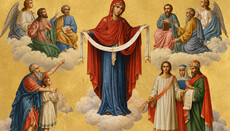
That night, the church was crowded. During the fourth hour of the night, Andrew saw the Mother of God, “exceedingly tall, accompanied by awe-inspiring attendants.” She was supported by John the Baptist and the Apostle John the Theologian. She entered through the Royal Doors and proceeded toward the ambo.
Andrew approached Epiphanius and asked:
“Do you see the Lady and Queen of the world?”
“I see Her, my father.”
And that was all. Two witnesses. Everyone else stood praying, making the sign of the cross, listening to the readings and hymns. Yet none of them noticed the miracle.
Tears instead of radiance
We are accustomed to imagining the Protection of the Theotokos as a scene of solemn splendor, forgetting that on that day the Mother of God “bent Her knees and prayed for a long time, bathing Her Godlike face in tears.”
The Queen of Heaven did not come among the people to display Her majesty. She came weeping.
Then She removed Her maphorion – the large veil worn by women to cover their heads and shoulders – and spread it over the people. According to the Life of Blessed Andrew, it shone “like lightning,” radiating the glory of God.
What an extraordinary sight: a spiritual Mother weeping and praying for Her spiritual children, who do not even realize that She is there beside them.
The Mother of God departed, but grace remained
While the Most Holy Theotokos was in the church, the saints could see Her veil spread above them. Then, after She departed, “She evidently took it with Her, but left Her grace with those who were there.”
The Life emphasizes that everyone received that grace. Not just Andrew and Epiphanius. Everyone. The drowsy servant of Epiphanius, the weary widow standing by a column, the merchant whose thoughts were occupied with his business.
Grace was not reserved for those who could see the miracle. It was given to everyone who had come to the church to pray.
The kontakion of the feast tells us the same thing: “Today the Virgin stands in the church, and with the choirs of saints She invisibly prays to God for us.”
Invisibly. That is the key word.
Most of us will never behold holiness with our own eyes. But that does not mean holiness passes us by.
A revelation to an ascetic
St. Silouan the Athonite knew this from personal experience. In his youth, he received a gentle rebuke from the Most Holy Theotokos. One day, She told him that it grieved Her to see the way he was living. Her words were “quiet and gentle,” and more than forty years later, the elder still could not forget them.
He recalled: “I did not see Her, but the Holy Spirit gave me to know Her and Her love for us.”
The great ascetic had not seen the Mother of God, yet he had come to know Her boundless love for humanity.
Of that love, he said: “She dwells in heaven and continually beholds the glory of God, yet She does not forget us poor creatures, and in Her mercy She covers the whole earth and all peoples.”
The protecting veil of the Queen of Heaven extends over everyone. Even those who feel nothing at this moment, whose faith is faltering beneath the weight of hardship and suffering.
Prayer in the darkness of the soul
Many believers know the feeling all too well. You stand in church, but your mind wanders. You pray, and silence is all you hear in return. Fear and anxiety creep in. It seems as though God has turned away from you.
And then comes the thought: Perhaps there is something wrong with me. Others experience something, see something, feel something – while I am left empty inside.
The story of the Protection reminds us that, of all the people gathered in the Church of Blachernae, only two saw the miracle.
Everyone else stood in the same spiritual darkness we so often experience.
And the Mother of God wept and prayed for them.
Her veil stretched over those who never even raised their eyes toward Heaven.
The feast of a forgotten miracle
For a long time, this event had no feast day of its own. One ancient writer expressed astonishment that such an “awe-inspiring and merciful vision” had remained without a liturgical celebration.
To remedy this omission, the Church gradually established the Feast of the Protection of the Most Holy Theotokos. In Rus’, it probably began to be celebrated in the twelfth century.
On this day, the Gospel reading tells the story of Martha and Mary, as it does on other feasts honoring the Mother of God.
St. Ignatius (Brianchaninov) explained that the Mother of God not only served Christ but also knew how to listen, as Mary did, “treasuring all His words in Her heart.”
Mary simply sat at Christ’s feet and listened to Him – and for this, she received the Lord’s praise. That is why the Feast of the Protection holds a special meaning for everyone who prays without visions, without extraordinary feelings, without an immediate answer from Heaven.
The Mother of God does not ask us to see Her. She asks only that we come to Her with a pure heart and take refuge beneath the shelter of Her prayers.