Salvation in solitude or life among others?
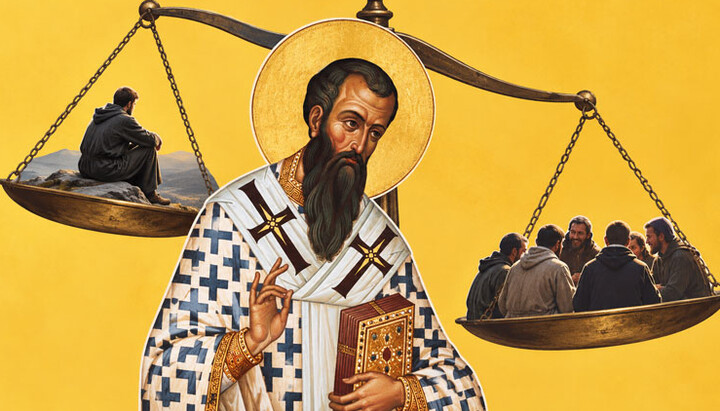
Sometimes, interacting with others leaves us drained and longing to escape the noise of the world. We turn to St. Basil the Great to understand why even the strictest monks did not seek complete isolation.
“Your Eminence, when the constant bustle and endless noise of modern life exhaust the soul, it's tempting to shut the door, disconnect from the world, and be alone with God. Isn't solitude the best path to salvation?”
“City life certainly exposes us to many troubles, and stillness helps free the soul from distraction,” St. Basil the Great replies with gentle compassion. “I once withdrew to a secluded place on the banks of the Iris River, hoping to find peace. But I soon had to admit that although I had left the city behind, I could not leave myself behind.”

We nod, recognizing the profound truth in his words. We often imagine that a change of scenery or simply closing our doors will somehow quiet all our passions. Yet our habits, resentments, and hidden stubbornness follow us wherever we go.
The trap of self-indulgence
“But if someone has found peace in prayer, why not remain in seclusion? Why return to people with all their weaknesses and demands?”
“The Creator fashioned our nature so that we would need one another,” the saint explains. “Human beings are social by nature, not solitary.”
The greatest danger of a solitary life is self-indulgence. When no one is around to offer an outside perspective on our actions, it becomes easy to imagine that we have attained spiritual perfection.
These words reveal a clear-eyed understanding of the human soul. When we pray alone within the confines of our rooms, we may seem perfect in our own eyes. Nothing provokes us, no one interrupts us, and no one forces us to compromise.
The mirror of brotherly love
“But Your Eminence, living alongside others inevitably brings disagreements and misunderstandings! Isn't it easier to preserve inner peace without constantly having to give way?”
“How can someone demonstrate humility if there is no one before whom he can humble himself?” the Cappadocian saint asks. “How can we practice patience if no one ever challenges our wishes?”
A life cut off from others becomes a life devoted to satisfying one's own needs. Christ's love does not seek its own advantage. Whose feet will you wash? Whom will you serve? Before whom will you take the lowest place if you live apart from everyone?
We reflect on his question. Christianity is not about finding individual peace through meditation but about actively serving others.
The people around us become a mirror in which we can see our true spiritual progress. Helping an exhausted coworker, remaining silent when someone speaks harshly, sharing another person's suffering – these are the moments when our faith is tested, not in the perfect stillness of a locked room.
The cure for stubbornness
“But Saint Basil, accepting criticism from others can be so painful! When our brothers or loved ones point out our mistakes, everything inside us rebels.”
“The unmerciful person is not the one who points out an error, but the one who remains silent about it,” the Archbishop of Caesarea replies firmly. “It is like drawing poison from a wound. When we reveal a physical illness to an experienced physician, we accept treatment with trust and a desire to recover. We should approach correction in the same way.”
Whatever a person chooses solely according to his own will is foreign to genuine fear of God.
The holy preacher touches the most vulnerable part of our selfishness. Self-will often disguises itself as a noble desire for spiritual independence.
We imagine that we are preserving our inner freedom when, in reality, we are simply protecting our pride from anything that might challenge it.
The living unity of the community
“You originally addressed these teachings to monks. But how can we apply them to our own lives as ordinary parishioners, living with our families and working in busy environments?”
“Serve those close to you as though you were serving the Lord Himself,” St. Basil urges. “And when you receive help from others, accept it humbly, as a servant would receive something from his master. True love means grieving when someone you love suffers harm and sincerely rejoicing in that person's success.”
No single person possesses every spiritual gift. But in a community, each person's gifts are multiplied and become a blessing to everyone.
We stand beneath the vaulted ceiling of the church, listening to these gentle yet profound teachings of the great teacher of the Church.
We begin to understand why Eastern monasticism and Christian communities have preserved this teaching of the Cappadocian archpastor through the centuries – his conviction that life in community offers the surest path to salvation.
Our parish, our family, and our workplace are the very places where our souls are formed.
Salvation is not something we achieve alone. It takes shape as we learn to bear one another's burdens, give way to others, show compassion, and recognize in every person the image of the One who unites us all.