
“Picaso”: Eve’s Dialogue with the Devil
Excerpts from Andrey Vlasov’s book “Picaso. Part One: Slave.” Episode 24.
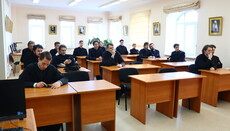
Time: 1992
Place: Kyiv
Characters: Fr. Lavr, seminarians
“But what about where it is written that ‘the love of money is the root of all evils’?” someone exclaimed.
Fr. Lavr tugged at his beard with a habitual gesture.
“Hmm… Remember, brethren, at our previous lesson I spoke to you about the rules for reading Holy Scripture. One of those rules is understanding every passage of Scripture in the context in which it was spoken. You, brother, just quoted a verse from the sixth chapter of the First Epistle to Timothy. But that chapter is devoted to questions of social inequality. Read it, brother… The rich and the poor, slaves and slave owners… It is in that context that it says the love of money is the root of all evils. Although avarice is indeed also the cause of other sins. But… judge for yourself… Can a person be proud without suffering from greed?”
“Well… probably yes.”
“He can,” Fr. Lavr said confidently. “A man can even give away all his possessions to the poor and afterward exalt himself because of it. But can someone be greedy and not proud?”
“No.”
“Exactly. Again… Pride is the beginning and cause of every sin. I repeat, brethren: remember that the sin of our forefathers did not consist in eating something unnecessary, but in wanting to attain godlikeness while rejecting God Himself and God’s love for them – that love which… that very love… was leading man toward deification. Now then, brethren… I see that you are already somewhat tired, but we still must examine how the sin itself was committed, how it developed… This is very important… I will try to be brief… Read,” he again turned to the seminarian who had been reading the Bible text.
“And the serpent said unto the woman, ‘Yea, hath God said, Ye shall not eat of every tree of the garden?’ And the woman said unto the serpent, ‘We may eat of the fruit of the trees of the garden: but of the fruit of the tree which is in the midst of the garden, God hath said, Ye shall not eat of it, neither shall ye touch it, lest ye die.’ And the serpent said unto the woman, ‘Ye shall not surely die: for God doth know that in the day ye eat thereof, then your eyes shall be opened, and ye shall be as gods, knowing good and evil.’ And when the woman saw that the tree was good for food, and pleasant to the eyes, and desirable to make one wise, she took of its fruit and did eat, and gave also unto her husband with her; and they did eat.”
“Here, brethren,” said Fr. Lavr, “before us is the archetype… so to speak, the model of every sin. …Every sin develops within us according to this very archetype. And in order to fight it, one must know the stages through which sin passes in its development within us. This scheme of the development of sin, with slight variations, is found in many fathers. I will name a few for you: Evagrius Ponticus, John Cassian, John Climacus… and our Russian saint of the fifteenth century, Nilus of Sora. …The stages are these: provocation, or a thought; coupling – that is, attention to it; consent – that is, delight in the thought; captivity – that is, the desire to realize it… Then comes the decision to commit the sin and the sin itself. Now let us examine each stage in detail.
“Provocation is the devil’s question: ‘Yea, hath God said…’ There is no sin in the provocation itself. A sinful thought comes from outside, apart from man’s will. Each of us receives such provocations a thousand times a day. Someone sees something, hears something… all sorts of thoughts… At this stage, sin is easiest to prevent. Like pulling up a blade of grass, like snapping a matchstick… What should Eve have done upon hearing the serpent’s question?”
“Told him to get lost,” someone said sarcastically.
“There were three options… I mean three correct options: ignore him, call Adam, or turn to God. That is exactly what a person should do when a sinful thought comes into his mind… not even necessarily an openly sinful one… simply a thought that a person cannot understand – whether it is from God or from the evil one. Again, there are three options: ignore the thought, ask one’s spiritual father, or cry out to God in prayer. …Notice, brothers, that the devil questioned not Adam, but Eve. Why? Eve was the weak link. She came into being after God had given the commandment to Adam, and she knew the meaning of the commandment only from him – secondhand.
“And here… attention, brothers, she does not entirely understand the commandment correctly… Again, whether Adam retold it inaccurately to her, or she herself misunderstood it, she makes mistakes when repeating the commandment to the serpent. What mistakes? …Who noticed them?” Fr. Lavr swept his eyes across the classroom. “What, no one sees the mistakes?”
He hoped at least someone would raise a hand and looked around the class for some time. Misha knew one mistake for certain, but was too shy to say it. Fr. Lavr sighed and continued:
“First, Eve makes the commandment harsher. God said: ‘But of the tree of the knowledge of good and evil, thou shalt not eat of it,’ that is, He forbade eating. But what does Eve say? ‘Ye shall not eat of it, neither shall ye touch it.’ That is, she arbitrarily makes the commandment stricter… God never said: ‘Do not touch it.’ Thus, in Eve’s eyes the commandment becomes heavier, and therefore more tempting to violate.”
Misha smiled. That was exactly what he had been thinking.
“Second, she confuses the trees…”
A light chuckle ran through the classroom. Fr. Lavr smiled slightly as well.
“Yes, brethren… this is how attentively you read Holy Scripture… And apparently this is how inattentively Eve listened. She says: ‘But of the fruit of the tree which is in the midst of the garden… ye shall not eat of it.’ But which tree stands in the midst of the garden?.. The Tree of Life… from which there was no prohibition against eating.”
The class began murmuring softly, discussing such an unfortunate mistake. Fr. Lavr paused.
“There is also a third point, not so obvious… When God gave the commandment, He said: ‘In the day that thou eatest thereof, thou shalt surely die.’ But Eve says: ‘Ye shall not eat of it, neither shall ye touch it, lest ye die.’”
“And what is the difference?”
“The difference is that the words ‘thou shalt surely die’ are not a threat, as though saying: ‘I will punish you with death,’ but the warning of a loving Father that, by doing this, human beings would become mortal. The words ‘to die by death’ signify a change in human nature, not that man was supposed to fall down dead immediately. Do you understand? A warning… But in Eve’s words it sounds precisely like a threat… ‘lest ye die’… in the Russian translation: ‘so that you do not die.’ That is, for Eve, God ceases to be loving and becomes terrifying. In this way, man’s love for God turns into fear. And fear, as we shall later see, is very easily destroyed by the devil… very easily… Yes… Love cannot be destroyed so easily. Again, the main thing is that Eve showed the serpent that she had not properly assimilated the commandment. And this gives us another moral lesson… One must know clearly… do you hear?.. know exactly what God has commanded us! And not invent things on our own… Ask anyone on the street: ‘Do you know God’s commandments?’ He will answer: ‘Of course I do.’ But ask him: ‘Which ones?’ He will say: ‘Do not kill, do not steal.’ And that is all! Yet there are ten Old Testament commandments alone. And each one must be properly understood.
“But we have already begun speaking about the second stage of sin – coupling. That is, Eve answered the serpent. It does not even matter what she answered. She turned her attention toward the serpent and began conversing with him. In that already there was sin… the beginning of sin…”
“But where is the sin in that? There was no commandment saying: ‘Do not speak with the serpent.’”
To be continued…
The previous episode can be read here.