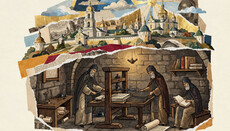

Aesthetics of refuge: Why Christianity always returns to catacombs
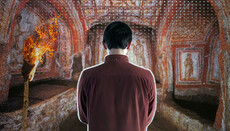
Magnificent cathedrals are only the Church’s temporary raiment. Her true body is the catacombs. When we are driven into basements, we lose nothing. We return home.
The smell of machine oil and incense – a strange pairing that should not work, and yet it does. A garage on the edge of town, or the basement of a high-rise. A low ceiling, concrete walls, stains of gasoline on the floor. In the corner – an icon of the Mother of God leaning against the wall. Before it – three candles in tin holders. People stand close, shoulder to shoulder – so close you can feel your neighbor’s warmth. This is the liturgy of the UOC faithful living through a new turn of persecution.
If you look at these faces, snatched from darkness by candlelight, you can see a fresco – a living fresco you cannot paint on any wall. It is written in the air, in the space between people, in the closeness that has bound everyone together.
We have grown used to thinking that Christianity means golden domes and marble iconostases – that God lives in height and light. But it is not so. God was born in a cave, and He rose in a cave. And when we are driven into basements, we are not cast downward. We are brought back to the beginning.
The cave as a womb: an archetype of darkness
Christianity was born underground – literally. Bethlehem: a cave into which a pregnant woman was driven because there was no room in the inn. There, in darkness and the smell of animals, God was born.
Jerusalem: the Holy Sepulchre. A cave cut into rock. There, in cold stone, a dead body became the source of eternal life.
The cave is a womb – a place where something new is born, where the old dies, and the living breaks through.
In a cave there are no distractions – no landscapes beyond the window, no golden ornament for your eyes to flee to. There is only you and God. In the dark, a person loses the sense of time and the outer world. Only “I” and “He” remain.
The Roman catacombs, the second to fourth centuries, were not merely cemeteries. They were cubiculas – chambers where the Eucharist was celebrated at the tombs of martyrs. Christians descended not because they wanted to hide. They descended because there, the Creator was near.
On the walls – simple signs: a fish, a dove, an anchor. Passwords understood only by their own.
An oil lamp tears from the darkness only a face – not the whole image, only eyes, only the countenance. It creates the effect of an intimate meeting. God is not on an iconostasis ten meters away. God is here, within this circle of light, at arm’s length.
Cappadocia: longing for heaven underground
The underground cities of Derinkuyu and Kaymakli in Cappadocia, descending to depths of up to eighty meters, could shelter as many as twenty thousand people together with their livestock. Christians lived there for centuries, escaping raids by Arabs and Persians. They could seal the entrance from within with a massive stone millwheel. Ventilation shafts were disguised as wells. Above – desert; below – an entire civilization. And there, in that darkness, they carved out churches.
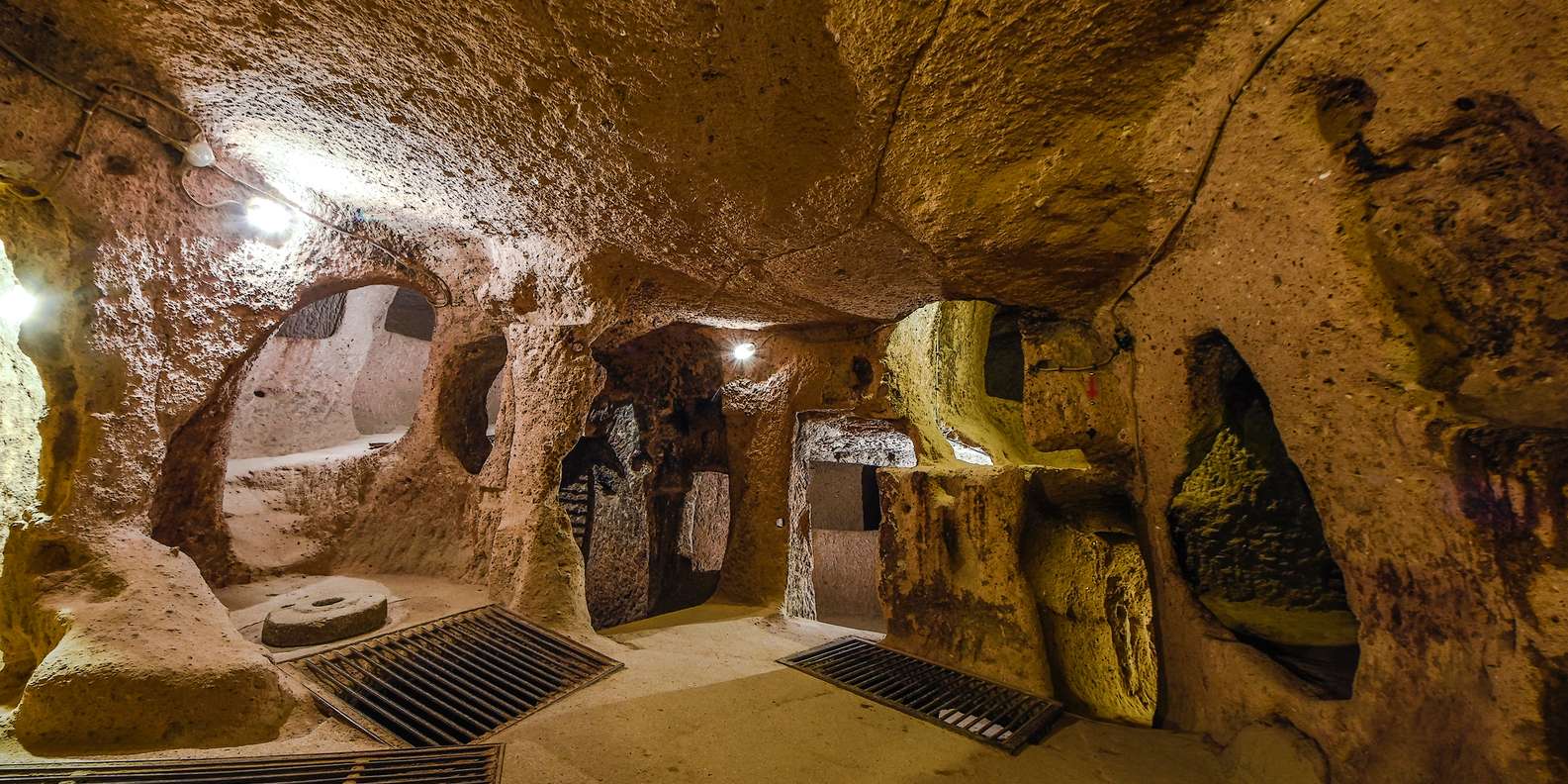
These churches can still be seen. Columns, vaults, arches – everything hewn from the rock. A column does not hold the ceiling. The ceiling holds itself; it is a monolith. The column was left in the stone as a memory of the church above ground.
This is longing for heaven underground. And in that longing lies the very essence of Christianity. We can live beneath the earth – but we remember the sky.
Domus Ecclesiae: when the church is a home
The first Christians did not build churches. They gathered in homes. Domus Ecclesiae – the house-church, an ordinary Roman dwelling. In the triclinium, the dining room, stood a table. On the table – bread and wine. Around the table – people. No iconostases, no domes – only a table and people.
For the Church is not a building. The Church is people gathered around Christ.
When the Romans shattered Christian communities, they searched for buildings, temples, shrines. They wanted to destroy the places where Christians worshiped God. But Christians answered: you cannot destroy our Church, because our Church is us. As long as we live and gather, the Church lives. That was their strength, their invulnerability. And today we are learning that truth again.
When a basement becomes a basilica
We know communities driven out of their churches – the keys taken, the locks changed, other icons hung on the walls. They left – not the Church, but the building. And they began to serve in apartments, in cramped garages, in damp basements, in whatever rooms could be adapted.
In a great church the acoustics “fly.” The priest’s voice rolls beneath the vaults, echoes off the walls. It is solemn, beautiful. But it is far away.
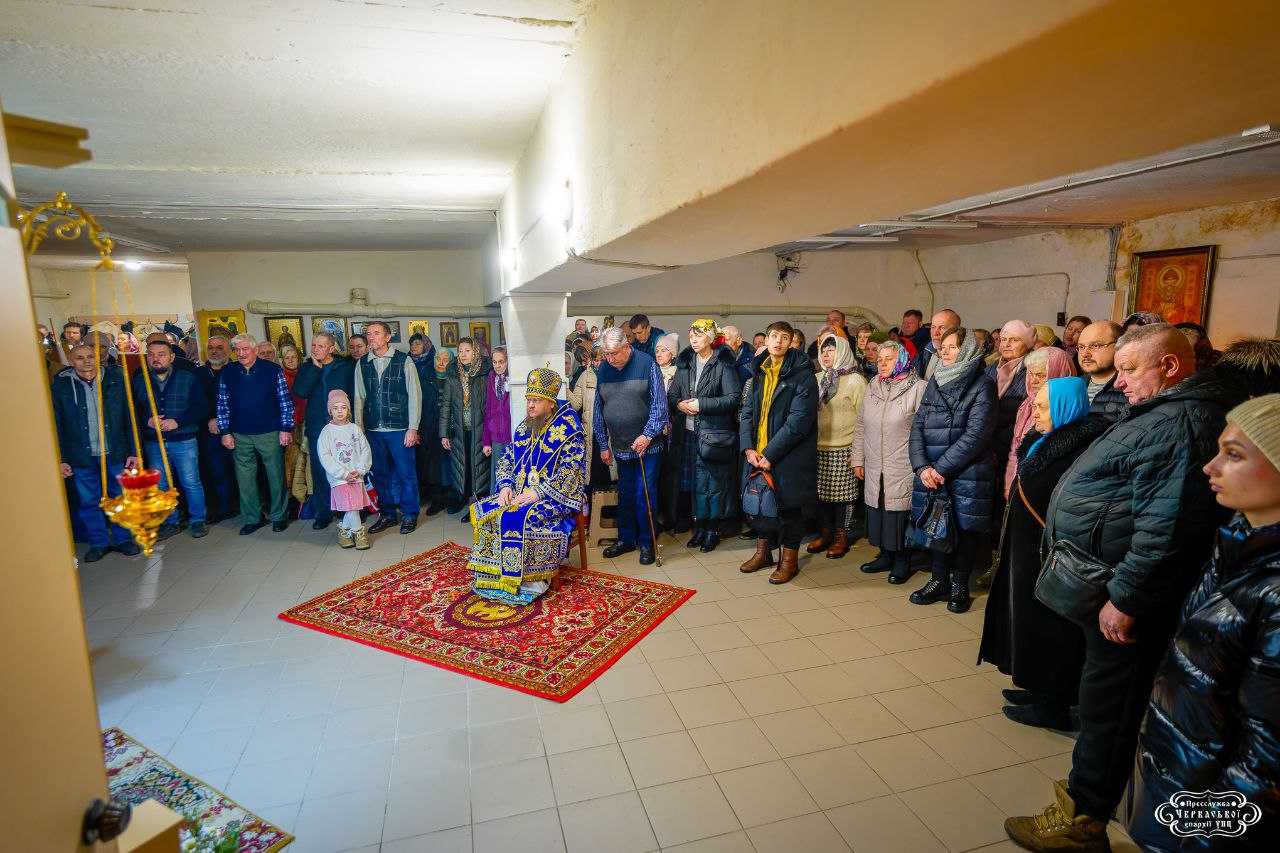
In a basement the acoustics are dull, dry. Prayer sounds close, in a half-whisper. The priest does not tower over you. He stands beside you. You see his face – you see weariness, you see faith.
And people stand tight. Not only because there is little room, though there truly is. Even if there were more space, they would stand the same.
Because in crampedness, warmth is born. In a vast cathedral you can be lonely. In a narrow basement you are part of a single body.
Chiaroscuro: the play of light and shadow
There is a technique in painting – chiaroscuro, the drama of light and shade. Caravaggio used it, and Rembrandt, and Georges de La Tour. The principle is simple: a dark background, a source of light that snatches from the darkness only what matters most – a face, hands, a gaze. It creates intensity, intimacy, the feeling that you are witnessing something profoundly personal.
You can see it with your own eyes in a basement where persecuted Christians serve the liturgy: the beam of a flashlight on a damp wall, the flicker of candles on a low ceiling, faces half in light, half in shadow.
Orans: the posture of absolute trust
In the Catacombs of Priscilla there is a fresco of the Orans – a woman with arms raised.
It is the posture of absolute trust: hands lifted, palms open – defenselessness, vulnerability, total surrender in unrelieved darkness.
That image resembles the people in these makeshift churches. They stand the same way: arms raised, unprotected, exposed. They were driven out of beautiful buildings, stripped of gilded iconostases, locked out behind bolted doors.
But they did not lower their hands. They lifted them higher – because they understood: God is not in a building. God is where palms are open, where there is trust, where one is ready to stand in the dark and believe that Light will come.
What will we paint on the walls of our refuges?
The early Christians painted an anchor and a fish on the catacomb walls. The anchor was the sign of hope. The fish was the acrostic of Christ’s name.
What will we paint? Perhaps only a cross – in charcoal, on the concrete wall of a garage. Perhaps nothing. Because our frescoes are living. They are written not on walls, but in hearts – on faces – in the way we stand shoulder to shoulder and believe.
Today, cramped shacks with prayer books in them can look more beautiful than Hagia Sophia – because here Christ is alive: between people, in the closeness that has become communion.
Persecution strips away the husk. It hurts. It is frightening. But it makes us real.
Magnificent cathedrals are the Church’s temporary clothing. Her true body is the catacombs – basements, garages – places where nothing superfluous remains: only people and God.
Let us not fear the darkness, for it is precisely there that the frescoes of our souls are revealed.