
How Orthodox Americans made Congress speak about persecutions against UOC
The rally in Washington is a significant step forward in the defense of the UOC. For the first time, the issue of religious persecution in Ukraine was voiced so prominently at the level of the American Congress.
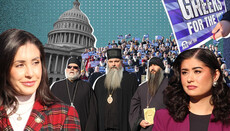
On December 16, 2024, an event took place in Washington that could change the Ukrainian authorities’ approach to the situation with the Ukrainian Orthodox Church. About 200 Orthodox believers from various churches held a large-scale action on Capitol Hill. They conducted around 80 meetings with members of Congress and representatives of the U.S. administration. As a result, U.S. politicians began openly speaking about religious persecution in Ukraine.
What happened in Washington?
The Action Day by Orthodox Christians and their allies was organized by two organizations: the Society of St. John of Shanghai and the New York Young Republicans Club. Representatives of the Serbian and Antiochian Churches, the Orthodox Church in America, and the Russian Orthodox Church Abroad attended the event, along with Christians from other denominations.
At the very beginning of the day, participants split into groups and systematically visited the offices of all members of Congress – in both the House of Representatives and the Senate. In total, they held 80 meetings. It is worth noting that the visitors came to politicians with specific facts, documents, and testimonies about what is happening with the Ukrainian Orthodox Church.
Simultaneously, a picket took place outside the U.S. Capitol. Orthodox Christians and representatives of other Christian denominations held signs reading: “Immediately Release Metropolitan Arseniy,” “Greeks for the UOC,” “Repeal Law 3894,” and “Stop the Imprisonment of Our Clergy.” The event concluded with a press conference on the steps of the Capitol, where several Republican members of Congress spoke.
Who said what?
Catherine Whiteford, a young American politician, Co-Chair of the National Federation of Young Republicans and Director of Government Relations for the Society of St. John of Shanghai in San Francisco, immediately stated: "We are not here to speak against the people of Ukraine, who many of us have supported and prayed for throughout this brutal war. Many here today are Ukrainian. Nor are we here to defend Russia. We are not pro-Russia group in any sense of the term."
Why say this? Because the Ukrainian authorities and their lobbyists in the USA use one simple trick: anyone who stands up for the UOC is immediately accused of working for Moscow. For this reason, Whiteford immediately emphasized that saying such things is a lie.
Catherine Whiteford recalled that in August 2024 Ukraine adopted Law No. 3894, which in effect abolishes the Ukrainian Orthodox Church, the country’s oldest and largest Christian denomination, with a history spanning more than a thousand years.
In addition, the politician cited specific examples of persecution of UOC believers and clergy: Metropolitan Arseniy, who has been in prison for more than 20 months and denied life-saving medical care; Metropolitan Onuphry, the Primate of the Church and a native of Ukraine, who has his citizenship revoked by order of President Zelensky; priests who are detained and forcibly sent to the front; the seizure of churches and monasteries, often violently, in front of parishioners and their families.
"I want to remind you that we are not speaking of North Korea or China here," Whiteford emphasized. "This is happening in a country the United States considers an ally."
She highlighted that concern over the persecution of the UOC was expressed by the UN, the US mission to the OSCE, human rights organizations, Christian Churches around the world, Pope Francis, and many others, but the Ukrainian authorities ignore all these appeals.
Catherine Whiteford formulated a position that became key to the entire action: "Ukraine’s survival matters, its sovereignty matters, but a nation cannot defend freedom while abolishing it at the same time. Religious freedom is not a luxury to be suspended during wartime. If anything, wartime is when it is needed most."
This is a very strong argument. Ukraine, at least according to its official representatives, is fighting for freedom and democracy. But how can one talk about freedom when the authorities imprison priests, take away people's churches, and forbid them to pray as they wish?
In the end, Whiteford voiced demands to the Ukrainian authorities:
- to suspend and repeal Law No. 3894,
- to immediately release Metropolitan Arseniy,
- to stop the forced mobilization of priests,
- to comply with Ukraine's constitutional and international obligations on religious freedom, with real accountability measures enacted.
"If Ukraine is to one day join the European Union, if it wants to remain aligned with the democratic worlds, if it hopes to retain moral authority and seeks from its allies, then it must protect the rights of millions of its people to worship in the Ukrainian Orthodox Church," Whiteford stated. "Because faith is not a crime, tradition is not treason, and religious freedom is not optional."
Congresswoman from Florida Anna Paulina Luna, who spoke at the event, noted: "We are here today because it is important to shed light on some of the persecution of our Christian brothers and sisters, especially those in countries that we, the American government, are currently funding." She recalled that religious freedom is enshrined in the First Amendment to the U.S. Constitution, and that the Trump administration made the protection of Christians from persecution around the world one of its priorities.
The congresswoman directly called the situation with the UOC an example of persecution of Christians in the modern world: "What is occuring in Ukraine – the persecution of the Ukrainian Orthodox Church – is a blatant example of the ongoing persecution of Christians today."
Luna's main thesis: "American taxpayers’ money should never support a government that is actively persecuting their brothers and sisters in Christ."
And then she said something that will undoubtedly be taken very seriously by Americans: "Today we are taking a stand for Christian liberty in Ukraine because their plight is ours. If Christians can be persecuted by our Western allies and countries fully reliant on us for funding, there is nothing to stop that persecution from coming home."
This is a very strong argument for American conservatives. If you turn a blind eye to the persecution of Christians in Ukraine today, the same could start in the USA tomorrow. Luna shifted the UOC topic from the category of "something is happening there" to the category of "this is a threat to our own values and freedoms." Such messages in modern America cannot go unnoticed.
Congressman from Arizona Eli Crane brought up the UOC as part of a broader critique of Ukraine’s authorities: "since the start of the war, there have been troubling authoritarian tendencies in Ukraine that stand in stark contrast to the core pillars of Western civilization. The cancellation of elections, control over media resources, and the misuse of financial funds."
He emphasized: "It’s clear that the situation on the ground is far different from what is portrayed by the mainstream media."
Crane particularly highlighted "the mistreatment of Christians" and expressed hope that the end of the war would bring relief "after many years of suffering and restrictions on freedom of religion and freedom of speech."
Bishop Theodosy of Seattle, vicar of the Western American Diocese of the Russian Orthodox Church Outside of Russia (ROCOR), delivered a statement, accusing the Ukrainian authorities of repeating the practices of Soviet god-fighters: seizing monasteries and churches, turning shrines into museum exhibits, restricting believers' access to the relics of saints, etc.
President of the New York Young Republican Club Stefano Forte noted that concern about the situation with the UOC is expressed by various Churches: the Church of England, the Pope, Orthodox Christians around the world.
"It is wrong to see the imprisonment of clergy, it is wrong to see our tax dollars going to the persecution of Christians in a land that is not ours," Forte said. "We need to stand together as Americans to say the persecution of any Christians anywhere is wrong and we will refuse to put our tax dollars behind it."
How Congressman Don Bacon changed his stance
The story with Congressman Don Bacon from Nebraska is very indicative. Before the action, he, along with two other congressmen – Joe Wilson and Austin Scott – signed a letter to US Attorney General Pam Bondi, requesting an investigation into the ROCOR for possible influence from Russia.
When the Orthodox delegation came to Bacon's office on December 16, he refused a normal dialogue, calling the visitors "lobbyists of Moscow's interests." After that, he wrote on X that he “told them the truth.”
But after the action, something changed. Bacon said on the social media platform X that he does not consider the UOC to be “taking orders from Moscow.” He clarified that his previous critical comments referred to the Russian Orthodox Church, not the UOC.
Bacon’s case shows that methodical work with congressmen –explaining the situation and providing facts – really works. Bacon represents the segment of Republicans who support Ukraine but are not fully aware of what is happening in our country regarding religious freedom. It is reasonable to hope that, once informed, these politicians will be able to influence the Ukrainian authorities and persuade them to reconsider and stop persecuting their own citizens.
Leak from the Ukrainian lobbyists’ camp
The most interesting developments occurred two days after the action. The UOJ of America received, from a confidential source, an internal document from the American Coalition for Ukraine, a lobbying organization representing the Ukrainian authorities in Washington.
The document contains an open admission that criticism of Ukraine over the persecution of the UOC is their Achilles’ heel – the weakest, most vulnerable point in their work. In other words, the lobbyists acknowledge that the persecution of the UOC is a reality.
Particularly telling are the phrases about Orthodox tactics. For example, the American Coalition for Ukraine considers it “standard tactic” to use “priests in cassocks on Capitol Hill”, and “icons, crosses, and prayer imagery”. According to the document, such visual imagery “short-circuit policy skepticism” and is “read as ‘authentic faith under attack.’”
In simple terms: when people see priests, icons, and crosses, they understand that it is about real faith, not politics. And it works. Ukrainian lobbyists find it very difficult to accuse a U.S. citizen bishop in robes with a cross, simply asking for the protection of the rights of Ukrainian believers, of “Russian propaganda”.
But this is not the most important thing. The most important point is that Ukrainian lobbyists and the Ukrainian authorities publicly claim that there is no persecution of the UOC, that it is all fabricated and Russian propaganda. Yet internal documents show that they are fully aware of every case of violations of the rights and freedoms of believers. Their goal is not to stop these violations, but to hide them or portray information about them as “Russian propaganda”.
In other words, the Ukrainian authorities and their representatives in Washington see the UOC issue as a weak point in their work not because they view the Church as a “Russian threat,” but because they are unable to conceal their efforts to destroy it.
What’s next?
After the action, several important points can be noted:
- An interchurch coalition is forming in the U.S. on the UOC issue: the Russian Orthodox Church Abroad, the Serbian and Antiochian Churches, and the Orthodox Church in America are joining their effort;
- The UOC issue has clearly entered the Republican agenda through the party’s youth wing;
- The UOC topic was linked by Anna Paulina Luna to domestic U.S. politics, meaning it cannot be further ignored;
- Methodical work with congressmen yields results. Even those who currently support the Ukrainian authorities can be persuaded;
- Ukrainian lobbyists’ admission that the UOC issue is their Achilles’ heel shows that they understand it is becoming increasingly difficult to hide the persecutions, especially before an American conservative and religious audience.
Short-term prospects
According to Anna Paulina Luna, the Trump administration has made the protection of Christians a priority. This means that the issue of religious freedom in Ukraine should be included in Trump’s “peace plan” package.
The Ukrainian authorities will face a choice: either comply with demands to repeal Law No. 3894, release Metropolitan Arseniy, and so on, or answer to the international community for the persecution of the UOC. Ignoring this issue will be very difficult.
Furthermore, it is clear that Kyiv’s lobbyists in Washington are already being forced to change their strategy. Their previous tactic – accusing the Church of a “pro-Russian stance” – does not work when Orthodox believers are supported by Republican members of Congress.
The main point: the December 16 action in Washington was a significant step forward in defending the UOC. For the first time, the issue of religious persecution in Ukraine was raised so loudly and professionally at the level of the U.S. Congress. One can say that people succeeded in being heard, and that congressmen began speaking about the problem. This gives hope that the situation may change.