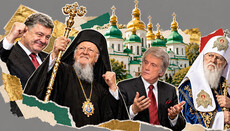

The Pope’s visit, Maidans and the “break from Moscow”: winners and losers
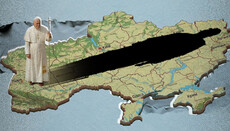
Yelensky admitted that John Paul II’s visit was a step “away from Moscow” and was linked to the two Maidans. Let us look at what the UGCC gained from it – and where it brought the rest of Ukraine.
At an event marking the 25th anniversary of Pope John Paul II’s visit to Ukraine, the DESS head, Viktor Yelensky, said that the visit had been a “colossal step away from Moscow” and had directly foreshadowed the two Maidans – those of 2004 and 2013.
One more point should be added to these words: after the pope’s visit, the activity of Ukrainian Greek Catholics in the country rose dramatically, reaching its peak during Euromaidan. This was not so much about pastoral care as about political struggle. The Uniates became a momentum behind the two Maidans, which led to a change of power in our country and brought about tangible implications for the entire Ukraine.
Not just a pastoral visit
John Paul II visited Ukraine on June 23–27, 2001. The Vatican called it a pastoral visit. Yet at that time, the Roman pope’s flock represented a rather small part of Ukraine’s population, concentrated mainly in the western part of the country.
Yes, John Paul II celebrated mass services in Kyiv and Lviv, both in the Latin and Byzantine rites. But already on the first day of his visit, June 23, 2001, the pope met with the entire Ukrainian political elite at the Mariinsky Palace. And at his farewell in Lviv, he called on Ukraine to intensify its European course, expressing the hope that it would be able to “fully integrate into Europe.” These were the very slogans later used by representatives of the UGCC and other power holders in their political struggle.
Thus, a visit that looked religious on the outside became a driving force – at least one of them – behind the geopolitical project of nationalist forces in Ukraine.
How it happened
The UOJ has repeatedly written about the link between the Catholic and Uniate factor and the Ukrainian Maidans.
For example, in 2020, the article “RCC and Mass Protests in U.S. and Ukraine: What Do They Have in Common?” cited a statement by one of the best-known UGCC figures, Borys Gudziak, who said that half of the Euromaidan protesters were Greek Catholics. The same article spoke of the sacralization of Maidan and the rhetoric presenting the “Heavenly Hundred” as a “Paschal sacrifice.”
In another article, the UOJ wrote that in Ukraine, Catholics – mainly Uniates – played the foundational role in bringing people to Euromaidan.
And the article “Are Catholics Preparing a ‘Maidan Scenario’ for Belarus?” noted that already during the first Maidan in 2004, a significant part of the protest core was linked to the UGCC and the Ukrainian Catholic University.
In the article "The Collapse of the EU as a Surrogate Heavenly Jerusalem," the UOJ separately examined the religious mythology of Euromaidan: the “Heavenly Hundred,” the “Ukrainian Golgotha,” the “Paschal sacrifice of the Revolution of Dignity.” Those killed on Maidan were positioned as new saints.
Let us stress: we are not now giving an assessment of the Maidans of 2004 and 2014, nor are we trying to analyze who was right and who was wrong. We are simply stating that these events revealed the merger of the UGCC and certain political forces into a single religious-political project. We are showing how, under the cover of religious slogans, power can be taken into one’s own hands.
The sacralization of Revolution
The role of the UGCC in the Revolution of Dignity deserves special attention – and not only because of numbers. Borys Gudziak claimed that Uniates made up half of the protesters, even though Greek Catholics accounted for less than 8% of Ukraine’s population in 2014. Such a disproportion speaks for itself: achieving such a result without the organizing role of UGCC representatives would have been extremely difficult. Even more important is the fact that many Maidan leaders also belonged to the UGCC: Arseniy Yatsenyuk, Oleh Tyahnybok, Andriy Parubiy, Dmytro Yarosh and others.
But the UGCC’s far more important contribution was ideological. Maidan needed religious sanction – proof that what stood behind it was not a struggle for power, but an almost sacred cause. It was the UGCC that gave the protest the symbols it needed and the conviction of its own historical, sacred mission.
The former head of the Greek Catholics, Lubomyr Husar, also actively used his religious authority – and did so in such a way that a political issue, the course toward the European Union, was presented as a spiritual matter. In an address to the youth of Maidan, he wrote that they had gathered to testify to their conviction “in favor of establishing association with the countries and peoples of Western Europe,” and urged them to spend the days on Maidan in such a way as to “become even more deeply convinced of the benefit of association with Western Europe.” From the mouth of a political leader, this would have sounded natural. But this was said by a Christian pastor.
Husar also justified Maidan as a moral uprising against an “alien” government. In the project “Maidan: Oral History,” he said that the “Revolution of Dignity was an inner upheaval,” a manifestation of what had “ripened in people’s hearts,” and that the people protested against Yanukovych and his government because they “did not consider it their government.”
Husar’s successor, Sviatoslav Shevchuk, directly sacralized both the victims of Maidan and the revolution itself. In 2015, he called the place where activists died “our Golgotha,” said that Christians should see in the Maidan shootings the “Paschal sacrifice of the Heavenly Hundred,” and claimed that this “holy blood” became the moment of “transition from slavery to freedom.” According to Shevchuk, the history of the new Ukraine would reveal the meaning of the “Paschal sacrifice of the Revolution of Dignity.”
In 2020, Shevchuk made another controversial statement: the blood shed on Maidan had supposedly become a “standard” by which public and even church life is measured. Not the Blood of Christ. Not the feat of Christian martyrs. But the blood of those killed on Maidan.
Such sacralization of Maidan and everything connected with it carries another danger: it turns everyone who did not support it, everyone who holds a different political view, into enemies. If Maidan is merely a political struggle, dissent is possible. But if it is a “Paschal sacrifice” offered on “our Golgotha,” then those who did not accept Maidan are not quite Christians.
What the UGCC gained
Before the Maidans, in the mass Ukrainian consciousness, the UGCC remained above all the church of Galicia. Yes, it had communities in Kyiv and other regions, but its historical, cultural and political core was western Ukrainian. After the Revolution of Dignity, the situation changed radically. The Uniates began to be perceived as one of the ideological centers of the new Ukrainian identity.
Back in 2015, Shevchuk said: “We are moving there, to eastern Ukraine, where the presence of believing Christians is so necessary.” And this simple phrase contains an obvious subtext: Orthodoxy, which has always existed on these lands, supposedly has no “believing Christians” – the Uniates will provide them.
Soon after Euromaidan, the UGCC moved far beyond Galicia. Its official website lists the Kyiv Archeparchy, as well as the Kharkiv, Donetsk, Odesa, Lutsk and Crimean exarchates. Religious statistics also show the growth of the UGCC’s influence. According to the Razumkov Center, in 2025, 11.8% of respondents already identified themselves with the Uniate church. According to the same data, from 2014 to 2025 the share of Orthodox Christians in Ukrainian society fell from 70% to 58%, while the share of Greek Catholics grew by roughly one and a half times – from 7.8% to 11.8%.
And even if trust in such statistics is not especially high, the trend itself is obvious: after the Maidans, the UGCC received enormous political and social dividends.
The Uniates achieved almost everything they had historically sought: they broke out of the regional frame, became part of state ideology, secured for themselves the image of “true European Ukraine,” occupied an important place in education and the media, and acquired the moral right to teach the whole country what “dignity,” “Europeanness” and a “break from Moscow” mean.
But what did the rest of Ukraine receive?
Ukraine before and after Maidan
We do not idealize pre-Maidan Ukraine. It was not a land of universal justice and prosperity. Corruption existed, the authorities were often cynical, and regional divisions were real. Nor can everything happening today be laid at the feet of the Ukrainian government. Yet the connection between present-day realities and Euromaidan is both obvious and direct. Let us compare the “before” and the “after” through several key indicators.
Then there was peace. Today there is war.
In 2013, Ukraine’s population stood at 45.553 million. Today, according to official figures, between 22 and 25 million people remain in government-controlled territory. Unofficial estimates put the number below 20 million.
There were no major disputes over language. Today, conflict exists not only with Russian speakers but also with representatives of other national minorities, both domestically and internationally.
There was no acute religious conflict. Today, the authorities have unleashed persecution against the largest religious organization in the country. Radicals seize churches, and violence against UOC faithful almost always goes unpunished.
In 2013, household gas cost 0.7254 hryvnias per cubic meter. Today it costs 7.96 hryvnias – roughly eleven times more.
Electricity cost households 28.02 kopecks per kilowatt-hour. Today it costs 4.32 hryvnias – an increase of approximately fifteenfold.
The exchange rate at the end of 2013 was about 7.99 hryvnias to the dollar. In June 2026, it stood at 44.9229. The hryvnia has lost more than five and a half times its value against the U.S. dollar.
One could also cite food prices, GDP per capita, and many other indicators. But there is little need. The facts speak for themselves.
Before Euromaidan, Ukraine was a peaceful country without obvious internal crises and, however slowly, it was developing economically. Today it is a state of ruined cities, millions of refugees, enormous military losses, demographic catastrophe, and an economy critically dependent on external assistance.
Shevchuk described the Revolution of Dignity as a journey “from slavery to freedom.” But are staggering corruption, closed borders, and the work of military recruitment centers really the freedom “for which Maidan stood”? Does this resemble a “Paschal sacrifice”?
Of course, direct responsibility for the war lies with the aggressor – the Russian Federation. Yet when Viktor Yelensky, a senior Ukrainian state official, himself links Pope John Paul II’s visit, the Maidans, and a “break from Moscow” into a single chain of events, he inevitably forces us to ask an honest question:
What was Ukraine then – and what has it become now?
Conclusion
Christ did not establish the Church to serve national projects.
The mission of Christ’s Church on earth is to unite man with God. Yet today we are witnessing Holy Scripture being turned into a political banner. The sacrifice of Christ is replaced by the sacrifices of Maidan. The Kingdom of Heaven is replaced by political ideology.
Christ once said: “For what is a man profited, if he shall gain the whole world, and lose his own soul?” (Matthew 16:26).
Today, Ukrainian Catholics and Greek Catholics have gained a great deal. Their structures stretch across all government-controlled regions of Ukraine. They influence both domestic and foreign policy. They increasingly claim the role of defining what the new Ukrainian identity should be.
By earthly standards, at this particular moment in history, one must acknowledge that the pope’s spiritual heirs have indeed emerged victorious from the Maidans.
But Christ’s question was never about victory.
It was about the price of victory.
Pre-Maidan Ukraine and the Ukraine in which we live today are different worlds, different countries.
Which one is closer to you?
In which one does prayer sound stronger – and more sincere?