
Two murders, one silence
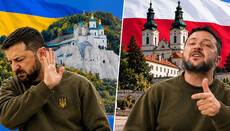
Zelensky condemned the killing of a Catholic priest in Poland the very same day. A month earlier, a UOC monk was murdered at the Sviatohirsk Lavra – and the president has remained silent ever since.
On September 24, 2026, in the Polish city of Jarosław, a citizen of Ukraine, a former soldier of the Armed Forces of Ukraine, attacked a convent of Benedictine sisters and killed a Catholic priest. That very evening, the crime was condemned by Volodymyr Zelensky.
Shortly afterward, the Ukrainian Embassy in Poland issued a statement of its own. Zelensky’s same-day condemnation and call for a thorough investigation were publicly reported.
And rightly so, one might think. When a citizen of your country commits such an atrocity abroad, the head of state should respond.
But there is another question.
A month earlier, on August 23, Monk Varsonofiy (Turianskyi) of the Ukrainian Orthodox Church was killed at the Sviatohirsk Lavra. He was killed on Ukrainian soil, behind Ukrainian army lines. Yet neither Zelensky, nor his Office, nor the Interior Ministry, nor the SBU has publicly responded to the killing to this day.
Why, then, does a Catholic priest murdered in Poland merit condolences from the Ukrainian president, while an Orthodox monk murdered in Ukraine does not?
Let us try to understand.
How Poland responded – and how Kyiv responded
First, let us recall what happened in Jarosław. At about 9:30 a.m., a 31-year-old Ukrainian entered the monastery grounds through open gates and began attacking people with a knife. Five people were injured, three of them Catholic priests. One of them later died in the hospital. The attacker was detained at the scene, and the mayor of Jarosław convened an emergency crisis team with the participation of the voivode the same day.
Contemporary reports confirm that one person was killed and four wounded in the attack. More details emerged later. The 31-year-old Ihor M. had previously served in the Armed Forces of Ukraine and fought at the front. He reportedly held Ukrainian and German passports, as well as a Polish PESEL number allowing him to obtain temporary protection status.
Poland’s top officials responded almost immediately. Prime Minister Donald Tusk wrote: “The Jarosław killer is in the hands of the Polish police. Investigative measures are underway. The perpetrator is a Ukrainian citizen. He will face the full severity of Polish law. I share the pain of the loved ones of the victims of this brutal attack.”
President Karol Nawrocki was even more forceful: “In the face of such acts, the state must be strong, act swiftly and relentlessly within the law... The task of the state is to ensure the safety of its citizens.”
One may have different views of Nawrocki’s tone, but his central point was clear: the state is responsible for people’s safety. When a priest is murdered in a monastery, it is a matter for the state, not merely for the police.
Zelensky responded to the killing in Poland that same day: “A horrific crime was committed at the Benedictine Sisters’ Abbey in Jarosław by a citizen of Ukraine. We are shocked by this evil... We extend our deepest condolences to the family and loved ones of the deceased.”
He continued: “The person responsible for this evil must be held fully accountable under the law. We expect a swift and thorough investigation into all the circumstances. It is painful that people are capable of such horrific crimes. Justice must prevail.”
The Ukrainian Embassy in Poland did not remain silent either: “We strongly condemn the brutal attack... We consider all manifestations of violence unacceptable. It is especially painful that such a tragedy occurred in a place that should be a sanctuary of prayer and mercy.” The diplomats stressed that “there can be no justification for violence or attacks against people.”
The following day, Ambassador Vasyl Bodnar was already telling journalists where the suspect was being held and what condition he was in. The Embassy’s public condemnation was also reported at the time.
It is not difficult to understand why Kyiv reacted so quickly. Poland is a key ally, relations are already complicated, and now the killer was a former Ukrainian serviceman – something Polish politicians were already highlighting. Silence would have carried too high a reputational cost for Ukraine.
The author’s contention is that the speed of the response reflected not only sympathy, but political calculation. UOC believers inside Ukraine, by contrast, have neither Poland’s Confederation party nor a Polish president capable of putting pressure on Bankova Street – and, in this view, there has consequently been no comparable response.
No one is criticizing Zelensky for what he said. Quite the opposite: those were the right words, spoken at the right time.
The question is why he could not find the same words for his own citizen – a UOC monk murdered at the Lavra.
The diplomats wrote that it was especially painful when tragedy struck “a place that should be a space of prayer and mercy.” They were speaking about a Polish monastery.
No Ukrainian official wrote anything comparable about the Sviatohirsk Lavra.
Sviatohirsk: a month of silence
At around 11 a.m. on August 23, a group of people attacked residents of the Sviatohirsk Lavra near St. Nicholas Church in the monastery’s upper grounds. Monk Varsonofiy (Turianskyi) died from a through-and-through gunshot wound to the head and neck. Monk Gregory was wounded, as was Andrii Kyriienko, who was living at the monastery.
The UOC reported the attack that same day, and the Lavra later said the forensic medical certificate identified a gunshot wound to the head and neck as the cause of Varsonofiy’s death. A criminal investigation remains underway.
Kyriienko spoke about the attack in the days that followed. According to his account, he was assaulted after responding “incorrectly” to the greeting “Glory to Ukraine!” with the words “Glory to God.” The article argues that the circumstances suggest Monk Varsonofiy paid with his life for similarly “incorrect” words.
Schema-Archimandrite Gabriel (Bunge) later put it this way: “That monk could easily have saved his life if he had obeyed his killers’ demand. But he did not. He answered as a Christian: glory belongs to God alone.”
Of course, the investigation into the Sviatohirsk killing formally continues. But already now we can say that the theory of a Russian sabotage and reconnaissance group appears untenable. We can judge this from a statement by Andrii Biletskyi, commander of the 3rd Army Corps – a man hardly likely to be suspected of sympathy toward the UOC: “There has never been a Russian soldier in Sviatohirsk... The city of Sviatohirsk lies within the defensive sector of the 60th Mechanized Brigade of the 3rd Army Corps. It is a rear area of our corps.”
In other words, the monk was killed behind Ukrainian army lines, in territory controlled by the Ukrainian state.
In Jarosław, the killer was a former Ukrainian serviceman. In Sviatohirsk, the article says, a monk was killed by people in military clothing behind Ukrainian lines. The president spoke about the former soldier who committed a crime abroad on the very same day. About the people in uniform who killed a monk at home – not a word.
Can that simply be coincidence?
Former Ukrainian MP Ihor Mosiychuk put his interpretation of the Sviatohirsk killing bluntly: “It sends a signal to the military that nobody cares – you can do whatever you want.”
Where did the hatred come from?
It is hard to believe that Zelensky simply failed to notice a tragedy in a small frontline city. More likely, the problem lies elsewhere. To honestly condemn the Sviatohirsk murder would mean having to say where the atmosphere came from in which a man in a cassock could be killed outside a church.
And that is something the authorities clearly do not want to do. Because that atmosphere was years in the making. And it was created by people who were anything but marginal.
Let us remember Kvartal 95 – the studio Zelensky himself once founded and headed. In late 2022, presenters on its Bayraktar News program used obscene language to insult UOC clergy and read out a mock “price list”: “spit at an MP priest – 20 hryvnias”; “hit him on the left cheek and automatically on the right – 100 hryvnias.”
Some people found it funny.
But on January 2, 2023, a man burst into a UOC church in Vinnytsia and slashed the rector across the throat with a straight razor. Beneath the Kvartal video, one user later wrote: “His blood is on your hands too.”

Government officials also spoke out in sweeping terms. Oleksii Danilov, then secretary of the National Security and Defense Council, said: “This institution [the UOC – Ed.] contained many representatives of the so-called intelligence community of the Russian Federation.”
Note the distinction: he was not speaking about specific individuals whose guilt had been established in court, but about the Church as an institution. When the official responsible for national security speaks this way during wartime, millions of believers can effectively find themselves branded without trial. The rhetoric was then picked up by lawmakers, “experts,” television “religious scholars,” and bloggers.
Gradually, it was reduced to three labels: “sect,” “Muscovites,” and “FSB in cassocks.”
A recent Kyiv FM broadcast offers a telling example. Journalist Bohdan Butkevych, appearing on the program Kyiv Speaks. War with activist Maryna Koval, discussed the question: “Is there a chance to ban the Russian Church in Ukraine?”
Speaking about UOC believers, he said: “I have my own score to settle with them – with that scum who pretend to be Christians even though they are not.”
Butkevych said the point of the broadcast was to determine whether it was possible to “cut off the head of this hydra.” He called the clergy “bastards in black cassocks.” By the end of the program, Butkevych said he would gladly serve as executioner at a trial of the UOC.
And this was not 2022, when emotions were running white-hot in the first weeks of the war. Butkevych said all this after the killing at the Lavra.
Such statements are nothing new for him. Back in 2014, appearing on Hromadske.TV, he spoke of “a certain category of people who simply need to be killed.”
Twelve years have passed. He is still on the air, and no state institution has publicly responded to those words.
Imagine for a moment that a journalist on Kyiv radio called OCU members, Catholics, Greek Catholics, Jews, or Muslims “scum” and volunteered to become their executioner. How long would it take for the National Council, prosecutors, or perhaps even the president himself to respond? Hardly more than a day.
But when such things are said about UOC Orthodox Christians, no one bats an eye.
Metropolitan Timotheos of Bostra of the Jerusalem Patriarchate put the danger this way: “When people are taught for years to see an enemy in their baptized brother, sooner or later someone will inevitably carry that idea to its ultimate conclusion.”
The Odesa Eparchy of the UOC put it more simply: “Words have consequences.”
And there is the answer to why the authorities remain silent about Sviatohirsk. If they seriously condemn the murder of Fr. Varsonofiy, they will have to admit that it has a prehistory.
And there are too many familiar faces in that prehistory – from former Kvartal colleagues to the former secretary of the National Security and Defense Council.
It is far easier to pretend nothing happened.
But when the head of state remains silent in a situation like this, that silence is still perceived as a signal.
The signal was understood correctly
Mosiychuk, as we have already noted, called this silence a "signal to the military." Someone may argue with that. But what is happening in practice speaks for itself.
First – mobilization.
Reports appear almost daily of UOC priests being detained by Territorial Recruitment Center (TRC) officers. At the same time, we have repeatedly stressed that the Church is not asking for any special privileges for its clergy. The issue is equal treatment and the fact that, under Church canons, a priest cannot take up arms – something DESS is perfectly well aware of.
Under the Geneva Conventions, military chaplains are considered noncombatants. Yet in Ukraine, UOC priests are sent to the front regardless of their clerical status or cassocks.
Second – the information environment.
Butkevych is not an exception. He simply says openly what others say in more veiled terms. When a capital-city radio station discusses how to “cut off the hydra’s head,” while the news routinely speaks of “Moscow priests,” a simple picture takes shape in people’s minds: these people are beyond the pale, and no one will stand up for them.
Bishop Job of Stuttgart warned about precisely this. He said that violence against a representative of a Church “that for many years in Ukraine has stood on the brink of a state ban” takes us “back to the days of early Christianity, when representatives of a religio illicita – a forbidden religion – could and should be destroyed for the good of society.”
And third – impunity.
Almost four years have passed since the attack in Vinnytsia. Throughout that time, attacks on UOC priests have become neither occasions for statements from the authorities nor high-profile court cases.
Metropolitan Anthony (Pakanich), Chancellor of the UOC, asked: “Has someone really been given the right to kill with impunity simply because another person is of the ‘wrong faith’?”
More than a month later, there is still no answer from the state.
And that silence is understood perfectly well by everyone – including those carrying weapons.
What the authorities should remember
Ukraine’s authorities are very fond of talking about the country’s European choice and European values.
Well then, let us remember what those values say about freedom of conscience.
Article 35 of the Constitution of Ukraine guarantees everyone freedom of worldview and religion. Article 24 prohibits privileges or restrictions on grounds of religious belief. Article 9 of the European Convention on Human Rights, ratified by Ukraine, protects the freedom to practice one’s religion. And the European Court of Human Rights has repeatedly stressed that the state must remain neutral and impartial toward different religious denominations and has no right to decide whose faith is “correct.”
And then there is the simplest point of all: the state exists to protect the lives of its citizens. All of its citizens – not just the ones it likes.
In the European Union, which Ukraine is so eager to join, people look not only at laws governing prosecutors and anti-corruption agencies. They also look at how a state protects minorities.
German CDU member Irina Volfson put it very clearly: “Freedom of religion and the protection of minorities must never depend on which religion a person belongs to.”
The picture is a strange one.
Gather together all the reactions to the tragedy in Sviatohirsk, and it turns out that some of the loudest demands for an investigation into the killing of a Ukrainian citizen on Ukrainian soil are coming from Europe.
Kyiv simply remains silent.
Instead of an afterword
So it appears that the Ukrainian state divides the dead into those whose deaths deserve acknowledgment and those whose deaths are better left unmentioned. And the dividing line is neither citizenship nor the place where the crime occurred.
It is church affiliation.
UOC believers will remember this.
They do not need to be told what war is. Many of them are fighting. Many are burying their sons. Many have lost their homes.
They do not need anyone to explain what it means to love Ukraine. They understand perfectly well. And they see everything – above all, the radically different responses to the same kind of crime.
The tragedy is that while the authorities remain silent, the Butkevychs keep talking.
And where the Butkevychs keep talking, sooner or later someone will once again pick up a weapon and walk to the gates of a monastery. And by then, he will no longer care which one.