The implications of recognizing Pochaiv Lavra's "affiliation"
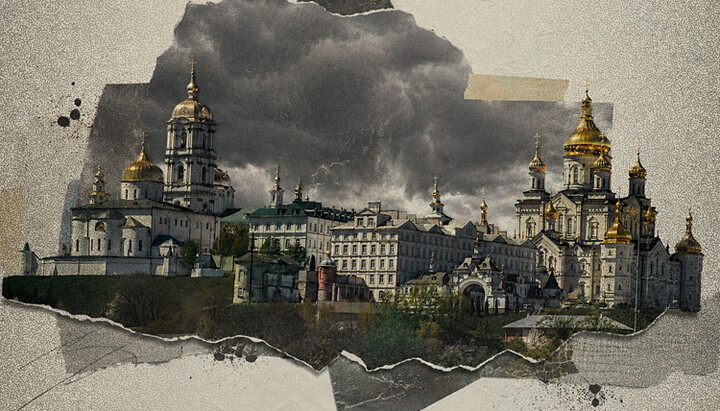
Dark clouds are gathering over the Pochaiv Lavra. Photo: UOJ
On July 22, 2026, the State Service of Ukraine for Ethnopolitics and Freedom of Conscience (DESS) announced the presence of signs of affiliation of the Pochaiv Holy Dormition Lavra with the ROC.
One might expect such a conclusion to be based on established financial, administrative, or personnel ties with the ROC. However, the published study is devoted primarily to the Lavra's membership in the Kyiv Metropolis of the UOC. Across 12 pages, DESS elaborately argues that the Pochaiv Lavra is part of the UOC and is subordinate to the Metropolitan of Kyiv and All Ukraine.
Here is what DESS asserts: “It has been established that the Pochaiv Holy Dormition Lavra is a structural subdivision of the Ukrainian Orthodox Church and is part of the Kyiv Metropolis of the UOC, which, in accordance with the legislation of Ukraine, has been recognized as affiliated with a foreign religious organization whose activities in Ukraine are prohibited.”
In other words, DESS’s central argument can be summed up in one sentence: the Pochaiv Lavra is connected with Moscow because it belongs to the UOC.
Three signs of "affiliation"
DESS stated that it had found three legally prescribed signs of affiliation:
- The Pochaiv Lavra is part of the structure of the Kyiv Metropolis of the UOC, previously recognized by DESS as affiliated with the ROC;
- the Lavra's founding documents confirm its membership in the Kyiv Metropolis;
- in accordance with the ROC's Statute, the Lavra's abbot, by virtue of holding episcopal rank, can theoretically participate in the work of the Local and Bishops' Councils of the ROC, and may also be a member of the ROC Synod.
Let us begin with the last sign, as the most absurd.
Indeed, the ROC's Statute contains provisions stating that bishops of the UOC are members of the Local and Bishops' Councils of the ROC and participate in the work of the Synod. Since the abbot of the Pochaiv Lavra, Metropolitan Volodymyr (Moroz), is a bishop of the UOC, DESS considers him an active member of the ROC's governing bodies.
DESS also found on the ROC's website a 2010 decision according to which the then-Archbishop of Pochaiv Volodymyr was a member of the Synodal Commission for Monastic Affairs. DESS further noted that it had been unable to find documents confirming the abbot's withdrawal from the ROC's governing bodies. However, the study also contains no evidence of his actual participation in these bodies following the UOC Council of 2022.
How legitimate and justified is it for a Ukrainian state body to rely on documents and data from Russian websites in decisions affecting millions of Ukrainian citizens? The UOJ has repeatedly drawn attention to the absurdity of such an approach. Under Russian legislation, Crimea and four Ukrainian regions are declared territory of the Russian Federation. Ukraine, however, considers these documents null and void. So why is an entry in the ROC's Statute accepted as evidence in proceedings aimed at banning Ukraine’s largest religious denomination by number of communities?
This absurdity is formally enshrined in the Law of Ukraine No. 3894-IX "On the Protection of the Constitutional Order in the Sphere of Religious Organizations' Activities," commonly referred to as the "law on the UOC ban." It turns out that Ukraine itself has allowed a Russian religious organization to determine the legal status of a Ukrainian one: the main argument against the UOC is the ROC's own statute. Yet the decisions of the UOC itself are not taken into account.
DESS ignores the Council of Feofania on May 27, 2022, which proclaimed the full independence and autonomy of the Church. It ignores the official letters by Metropolitan Onuphry stating that the UOC is not part of the Moscow Patriarchate. It ignores, ultimately, common sense: Ukrainian bishops can neither rewrite someone else's statute nor compel Moscow to remove their names from its lists.
Now regarding the first two signs of the Lavra's "affiliation." As is easy to observe, they repeat one another. DESS's own research group acknowledges this. The study then goes on to mention norms that are entirely standard for any stavropegial monastery:
- the abbot is appointed by the Holy Synod of the UOC;
- the monastery is accountable to the Metropolitan of Kyiv;
- financial audits are conducted at his direction;
- certain decisions of the Lavra's brotherhood require his approval.
DESS has provided no evidence that the Pochaiv Lavra maintains independent active ties with the ROC. And the fact that Pochaiv Lavra is a monastery of the UOC has never been denied by anyone.
DESS provided a rather detailed “proof” of this well-known fact and reached the following conclusion: since the Pochaiv Lavra belongs to the Kyiv Metropolis, and DESS had previously recognized the Kyiv Metropolis as affiliated with the ROC, it therefore follows that the Lavra itself is also affiliated.
But there is a deception concealed here. On August 27, 2025, DESS issued a decision recognizing the Kyiv Metropolis of the UOC as affiliated with the ROC; and on August 29, 2025, it filed a lawsuit seeking to terminate its activities. However, no court ruling on this case has yet been issued. Moreover, on April 6, 2026, the Sixth Appellate Administrative Court overturned the DESS's order of January 27, 2023, which had approved the conclusion of a religious studies expert examination of the UOC's Statute.
Although this formally did not affect the DESS's decision of August 27, 2025, regarding the "affiliation" of the Kyiv Metropolis with the ROC, the court proceedings on the Metropolis are still ongoing. And the invalidation of the very "expert examination" upon which the entire anti-church campaign is built reduces DESS's chances to win the case to ban the UOC.
The result is that there is no court ruling, yet DESS presents the "ties" of the Kyiv Metropolis with the ROC as an established fact and on this basis seeks to ban the activities of the Pochaiv Lavra.
What will happen next to the Lavra
On the basis of its decision identifying signs of affiliation, on July 27, 2026, DESS announced that it had sent the Lavra a demand to comply with its directives within 30 days. There are only two requirements: first, that the Lavra’s abbot and Spiritual Council make a decision for the Pochaiv Lavra to withdraw from the structure of the Kyiv Metropolis of the UOC; second, that Metropolitan Volodymyr declare his refusal to hold the positions provided for by the ROC’s Statute in its governing bodies and announce the termination of ties with it.
Although the second directive does not, in principle, contradict the decisions of the UOC Council held in Feofania on May 27, 2022, the first would amount to the Pochaiv Lavra breaking away from the Church. It is impossible to imagine the brotherhood agreeing to such a step.
Put simply, DESS is offering the Pochaiv Lavra a choice: either leave the UOC, or become a defendant in a lawsuit seeking to ban its activities. This is no idle threat. On July 7, 2026, DESS filed a lawsuit to terminate the activities of the Holosiiv Pustyn in Kyiv, and on July 13, a court opened proceedings in this case. The Pochaiv Lavra is one of the largest and most venerable monasteries in Ukraine, and if it can be banned, what then can be said of other monasteries or churches.
One might say that the scheme has already been tested and the conveyor belt set in motion. DESS labels any parish, eparchy, or monastery as connected with the Kyiv Metropolis and, on that basis, files a lawsuit seeking to ban its activities.
Yet there is one significant flaw in this scheme. If the court denies the DESS's claim to ban the Kyiv Metropolis, the entire scheme for banning UOC monasteries and parishes will become considerably more complicated, though it will not collapse entirely.
The current DESS order identifying signs of affiliation does not in itself ban the activities of the Pochaiv Lavra, evict the monks, or terminate the property use agreement. However, if within 30 days DESS issues the next, now formal, decision recognizing the Lavra as affiliated, the law provides for the early termination of the right to use state and communal property and related agreements within 60 days. Thus, the property consequences may be set in motion even before the completion of court proceedings on the termination of the religious organization's activities.
The property front prepared in advance
One cannot fail to notice that DESS's activities coincide remarkably with other developments around the Pochaiv Lavra, particularly regarding property.
In December 2003, the monastery concluded an agreement for the free use of the Lavra's complex of buildings for a period of 49 years, that is, until 2052.
On April 3, 2023, draft resolution No. 9179 was registered in the Verkhovna Rada, calling on the Cabinet of Ministers to terminate the agreement for the use of the Pochaiv Lavra complex. On February 10, 2026, this draft was included on the Verkhovna Rada's agenda and currently has the official status of "awaiting consideration."
In June 2024, the Ministry of Culture and Information Policy sent a commission to Pochaiv to inspect the preservation and use of state property. Following the inspection, the commission reported the absence of certain items of property, unauthorized additions to protected monuments, improper documentation of works, and other violations. The commission's conclusion was to raise the question of terminating the property use agreement. The Lavra disputed these findings, stating that no official documents from the inspection had been received.
In August 2024, the Commercial Court of the Ternopil Region annulled the registration of the UOC's rights to the complex of buildings of the Holy Spirit Skete near the Pochaiv Lavra. In October, the Appellate Court upheld this decision.
The resulting combination is as follows: there is a draft Verkhovna Rada resolution on terminating the property use agreement, there is a state commission's conclusion to the same effect, there are court rulings on the property of the Holy Spirit Skete. And now DESS has played its trump card – the recognition of "affiliation" with the ROC.
Those hunting for the Pochaiv Lavra’s property are already at the starting line.
Сlaimants are already lined up
The enemies of the UOC received DESS's decision as a signal to act.
MP Oksana Savchuk wrote on her Facebook page: "The State Ethnopolitics Service has officially confirmed that the Pochaiv Lavra is affiliated with the ROC," adding that "we all knew this for years."
The Ternopil organization "Svoboda" declared: "Now no one will be able to say that these are merely political statements and assumptions." At the same time, the publication itself practically reproduces DESS’s argument almost word for word: the Lavra is part of the Kyiv Metropolis, the Metropolis has been recognized as affiliated, and therefore the Lavra itself is also affiliated.
An even more explicit comment came from UGCC cleric Vasyl Ivashkiv: “Return it to the Basilian fathers – and the matter is resolved.”
In any case, those claiming the Pochaiv Lavra’s property emerged long ago.
On March 28, 2023, the OCU Synod established, within the Ternopil Eparchy, a religious organization called the “Holy Dormition Pochaiv Lavra” and appointed “Metropolitan” Nestor Pysyk as its “sacred archimandrite.”
In other words, the OCU has already set up a legal entity bearing the name of a monastery it has never administered and on whose territory it has not had a single monk.
In 2023, OCU head Epifaniy Dumenko explicitly stated that in the future the Kyiv-Pechersk and Pochaiv Lavras should join the OCU, it was simply necessary to "wait a little." Later, Dumenko formulated his position even more plainly: "We lay claim to the Pochaiv Lavra; we have already established a legal entity there."
Nestor Pysyk also makes no secret of his expectations. He stated that Pochaiv should become "a place of unity for Orthodox Ukrainians," and that among the current brotherhood there may emerge "its own Avraamiy" (Lotysh. — Ed.), who would defect to the OCU and help it acquire the monastery following the scenario of the Kyiv-Pechersk Lavra.
The UGCC has also repeatedly declared its claims to its presence in Pochaiv. In January 2023, Sviatoslav Shevchuk recalled the Basilian period of the monastery's history, the coronation of the Pochaiv Icon with papal crowns, and emphasized: "We do care of what will happen there."
In December 2024, Shevchuk expressed himself even more plainly: when the authorities decide the fate of the Lavra "after its de-Moscowization," the state should bear the UGCC in mind, since it, in his words, holds the relevant historical rights.
The Basilian Order, as early as February 2023, discussed with the chairman of the Ternopil Regional Council the "return" of the Pochaiv Lavra to the UGCC and proposed transferring the complex to those they consider its "lawful owners."
Thus, claimants have already lined up before the Lavra, each seeking to prove their right to the shrine. There has even been a public dispute between the OCU and the UGCC over which of them Pochaiv Lavra should belong to.
Meanwhile, no one is considering how the civil confrontation that the enemies of the UOC are provoking around the Pochaiv Lavra will affect the unity of Ukrainian society and, consequently, the country's defense capability. Such irresponsibility may cost Ukraine very dearly.
After all, Pochaiv is not a museum complex or merely an architectural monument. It is a center of spiritual life and a functioning monastery. An attempt to forcibly change its ecclesiastical affiliation could lead to a grave interfaith, and possibly even civil, conflict. However, for now the public debate is focused primarily on who should receive the walls, buildings, and other property.
Conclusion
The recognition of the Pochaiv Lavra's "affiliation" will affect, without exaggeration, the entire UOC. If DESS manages to ban the Lavra through the legally prescribed procedures, this will set a precedent. The scheme can then be applied to other monasteries, eparchies, and parishes: DESS will no longer need to trouble itself with proving a specific community's ties to the ROC – it will be sufficient to prove a connection to the Kyiv Metropolis.
The property consequences for Pochaiv may come about even before a court ruling on the termination of the religious organization's activities. The law sets in motion the mechanism for the early termination of the right to use state and communal property 60 days after DESS formally recognizes the "affiliation."
Therefore, the Lavra must be defended by all lawful means: in court, in the media, and in the public sphere. And most importantly, one must pray and remember the words of the Apostle Paul: "Do not be overcome by evil, but overcome evil with good" (Rom. 12:21).
Read also
Why nation-first advocates do not call for peace
Ukraine’s population is declining by nearly one million people a year, and experts are warning of the nation’s demographic extinction. Yet the leaders of the Orthodox Church of Ukraine (OCU) and the Ukrainian Greek Catholic Church (UGCC) continue to call for war and mobilization.
The deception that decided the fate of the Tomos
In 2008, the "Filaret problem" derailed Yushchenko's plan. In 2018, Poroshenko solved it in just one hour – with a police escort for the Greeks and verbal promises to Filaret.
Lawyers in the crosshairs: How UOC is being stripped of its right to defense
Activists harass UOC lawyers outside courthouses, call them “traitors” on air, and promise them a “warm welcome” at hearings. The Church’s right to a legal defense is at stake.
How to respond to persecution: Lessons from St. Silouan the Athonite
The Church can and should be defended, but without malice. Why love for persecutors is not weakness but the only way to preserve the Spirit of Christ in the midst of the struggle.
Where the Spirit of the Lord is, there is freedom
Reflections on the controversies surrounding the creation of the OCU.
Pentarchy with Rome: A return to the roots or a new schism?
Patriarch Bartholomew wants to revive a council of five patriarchates, including Rome. What would reunion with Catholics look like, and what role would be left for the other Churches?