“Want to eat sausage? Go ahead!”: Why OCU is doing away with fasting
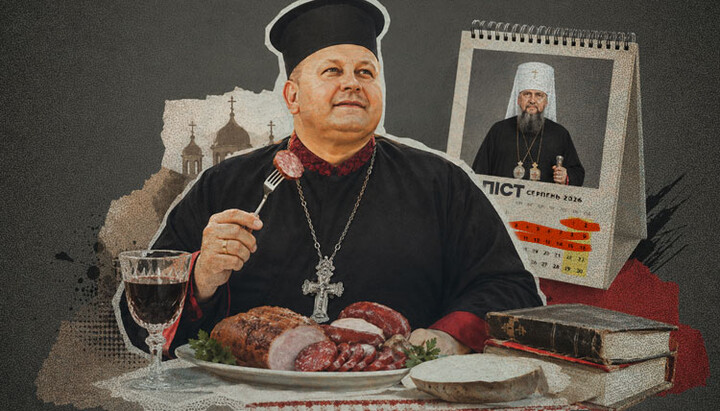
Can you eat sausage during a fast in the OCU? Photo: UOJ
In early August 2026, during the Dormition Fast according to the new calendar, OCU cleric Oleksiy Filiuk recorded a video in which he urged people to eat sausage.
“Fasting is prayer, it is works of mercy – not boiled sausage that contains nothing but soy,” he said, before concluding: “Have your breakfast, eat your boiled sausage. Just don’t eat each other alive.”
In another video, Filiuk is already slicing up that very sausage.
What the Church says about fasting
Fasting is a spiritual struggle, an ascetic discipline, our own effort on the path toward God. Christ fasted, the apostles fasted, and so did the first Christians. From ancient times, the Church established a regular discipline of fasting.
At the same time, the Church has never reduced fasting to a matter of diet. As early as the fourth century, St. Basil the Great wrote: “Abstinence from food alone is not enough for a praiseworthy fast… True fasting is turning away from evil, restraining the tongue, suppressing anger, cutting oneself off from lust, slander, lies, and perjury.”
St. John Chrysostom says almost the same thing: “What good is it if we abstain from birds and fish, but bite and devour our brothers?”
At first glance, Oleksiy Filiuk seems to be saying much the same thing: the main thing is not to “eat each other alive.” But Chrysostom’s logic is exactly the opposite. He does not say that because we must not “devour our neighbor,” we are therefore free to eat meat. He says that changing what is on our plate is not enough – we must change our lives so that they conform to God’s commandments. The centuries-old experience of the Church shows that fasting is precisely one of the means that helps us fight the passions more effectively.
Patristic teaching adds spiritual labor to bodily fasting; it does not replace one with the other. At the same time, the Church has never demanded the same measure of abstinence from everyone.
As early as the fifth century, St. John Cassian devoted a separate chapter of his Institutes to this very subject: “That the same rule of fasting cannot be observed by everyone.” He explained that people differ in physical strength, and therefore the measure of fasting depends on one’s bodily condition, age, and other circumstances.
In the nineteenth century, St. Ignatius Brianchaninov put it even more specifically: “Anyone engaged in physical labor, or so weak in body that he cannot be satisfied with eating once a day, should eat twice. Fasting is for man, not man for fasting. …> The rules of fasting were established by the Church to assist her children, as guidance for the whole Christian community. At the same time, each person is instructed… not to impose on himself a fast beyond his strength.”
In 2022, Serbian Patriarch Porfirije explained: “Not everyone possesses the same physical strength,” and therefore fasting cannot be practiced by everyone in exactly the same way. A layperson, in particular, should not mechanically imitate the monastic measure of fasting. At the same time, the Patriarch emphasized, “the spirit of fasting must be and remain the same for everyone.”
The principle the Church has followed throughout every period of her history can be stated simply: the measure of fasting may differ, but fasting itself remains an obligatory ascetic practice for a Christian.
But the rhetoric of Oleksiy Filiuk and similar OCU representatives is quite different.
“Want to eat? Then eat”
On March 24, 2025, during Great Lent, Oleksiy Filiuk was asked whether it was permissible to eat sausage. He replied: “Fasting is not a diet. And don’t turn it into some kind of fanaticism. So, my dear ones, if you want to eat – eat… Eat whenever you feel like it.”
Let us emphasize: Filiuk is not suggesting that people relax dietary fasting because of physical weakness, illness, exhausting labor, or some other serious reason. No – simply because they feel like it.
On December 8 of the same year, this time during the Nativity Fast, Filiuk had this to say about milk: “Store-bought milk is basically like water. Go ahead, drink it, cook dairy food for yourself – there’s no sin in that. People have invented all these diets for themselves; it all comes from the ‘Mokshans.’”
Incidentally, who are the “Mokshans”? The Moksha are a Finno-Ugric people historically living mainly in the Volga region. In contemporary Ukrainian rhetoric, however, the word is also used as a derogatory or mocking term for Russians. Which raises a question: does Filiuk believe that only backward Russians observe the fasts?
A quick look through the OCU cleric’s videos gives the impression that he hardly ever observes dietary fasting at all. During a volunteer cleanup at Kyiv-Pechersk Lavra on a fast day, Filiuk urges people to eat cheese; during the Dormition Fast, he appears on camera with ice cream; and dry-cured sausage is prominently displayed on his table.
Of course, one could dismiss all this as the eccentric behavior of a single popular blogger. Formally speaking, Filyuk is just an ordinary “priest” and is not part of the OCU leadership.
But things are not quite that simple.
First, he has a huge social-media audience – larger than all the OCU’s official platforms combined: 1.3 million followers on Facebook, 200,000 on YouTube, 800,000 on TikTok, and 275,000 on Instagram. Many of these people likely take Filyuk’s words as Church teaching and shape their lives accordingly.
Second, the OCU leadership has publicly remained silent about his statements. And, as the saying goes, silence gives consent.
Third, very similar rhetoric can be heard from other OCU representatives.
For example, in April 2020, Andriy Dudchenko said that apart from the first and last weeks of Great Lent, he usually eats fish. That in itself is his personal matter. But here is how he explained it: “I believe that every family, every person, has the right to set their own fasting rules.”
Dudchenko is not an ordinary parish priest. He is an associate professor at the OCU’s Kyiv Orthodox Theological Academy and secretary of its Synodal Theological and Liturgical Commission. Yet his statement that “everyone sets their own fasting rules” is very difficult to reconcile with the very idea of Church discipline.
St. Ignatius says that the Church establishes the rules, while each individual Christian should measure them against his own strength. Dudchenko turns this upside down: the Christian himself makes the rules.
That is no longer oikonomia, because oikonomia presupposes the existence of a common norm from which, for valid reasons, an exception may be made. Here, however, everyone simply sets their own rules.
When fasting gets in the way of New Year’s Eve
Back in December 2021, when the OCU still followed the Julian calendar, the head of the organization, Serhiy Dumenko, told Radio Liberty how one might get around the awkward situation in which someone wants to celebrate New Year’s Eve in style but the Nativity Fast gets in the way.
At the time, he said that for December 31 and January 1, the Church could “relax the fast or even abolish it altogether for two days.”
From the standpoint of pastoral oikonomia, an obvious question arises: what kind of human weakness requires the Nativity Fast to be abolished? Illness? Military service? Heavy physical labor? Pregnancy?
No.
What requires the fast to be canceled is the desire to have a good time on New Year’s Eve.
Curiously enough, Serhiy Dumenko has also made perfectly traditional statements about fasting. For example, in a sermon on March 30, 2025, he said that fasting is a practice through which, by means of “voluntary self-restraint,” the body and soul are trained in temperance. He also urged people “not to submit to our own unrestrained desires, but to humble ourselves before the will of God.”
Which raises another question: when was he speaking sincerely?
So what lies behind this dismissive attitude toward fasting among OCU representatives, and why is the organization’s leadership so ready to revise it?
“Priests for the people”
In the comments under Filiuk’s sausage video, one viewer wrote: “At last, proper priests. Priests for the people. Makes you want to go to church.”
Of course, one comment does not represent everyone’s opinion. But it nevertheless captures the essence of the OCU’s “innovations” regarding fasting with remarkable clarity.
Fasting is not what matters – winning people over is. And the easiest way to win someone over is to relieve them of whatever burdens them.
Fasting feels burdensome? Then call it “fanaticism.”
Craving dairy? Then store-bought milk is “basically water.”
Want sausage? Then it is “nothing but soy.”
And this has nothing to do with mercy or love for people. It is simple servility. Or, in the language of the Church, people-pleasing.
Patristic teaching says this about fasting: if you cannot bear a stricter measure, take on a lighter one – but take on something. Servility says something else: if you want sausage, eat sausage.
And the problem goes far beyond fasting. Which doctor do we find more pleasant – the one who tells us to cut back on alcohol, sweets, and starchy foods, or the one who allows us everything? The one who insists on daily exercise, or the one who lets us spend that time on the couch?
The answer is obvious.
But will that choice actually be good for our health?
Conclusions
Christian life is impossible to imagine without ascetic struggle: “the kingdom of heaven suffers violence, and the violent take it by force” (Matt. 11:12). Fasting is one form of spiritual labor – and one of the simplest and most accessible. It was certainly not established in order to torment parishioners for no reason.
The Church has never demanded the same degree of fasting from everyone. One person can fast strictly; another needs concessions because of illness, age, hard physical labor, or the circumstances of life.
But the whole point of Church oikonomia has always been to help a person undertake an ascetic effort that is within his strength – not to persuade him that no effort is needed at all, and that he may simply abandon it because he does not feel like making it.
That is why statements by OCU representatives along the lines of “if you feel like it, eat,” the claim that everyone can set their own fasting rules, or the idea that Church restrictions can be abolished for the sake of customary celebrations are about much more than sausage or milk.
They reflect the notion that Church life should be easy and comfortable, that it should demand no particular effort from a person, and that it should never come into conflict with his habits and desires. It is an indulgence of fallen human nature – an attempt to please the audience and collect as many “likes” as possible.
But the Apostle Paul put it this way: “If I were still trying to please people, I would not be a servant of Christ” (Gal. 1:10).
Read also
Why nation-first advocates do not call for peace
Ukraine’s population is declining by nearly one million people a year, and experts are warning of the nation’s demographic extinction. Yet the leaders of the Orthodox Church of Ukraine (OCU) and the Ukrainian Greek Catholic Church (UGCC) continue to call for war and mobilization.
The deception that decided the fate of the Tomos
In 2008, the "Filaret problem" derailed Yushchenko's plan. In 2018, Poroshenko solved it in just one hour – with a police escort for the Greeks and verbal promises to Filaret.
Lawyers in the crosshairs: How UOC is being stripped of its right to defense
Activists harass UOC lawyers outside courthouses, call them “traitors” on air, and promise them a “warm welcome” at hearings. The Church’s right to a legal defense is at stake.
How to respond to persecution: Lessons from St. Silouan the Athonite
The Church can and should be defended, but without malice. Why love for persecutors is not weakness but the only way to preserve the Spirit of Christ in the midst of the struggle.
Where the Spirit of the Lord is, there is freedom
Reflections on the controversies surrounding the creation of the OCU.
Pentarchy with Rome: A return to the roots or a new schism?
Patriarch Bartholomew wants to revive a council of five patriarchates, including Rome. What would reunion with Catholics look like, and what role would be left for the other Churches?