The portrait of a Bulgarian OCU supporter
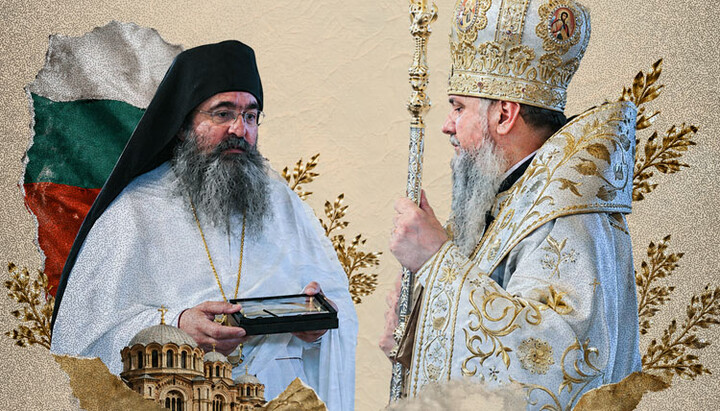
Archimandrite Nikanor (Mishkov) concelebrated with the OCU. Photo: UOJ
More than 7.5 years have passed since the OCU was established, but few people abroad support this structure. Who are they? What motivates them? What is their religious worldview? We offer one example.
The accusations of Archimandrite Nikanor
In late July 2026, Bulgarian Archimandrite Nikanor (Mishkov) published an offensive statement targeting the Primate of his own Church. He referred to Patriarch Daniil as: "Atanas Trendafilov, playing at being 'patriarch.'"
Nikanor went on to declare that the Patriarch had no authority over him and that his election had been “a particularly vile crime against the Orthodox faith and the Bulgarian people.” But that was not all. The archimandrite described the Bulgarian Church under Patriarch Daniel as an enemy of its own people – "captured and enslaved, forced onto demonic Kremlin tracks," "a pitiful imitation of a church, a lackey of Russian imperialism." He concluded with a call: "It is time for the so-called 'Patriarch Daniil' to go!"
Shortly before this, on July 14 and 15, the Archimandrite concelebrated in Kyiv with OCU head Serhiy Dumenko, even though the Bulgarian Orthodox Church has not recognized the OCU. Patriarch Daniil, while still Metropolitan of Vidin, had criticized the creation of Dumenko's structure. In August 2024, he named the UOC as the only canonical Orthodox Church in Ukraine, and in 2025 he again spoke of serious canonical obstacles to recognizing the OCU.
Nevertheless, Archimandrite Nikanor makes no mention of the OCU in his rude criticism of the Bulgarian Primate.
But perhaps we are unaware of something about the Bulgarian Patriarch, and Nikanor has opened our eyes? It appears not. Despite his relative youth (the Patriarch is 54 years old), he commands respect both within the Church and in secular circles. All who know him speak of him as a very humble and decent man. For example, in one publication, the principal of a secondary school in Vidin said that during the years when Daniel headed the Vidin Diocese, the Church became noticeably closer to ordinary people. The hierarch himself was distinguished by humility and integrity.
The Bulgarian newspaper Trud published an article in which priests and laypeople of the Vidin Diocese described Daniel as a humble, exceptionally modest, and ascetic man.
We were unable to find any serious publications confirming the grave moral accusations that Nikanor levels against Patriarch Daniel. Such criticism therefore appears to be nothing more than ordinary rudeness.
The Church hierarchy and clergy of the Bulgarian Church responded accordingly.
The Bulgarian Church's response to Nikanor's statements
On July 28, 2026, Patriarch Daniil suspended Nikanor from ministry for 15 days. The grounds cited were conduct incompatible with holy orders and monastic vows of obedience, as well as actions undermining the authority of the Church.
On July 30, seventy-five priests of the Sofia Diocese signed a declaration in support of their Patriarch. They stated that Nikanor's public statements contained insults, defamatory claims, and political agitation, and that the "street and unchurchly language" he employed was unacceptable for a cleric of the Bulgarian Church.
On July 31, the Holy Synod of the Bulgarian Orthodox Church described the archimandrite’s statements as systematic insulting and defamatory remarks by a man who places himself in the position of “judge of everything and everyone.” And on August 10, 2026, the suspension was extended for another 15 days.
"I Know God": Nikanor on himself, the Church, and Ukraine
But the archimandrite continued his attacks. In an interview with the Viche channel, Nikanor stated: “Patriarch Daniil should already be thinking about retiring. He is failing as a patriarch. …> Someone has to be the first to say that the emperor has no clothes.”
To call the primate of one’s own Local Church, a man widely respected, an “emperor who has no clothes” is no longer criticism, or even an insult, but sheer absurdity. But this is only the beginning. He then makes the following statement: “The Patriarch’s spiritual DNA is the spiritual DNA of spiritual murderers.”
The archimandrite presents himself as the victim of a premeditated reprisal: "Apparently, he deceived me in order to find an opportunity to discover something against me and to kill me ecclesiologically, by stripping me of holy orders."
This refers to the dispute over the Chernogorski (Giginski) Monastery. The essence of the matter is as follows. In January 2025, Archimandrite Nikanor himself requested to be relieved of his duties as abbot of the monastery, and the brotherhood elected Hieromonk Zakharia as the new superior. Later, the archimandrite requested a canonical release letter to transfer to the Diocese of Ruse. However, Patriarch Daniil did not approve the new abbot or issue the letter, explaining that the delay was due to the need to audit the monastery’s financial and administrative records.
The audit findings have not yet been published, but 24 Chasa, citing information from the Holy Synod, claims that the matter involves major abuses and a sum exceeding 1 million euros.
Naturally, Nikanor admits to nothing of the sort, and in the interview he reflects: "To judge a cleric for following Christ and the Gospel is to become a Sanhedrin." That is to say, the matter may concern accusations of financial misconduct – as yet unconfirmed – while he compares himself to Christ standing trial before the Sanhedrin.
Here is what Nikanor said in response to a question from Viche channel host Ilona Sokolovska about the 75 priests of the Sofia Diocese who came out in support of Patriarch Daniil. The journalist directly asked whether it was not at least possible that Nikanor was mistaken, rather than those priests. To which the archimandrite, without the slightest hesitation, declared: "But I do not merely believe in God – I know God. I know what I am doing. I have no doubts about my position as a Christian: this is my witness before the world."
He compared the position of the Sofia clergy to the behavior of serfs.
At this point, the words of the Apostle John the Theologian immediately come to mind: "He who says 'I know Him' but does not keep His commandments is a liar, and the truth is not in him…" (1 Jn. 2:4). Can a man who knows God so groundlessly and brazenly slander his own Patriarch?
But the matter does not end with attacks on the Bulgarian Primate. What follows is criticism of the entire Orthodox Church.
In Nikanor's view, "Orthodoxy is very sick." He speaks with considerable contempt of miracles and myrrh-streaming: "They bring some Russian leaflet or a photocopy – and it streams myrrh. But there are thousands of such cases in the world. Even ancient pagan statues of Zeus streamed myrrh; in Russia, it seems, even a statue of Lenin streamed myrrh – I don't know what kind of 'myrrh' that was."
The archimandrite also attributes hatred of LGBT people to the Church: "The same mindset extends to sexual minorities: destroy them – and piety and grace will reign. …> The more of them we kill, the better we will supposedly become. As if the Lord did not create them and it were not the Lord who keeps them alive, as if they were not His children."
But we know of no case in which Orthodox Christians have called for killing LGBT people. This rhetoric itself is based on a false premise: here, love for the sinner is used to justify the sin itself.
Nikanor also accuses the UOC of inciting hatred. He describes it simultaneously as the “former canonical Church” and as a “Russian structure” that for years turned its faithful against the followers of Filaret Denysenko and Makariy Maletych – the UOC-KP and the UAOC. In his words, "people were kept in spiritual captivity, being instilled with the idea that the 'Filaret people' and the 'Makariy people' were the worst, as though they were subhuman."
But first, the UOC-KP and the UAOC were accused of schism, not of being “subhuman.” Second, we know of no cases in which UOC faithful have seized a church belonging to the UOC-KP, UAOC, or OCU, or displayed aggression toward them. The opposite is entirely true: it is representatives of the OCU who seize churches, beat priests, and assault UOC parishioners.
Could it be that the hatred actually comes from Dumenko’s structure? Nikanor acknowledges that such hatred exists, but considers it… natural, understandable in the context of war: “This is also hatred, but natural hatred. So two kinds of hatred clash with each other.” Moreover, he expresses solidarity with those persecuting the UOC: “I myself could grab something, smash everything there, and drive them out: ‘Traitors! This is an abomination!’”
Nikanor speaks of the OCU in a fundamentally different tone. He calls it "the current canonical Orthodox Church of Ukraine" and does not consider his concelebration with Serhiy (Epifaniy) Dumenko a violation of church order. On the contrary, when Sokolovska noted that Patriarch Daniil recognizes the UOC as the only canonical Orthodox Church in Ukraine, Nikanor replied: "He is lying very unbecomingly to the whole world."
On attempts to influence the Bulgarian Patriarchal election via the Vatican
The portrait of Archimandrite Nikanor would be incomplete without one interesting episode.
On August 7, 2026, the Bulgarian resource 24 Chasa published a transcript of a conversation between a person identified as Archimandrite Nikanor and a representative of the Roman Curia. Nikanor denies the conversation, although the second participant confirmed to the newspaper the fact of the exchange, which took place in March 2024, on the eve of the election of the new Bulgarian Primate.
In it, the archimandrite proposes that his interlocutor assist in securing the election of Ruse Metropolitan Naum as the future Patriarch. He characterizes Naum as a candidate close to the Patriarchate of Constantinople and aligned with the interests of the Vatican. The conversation then turns to Metropolitan Nikolay of Plovdiv: the interlocutor is invited to visit him and convey something from the Pope. Political influence also comes up, with former Prime Minister Boyko Borisov and media mogul Delyan Peevski being mentioned.
According to the editorial team, the politicians and metropolitans mentioned were unaware of the initiative of the person presented on the recording as Nikanor. He assessed his own role in the entire operation with characteristic "modesty": "I am merely a strategist at headquarters."
Another interesting detail of the conversation: speaking of one of the possible candidates for Bulgarian Patriarch, he says that the man "won’t do anything – neither with the Vatican nor with the Ukrainians, nor with anyone else." What exactly is meant is difficult to determine. However, it is evident that the Ukrainian issue featured in one way or another in the deliberations about the future of the Bulgarian Church in the context of the election of a new Patriarch.
What the OCU has to do with it
Archimandrite Nikanor is one of the few clerics of Local Churches who supports the OCU. Of course, it would be wrong to judge all of its supporters by him. But it is hard not to notice: his support for the OCU and his conflict with his own Church grow from the same root – a particular religious worldview.
Let us analyze the situation.
The Bulgarian Church elects a Patriarch unwelcome to Nikanor – and the archimandrite publicly demands his resignation. The Bulgarian Church does not recognize the OCU – Nikanor enters into Eucharistic communion with it. Patriarch Daniil considers the UOC the canonical Church in Ukraine – the archimandrite accuses him of lying. The priests of the Sofia Diocese support their Primate – Nikanor compares their position to the behavior of serfs.
It follows that he reserves for himself the right to determine independently which church decisions are binding and which are not, which hierarchs are canonical now and which were canonical in the past, who is a true patriarch and who is merely “playing patriarch.”
What is this, if not the principle: "I am the supreme authority"?
But it was precisely on this principle that the OCU was created. In 2018, Patriarch Bartholomew, contrary to the canons, contrary to the opinion of the millions-strong flock of the UOC and its hierarchy, contrary to his own previous position by which Filaret and his religious structure were recognized as schismatics, intervened in the ecclesiastical situation in Ukraine and played a decisive role in the creation of the OCU.
To all calls to resolve the matter conciliarly, through the fullness of the Orthodox Church, he responded in essence with the same thing: "I am the supreme authority."
What can one say to the man who is convinced of his own rightness? What is there to say when, in response to the tentative remark "perhaps you are mistaken," he answers: "I know God, I know what I am doing"?
One can only remind him of the words of the Apostle Paul: "Those who think they know something do not yet know as they ought to know" (1 Cor. 8:2).
Read also
Why nation-first advocates do not call for peace
Ukraine’s population is declining by nearly one million people a year, and experts are warning of the nation’s demographic extinction. Yet the leaders of the Orthodox Church of Ukraine (OCU) and the Ukrainian Greek Catholic Church (UGCC) continue to call for war and mobilization.
The deception that decided the fate of the Tomos
In 2008, the "Filaret problem" derailed Yushchenko's plan. In 2018, Poroshenko solved it in just one hour – with a police escort for the Greeks and verbal promises to Filaret.
Lawyers in the crosshairs: How UOC is being stripped of its right to defense
Activists harass UOC lawyers outside courthouses, call them “traitors” on air, and promise them a “warm welcome” at hearings. The Church’s right to a legal defense is at stake.
How to respond to persecution: Lessons from St. Silouan the Athonite
The Church can and should be defended, but without malice. Why love for persecutors is not weakness but the only way to preserve the Spirit of Christ in the midst of the struggle.
Where the Spirit of the Lord is, there is freedom
Reflections on the controversies surrounding the creation of the OCU.
Pentarchy with Rome: A return to the roots or a new schism?
Patriarch Bartholomew wants to revive a council of five patriarchates, including Rome. What would reunion with Catholics look like, and what role would be left for the other Churches?