Can a recording pray?
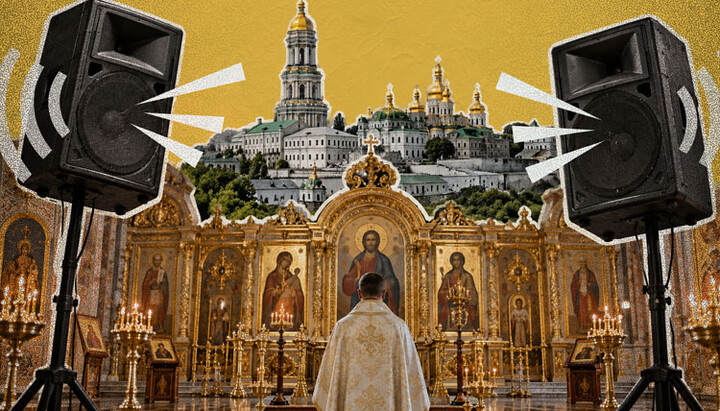
OCU “service” at the Lavra with prerecorded choir music. Photo: UOJ
On August 30, 2026, during an OCU service at the St. Anna Conception Church of the Lower Lavra, a pre-recorded church chant was used instead of a live choir. The recording could also be heard in the live stream of the service broadcast on the Facebook page of the OCU’s "Kyiv-Pechersk Lavra."
The phonogram debate
Even within the OCU itself, opinions on the permissibility of such a practice were divided. "Who are we fooling? This is a recording," wrote Oleksandr Tarasenko, a regent of the OCU’s Transfiguration Cathedral where Oleksandr Drabinko serves, in the comments. Here are other similar reactions: "I am unpleasantly surprised! You can hear the recording from the very first sounds!"; "Shame! Playing audio recordings instead of a choir!!"
However, there were also those who approved: OCU “priest” Mykola Kapitula wrote that it was "very good!"
The discussion, however, extended beyond the OCU.
UOC priest Oleksandr Klymenko sarcastically suggested that those who favor phonograms in church should go further: "If you can play an audio recording instead of a live choir, then why not also play an audio recording of the priest’s or deacon’s voice during services? There is a shortage of them too, just like choristers. What a wonderful solution!"
OCU cleric Viktor Martynenko wrote the same: "Maybe, to avoid putting people at risk and to save on costs, we should broadcast the priest on a screen too?"
Ukrainian cleric of the Ecumenical Patriarchate Kostiantyn Shevchenko, on the contrary, saw no problem with the practice itself. According to him, in the Kherson church where he served for a long time, a phonogram was used when a choir could not be assembled. In his view, the problem is not the use of a recording itself, but its quality: “What I heard in the recording of the service at the Lavra is not terrible, but it is very poor work by the sound engineer.” He added that he knows many churches where the choir is replaced by a phonogram.
Oleksandr Drabynko, however, disagreed. He cited the opinion of the late Primate of the UOC, Metropolitan Volodymyr (Sabodan), who, according to Drabynko’s recollections, responded with a categorical "no" when asked about the permissibility of phonograms. Drabynko himself called the use of a recording in place of live singing "a profanation of worship – a dummy."
One can certainly debate the technical quality of a phonogram, cite the opinion of the late UOC Primate, or propose adopting a new canon: "If anyone shall dare to play a phonogram in a church…" But one can also ask a different question: what makes a service a service?
Is the choir musical accompaniment, or something more?
In the ecclesial consciousness of modern Christians, the prevailing view is that the service is performed by the priest, while the church choir lends it beauty and solemnity. The role of the parishioners is to stand in the church, observe what is happening, and, ideally, pray.
Yet the essence of worship is different. Worship is the action of the assembled Church – not of the priest, the choir, or the reader separately, but of the whole Church. In his Epistle to the Corinthians, the Apostle Paul writes: "…when you come together as a church…" (1 Cor. 11:18). Many understand this as simply referring to believers entering a church building. But that is not the case. The Apostle means that Christians, gathering together in the name of Christ ("where two or three are gathered in my name, there am I among them: (Matt. 18:20)), constitute the Church – much as puzzle pieces come together to form a single picture.
In this assembled Church there are clergy and laity, and the entire structure of worship is arranged as a dialogue between them. For example, in the litany the priest or deacon calls out: "Let us pray to the Lord," and the laity respond: "Lord, have mercy." This is followed by a call to pray for something more specific, to which the laity likewise respond.
Consider the Liturgy. The priest calls out, "Let us lift up our hearts," and the laity respond, "We lift them up to the Lord." The priest: "Let us give thanks to the Lord." The response is, “It is meet and right…” All those present in the church are meant to respond. Today these responses are voiced by the choir, but that does not make them a "choir part" in the concert sense.
Indeed, even today some churches practice singing by the entire congregation. It is telling that in the official text of the Divine Liturgy of Saint John Chrysostom published by the Greek Orthodox Archdiocese of America, the responding party is in many places designated by the word "People."
The hymns are the response of the people standing before God here and now — not of a recorded choir.
Byzantine music historian Dimitri Conomos notes that one of the characteristic features of ancient Christian worship was the active participation of the congregation in reciting and singing psalms, hymns, and responses. Moreover, the Greek word "choros" ("choir") in the early Christian era could refer not to a separate group of professional singers but to the praying and singing community itself. Later, a distinct ministry of specially trained singers gradually emerged within it. But this does not change the essence of what takes place during the divine service: the whole Church prays, while the choir merely gives voice to that prayer.
Around the middle of the second century, St. Justin Martyr wrote that after the prayers and thanksgiving of the presiding minister, "all the people present express their assent, saying: 'Amen.'" Note that Justin does not write that after the presider’s prayer "a hymn is performed." He says that the people express their assent. Saint John Chrysostom, several centuries later, would put it even more plainly: "The thanksgiving is common: it is not the priest alone who gives thanks, but the whole people."
Can a recording express assent?
According to St. Justin, the people present in the church express their assent to what the priest does and says by responding: "Amen." But what happens when a phonogram is playing?
Imagine a professionally made recording: flawless voices, perfect intonation, beautiful acoustics, etc. The priest begins the Liturgy: "Blessed is the Kingdom of the Father and of the Son and of the Holy Spirit, now and ever and unto ages of ages." And then someone presses a button, and from the speakers comes: "Amen."
"Amen" is not merely a beautiful combination of sounds. It is an assent that makes the celebration of the Liturgy possible. St. Justin understands it precisely this way: the people "express their assent." But can a phonogram express assent? Can it say "Amen" to God?
This is precisely why Father Oleksandr Klymenko’s question, despite its obvious sarcasm, is entirely valid from a theological standpoint: if a recording can say "Amen," why could it not also say "Blessed is the Kingdom…"?
The COVID-19 experience
During the period of total lockdown, the question of the permissibility of online broadcasts of services was equally acute. And at that time, too, a variety of opinions were voiced.
In March 2020, UOC Metropolitan Theodosiy (Snihirev) said that an online broadcast could be useful in exceptional circumstances but should not become a routine substitute for physical presence in church.
UOC Metropolitan Clement (Vecheria) of Nizhyn expressed himself even more categorically: "An online broadcast is not a worship service. Our God is a living God, not an 'online God.'" He also emphasized that watching a broadcast cannot replace Confession and Communion.
But at that time the discussion was not about a choir recording being played back at a different time. The broadcast conveyed what was happening at that very moment with living people, even if in a different location: it was merely a "mediator" of human action.
In the case of a phonogram, we are dealing not with the transmission of an action or a response but with its imitation.
And if an online broadcast could not be recognized as a full substitute for physical presence in church, how can an imitation substitute for the choir’s participation in worship?
Why was a recording needed at the Lavra?
Why was it necessary to use a phonogram at a service in the Kyiv-Pechersk Lavra in the first place? After all, this is not some remote rural church where it can genuinely be difficult to find choir members. The Lavra is Ukraine’s principal holy site.
Could it be because the UOC monks have been almost completely driven out of the Lavra? Could it be because, just as in Soviet times, the secular National Reserve “Kyiv-Pechersk Lavra” has once again become the authority in control of the Lavra?
When in 2023 the Reserve unilaterally terminated the agreement on the gratuitous use of state property with the Holy Dormition Kyiv-Pechersk Monastery of the UOC, the OCU Synod officially supported that decision. Moreover, the OCU petitioned the state to provide it with premises at the Kyiv-Pechersk Lavra.
On June 16, 2026, the Director General of the Reserve, Maksym Ostapenko, reported that "no fewer than 140 monks, novices, and representatives of the UOC" remained on the grounds, and that the question of their eviction depended on a court ruling.
On February 17, 2026, reserve employees cut the locks on the Exaltation of the Cross and the Warm Churches of the Lower Lavra. According to the monastery’s lawyer, Archpriest Nikita Chekman, these were the last two churches where the UOC brotherhood could still hold services.
And on August 30, 2026, in another church of the Lower Lavra, a recording was played at an OCU service instead of a live choir. The OCU was unable to gather even a handful of singers for the main Ukrainian monastery.
One may hold entirely different views on the UOC and the OCU, on the conflict surrounding the Kyiv-Pechersk Lavra, and so on. But one cannot fail to notice: when the Lavra had a full monastic life, the UOC sometimes celebrated as many as four Liturgies a day – and not one of them lacked singers or lay worshippers. Now the churches are virtually empty, and a phonogram plays during services.
Is this the spiritual renewal of Ukraine?
Conclusion
In many psalms, King David speaks of worship: "One thing I ask from the Lord, this only do I seek: that I may dwell in the house of the Lord all the days of my life, to gaze on the beauty of the Lord and to seek him in his temple" (Ps. 27:4); "How lovely is your dwelling place, Lord Almighty! My soul yearns, even faints, for the courts of the Lord; my heart and my flesh cry out for the living God" (Ps. 84:1–2); "Enter his gates with thanksgiving and his courts with praise; give thanks to him and praise his name" (Ps. 100:4).
Can a recording bless the name of the Lord? Let each person answer that question for themselves.
Read also
Why nation-first advocates do not call for peace
Ukraine’s population is declining by nearly one million people a year, and experts are warning of the nation’s demographic extinction. Yet the leaders of the Orthodox Church of Ukraine (OCU) and the Ukrainian Greek Catholic Church (UGCC) continue to call for war and mobilization.
The deception that decided the fate of the Tomos
In 2008, the "Filaret problem" derailed Yushchenko's plan. In 2018, Poroshenko solved it in just one hour – with a police escort for the Greeks and verbal promises to Filaret.
Lawyers in the crosshairs: How UOC is being stripped of its right to defense
Activists harass UOC lawyers outside courthouses, call them “traitors” on air, and promise them a “warm welcome” at hearings. The Church’s right to a legal defense is at stake.
How to respond to persecution: Lessons from St. Silouan the Athonite
The Church can and should be defended, but without malice. Why love for persecutors is not weakness but the only way to preserve the Spirit of Christ in the midst of the struggle.
Where the Spirit of the Lord is, there is freedom
Reflections on the controversies surrounding the creation of the OCU.
Pentarchy with Rome: A return to the roots or a new schism?
Patriarch Bartholomew wants to revive a council of five patriarchates, including Rome. What would reunion with Catholics look like, and what role would be left for the other Churches?