
Christ wrecked a town’s economy to save a madman from the tombs
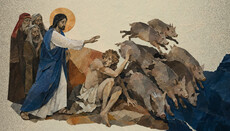
The Lord cast the demons into a herd of two thousand pigs – and the entire herd drowned. Instead of rejoicing at the miracle, the townspeople were terrified and asked Jesus to leave.
Before we talk about the pigs, let us remember the man because of whom all this happened. The Evangelist Mark tells us that he lived among the tombs, cried out day and night, cut himself with stones, and could not be restrained by anything – he broke every chain, no matter how many times people tried to bind him (Mark 5:3–5).
To those around him, the suffering man had long since become a local monster, a creature living outside the town whom it was best not to encounter alone. And this is the man Christ meets immediately after setting foot in the land of the Gadarenes.
Now shift your attention to the herd of two thousand pigs. Mark gives the number with almost accountant-like precision (Mark 5:13). On the eastern shore of the Sea of Galilee, where agriculture was barely scraping by, a herd of that size was a reliable source of income. For years, people had fed those animals, tended them, and sold them at market to make a living.
And in a matter of minutes, this hard-earned livelihood disappeared beneath the waters of the lake – all because Christ allowed the unclean spirits to enter the herd of pigs.
After witnessing the astonishing miracle, the herdsmen rush into town. The townspeople come down to the lakeshore and see the man who had lived among the tombs for years now sitting at Jesus’ feet, clothed and in his right mind. They are terrified and ask Christ to leave their region (Mark 5:17). A human life has been saved. The economy has been devastated. And the townspeople are convinced it was a bad bargain.
Where exactly did the pigs drown?
Before examining what drove the crowd’s reaction, it is worth sorting out the somewhat confusing geography. Mark and Luke speak of the “country of the Gerasenes,” Matthew of the “country of the Gadarenes,” while some manuscripts give a third version altogether – the “country of the Gergesenes.” The problem is that Gerasa lies about sixty kilometers from the Sea of Galilee, while Gadara is about ten kilometers away. Neither city could have had the steep bank from which the pigs rushed into the water.
Origen proposed a solution. He believed that somewhere on the eastern shore, opposite Galilee, there was a small settlement called Gergesa – the site known today as Kursi – where there is indeed a steep slope running down to the water. Nearby are ancient rock-cut tombs carved into the limestone. Most likely, the events took place in this small, obscure village, while the Evangelists, writing for readers abroad, associated the episode with a larger and more recognizable nearby city.
Mysterious parallels
The name given by the possessed man is also intriguing. When Christ asks his name, the demon replies, “My name is Legion, for we are many” (Mark 5:9).
A legion was a military term for a Roman formation numbering around six thousand men. To people of that era, the word carried powerful associations.
The Roman Tenth Legion was stationed in this very region for decades and later took part in the capture of Jerusalem in AD 70. Its emblem – appearing on seals, bricks, and military standards – was a wild boar. Modern biblical scholars have pointed to the striking coincidence: the possessed man identifies himself by the name of a Roman military force, while the unclean spirits are driven into pigs – animals whose image appeared on the insignia of the occupying army and whose meat was ritually unclean to Jews.
There is another noteworthy detail: the spirits beg Christ not to send them “out of the country” altogether (Mark 5:10), but merely to allow them to enter the pigs. They cling to their territory to the very end. Here we can discern a subtle parallel with an occupying army entrenched on foreign soil and unwilling to leave.
We cannot know for certain how deliberately Mark constructed this parallel, but the fact that all the details of his account fit together in precisely this way is striking.
The justice of divine logic
It is easy to dismiss the Gadarenes’ reaction as superstitious fear of the supernatural. But by now we can see that the townspeople had suffered a devastating economic loss. That enormous herd of pigs provided livelihoods for herdsmen, merchants, and middlemen throughout the neighboring cities of the Decapolis, where pig farming was commonplace among the Gentile population.
But Christ does not hesitate for a second. To Him, one tormented man, rejected by society for decades, is worth more than the economy of an entire town.
The townspeople, by contrast, might well have preferred the man to remain a madman wandering among the tombs, as long as their herd remained intact. Through this episode, God shows just how differently He and human beings value a human life.
The first missionary with no education
At the end of the story, the healed man asks the Lord to take him along, but Christ sends him back home to tell his fellow townspeople what God has done for him (Mark 5:19). Christian mission is not an escape from one’s former life into the safety of a chosen circle. It means that the healed person returns to the place from which he was once cast out – but now as a different person, enlightened and transformed.
The former outcast becomes the first preacher Christ sends to the Gentiles.
This happened long before the apostolic mission and long before the Savior commanded that the Gospel be carried to the ends of the earth. And when Christ returns to this region a little later to feed a hungry crowd of four thousand (Mark 8:1–9), we can already guess who, in the meantime, had told the local people that this Teacher could be trusted.