
The сourage to be the first: Why the Apostle Andrew chose the cross
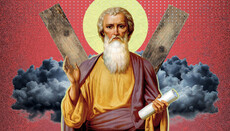
On December 13, the Church commemorates the one who was first to believe, first to follow, and first to bring us the good news of the Savior. This is a reflection on the “fisherman’s net” of the Apostle Andrew, on his astonishing sermon from the cross, and on his ability to thank God for pain.
There has long been debate about the geography of the Apostle Andrew’s preaching. Some historians call him the enlightener of the Slavic lands and claim that he ascended the hills of Kyiv. Others skeptically deny this, demanding archaeological proof.
But for us, living two thousand years later, what matters is not so much the map of his journeys as the spiritual map of his heart. What matters is the essence of the Message that sounded from his lips and changed the world.
The Apostle Andrew entered history with the name “the First-Called.” This is not merely a numerical designation in the list of the disciples. It is a characterization of his person. To be first requires a special cast of soul – decisiveness, a thirst for truth, and absolute fearlessness. It is no coincidence that the very name “Andrew” (Andreas) in Greek means “manly” or “courageous.”
Seeking the One Who takes away sin
From his youth, the future apostle burned with a longing rarely found in people engaged in hard physical labor. A simple fisherman from Galilee, he sought not a rich catch but the meaning of life. His soul thirsted for total self-renunciation for the sake of Truth.
When the stern ascetic John the Forerunner appeared on the banks of the Jordan, Andrew became his disciple. He chose the path of strict asceticism, fasting, and prayer. He listened intently to every word of prophecy about the coming Messiah, understanding that the time of salvation for the chosen people was drawing to a close. The tension of expectation reached its peak.
And then came the moment that divided history into “before” and “after.” The pointing finger of the Forerunner was directed at a Man walking by, and the words were spoken that became the foundation of our faith: “Behold, the Lamb of God, who takes away the sin of the world” (John 1:29).
Among the disciples of John there were surely doubts. Who was this Galilean? Was He truly the One? But Andrew had no doubts. He possessed a unique spiritual hearing. While others hesitated, Andrew and his fellow disciple John the Theologian believed their teacher without reservation.
Andrew’s reaction was immediate. He did not simply follow Christ – he ran to share this joy. Rushing to the house of his brother Simon (Peter), Andrew cried out at the threshold the words that became the first Christian confession of faith: “We have found the Messiah” (John 1:41). In this is all of Andrew. Having found the Treasure, he immediately calls others to share it.
“A wondrous memory of Andrew”
Saint John Chrysostom begins his encomium to the apostle with a striking metaphor: “Strong is the net of apostolic fishing; wondrous is the memory of Andrew, and wondrous the remembrance of the net which he used for fishing and for drawing the nations to the faith of Christ.”
The Gospel says very little about Andrew’s behavior during Christ’s earthly ministry.
He remains in the shadow of the more impulsive Peter. Yet, being among the Twelve, he absorbed every word of the Savior. He was learning to be a “fisher of men.”
Having received the gift of preaching on the day of Pentecost, the former fisherman set out on distant voyages – no longer across the Sea of Galilee, but across the sea of life. He passed through lands that nine centuries later would unite into a mighty state – Kyivan Rus. He enlightened pagans in the Hellenic world, fearlessly entered royal palaces and the huts of the poor, ordained priests, and built the Church where just yesterday sacrifices had been offered to idols.
His earthly path ended in Patras, a city on the shore of the Corinthian Gulf. Here he was destined to deliver his main sermon – a sermon spoken not from an ambo, but from a cross.
A word from the scaffold
The cruel ruler of the city, Aegeates, condemned the apostle to crucifixion. But what was meant to be disgrace and a public execution, Andrew turned into a triumph of faith.
The governor was struck by the zeal with which the old man went to his death. Instead of fear and pleas for mercy, he heard a hymn to the instrument of execution. “Great is the mystery of the cross,” Andrew proclaimed. “This punishment is the mystery of human renewal.”
For a pagan, the cross is a gallows, an instrument of torture, a shameful post. For the apostle, it is the “mystery of renewal.” He explained to his tormentors that through suffering God heals human nature, that death is not an end, but a door into eternity.
Andrew was crucified. But in order to prolong his torment, Aegeates ordered that his hands and feet not be nailed with iron, but bound with ropes. The calculation was for a long, agonizing death from thirst and suffocation. Yet this gave the apostle the opportunity to preach for two more days.
Thousands gathered around the cross. They listened to the living word of the martyr and demanded that the execution be stopped. Frightened by the people’s outrage, Aegeates ordered Andrew to be taken down from the cross.
And here the most astonishing thing happens. The apostle refuses. “I do not desire, while I yet live, to be taken down from the cross, for I already see my King, I already worship Him, I already stand before Him,” he says to the ruler.
The soldiers tried to untie the ropes, but their hands would not obey them, as if they had turned to stone. The apostle did not wish to descend from his personal Golgotha. The crucified preacher stretched out his arms toward heaven and cried aloud: “Lord, receive my spirit in peace, for the time has come for me to come to You and behold You, whom I have so greatly desired!”
At that moment, as the life of the saint testifies, a dazzling radiance of heavenly light enveloped the cross and the martyr. This light lasted for about half an hour. When it faded, the holy apostle had already departed to God.
The highest school of gratitude
The words spoken by Andrew the First-Called before his death contain the deepest lesson for us. It is the lesson of gratitude.
Experiencing indescribable pain in dislocated joints, suffocating under the scorching sun, he addresses the Savior: “Receive me, my Teacher, through whom I have become what I am!”
We are all taught to be polite. Secular etiquette teaches us to say “thank you” for the salt passed at the table, for a favor rendered, for a gift. We thank doctors for healing, employers for bonuses, parents for life. This is gratitude for benefits. It is natural even for pagans.
But are we capable of thanking God as the Apostle Andrew did? Thanking Him not for comfort, but for the cross. Not for success, but for dishonor.
Can we say: “Lord, thank You for being slandered; for finding myself in illness; for the world considering me an outsider and a reject”?
We are accustomed to blaming external circumstances, the authorities, enemies, the economy for all our troubles. We fiercely defend our rights and our comfort. But the feat of the Apostle Andrew asks us an uncomfortable question: will we be able, even once, to lift our eyes to heaven in the midst of sorrow and say, “I thank You, Lord, for who I am now, for through this pain You are renewing me”?
A final prayer for the persecutor
There is one more detail in the saint’s life that brings the death of the apostle close to the events of Golgotha. Hanging on the cross, Andrew did not curse Aegeates. On the contrary, he addressed him until his last breath, trying to save the soul of his executioner: “I suffer for you, because eternal destruction awaits you.”
He redeemed the sin of his crucifier with love and prayer. And this sacrifice was not in vain. The death of the apostle shook the city. The ruler’s brother, Stratocles, and his wife Maximilla, who were secret Christians, reverently took down the body of the martyr. Stratocles, like the Gospel centurion, exclaimed, “So holy a man suffers unjustly!” and renounced his brother’s inheritance, choosing poverty with Christ.
Today, in our prayers to the Apostle Andrew, we ask him to teach us the most important thing – the courage to be Christians. To be first in faith when doubt reigns around us. To be fearless when the world threatens with persecution. To be grateful when we want to grumble.
And just as he once united scattered peoples with his “net,” so today we are called to unite in Christ. The Apostle Andrew teaches us that there are no “ours” and “theirs,” no Greeks and Jews – there are only those who have found the Messiah and those who are still seeking Him. And our task is not to hide this discovery, but, like Andrew, to cry out to everyone we meet: “We have found Him! Come and see.”