
“Picaso”: Eve’s Dialogue with the Devil (conclusion)
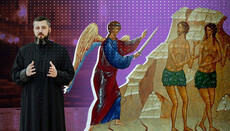
Excerpts from Andrey Vlasov’s book “Picaso. Part One: Slave.” Episode 25.
Time: 1992
Place: Kyiv
Characters: Fr. Lavr, seminarians
“But where is the sin in that? There was no commandment saying: ‘Do not speak with the serpent.’”
“The sin lies in the fact that a person begins to take interest in the sinful provocation, turns his attention toward it, and accordingly becomes distracted from good thoughts, from prayer, from remembrance of God. Remember, brethren, the first and greatest commandment: ‘Thou shalt love the Lord thy God with ALL thy heart, and with ALL thy soul, and with ALL thy mind.’ And the second commandment: ‘Thou shalt love thy neighbor as thyself.’
“Eve ought to have loved, thought about, and communed only with God and Adam, her neighbor – that is, the one closest to her. But the serpent was not Eve’s neighbor. Yet here she abandoned her thoughts of God and of Adam, her husband, and began conversing with the serpent.”
Fr. Lavr fell silent, as though reflecting.
“When I was studying at the Moscow Academy, we had a teacher who loved joking,” – everyone knew that Fr. Lavr himself disliked joking, especially on theological subjects. “And while explaining this episode to us, he said: ‘Imagine the Garden of Eden – beautiful trees, birds singing, the sun shining, everything fragrant. Eve is walking through the garden, admiring it… Everything is wonderful… And then – imagine this! Some viper crawls up to her and starts speaking in a human voice…’”
The students burst out laughing.
“…Any woman would have been terrified and run straight to her husband.” Of course, that is exaggerated, but… the point is that she should not have been speaking with the serpent. The holy fathers say that experienced ascetics may accept a sinful thought and begin conversing with it in order to expose it and drive it away in shame. But beginners, which we are, absolutely must not do this, because it will not be we who conquer the thought, but most likely the thought that conquers us.
“So what should a person do if he has accepted a sinful thought and begun conversing with it? At every stage of sin, brethren, there is one universal weapon: flee to God in repentance and prayer. But at this stage one can still resist the sin mentally, opposing it with pious reasoning. Yet I repeat, the safest course is to turn to God and to one’s spiritual father, if such an opportunity exists.
“Do not be self-confident, brethren. The devil is already thousands of years old, and to outargue him is exceedingly difficult. Thus, in paradise, once he saw that our foremother fearlessly turned her attention toward him and had moreover incorrectly retold the commandment, he struck her with the words: ‘Ye shall not surely die: for God doth know that in the day ye eat thereof, your eyes shall be opened, and ye shall be as gods, knowing good and evil.’
“First, he destroys the fear of death and says: ‘Ye shall not surely die.’ And incidentally, he repeats the commandment absolutely accurately – only in reverse. And now, brethren, consider that the evil one repeats these same words to every one of us to this very day: ‘You shall not die!’ To all the calls of God’s prophets, apostles, saints, pastors of the Church, and of Christ Himself – ‘People, repent of your sins and keep the commandments’ – the devil says: ‘No, you shall not die!’ And people believe him; they are not afraid.
“And second, he portrays God as jealous. God supposedly fears that human beings will become like gods. Yet if that had truly been the case, God simply would not have caused the tree of knowledge to grow in paradise.
“And third, the evil one seduces Eve with the prospect of quick and easy deification. How can one not recall Christ’s words: ‘Enter ye in at the strait gate: for wide is the gate, and broad is the way, that leadeth to destruction, and many there be which go in thereat: because strait is the gate, and narrow is the way, which leadeth unto life, and few there be that find it.’
“Notice, brethren, that the serpent says and does nothing more. He does not tell Eve: pluck the fruit. He has already injected his poison into her soul and waits to see what happens next.
“And next comes the following stage in the development of sin – consent, or delighting in the thought. This is when our senses begin to delight in the prospect of committing the sin. Sin appears pleasant and sweet to us. The struggle is still taking place in the soul; our will has not yet inclined itself toward committing the sin, but the senses have already begun to delight in it.
“This state of Eve is described in the words: ‘And the woman saw that the tree was good for food, and pleasant to the eyes, and desirable to make one wise.’ What immediately stands out here, brethren, are the words that the woman saw that the tree was good for food.”
“And why does that stand out?”
“Because before this only God said what was good and what was not good. Do you understand? Only God can call something good or bad. That is not given to man. Remember how God says of His creation that it is very good. And of Adam He says that it is not good for man to be alone. Only God! But here the woman appropriated to herself the divine right and saw that the tree was good. Do you see how the pride we spoke of reveals itself in her soul?
“So what should a person do if he has already been wounded by sin and has reached the stage of consent? Here the struggle is sometimes very painful. The will has not yet inclined itself toward sin, but the senses have already begun delighting in it. At this point one must flee to prayer, cry out to God, beg for help, pray to the saints. It is very good if one can reveal this inner condition to one’s spiritual father and ask for his prayers.
“There is yet another remedy. By some desperate effort of the will, do the exact opposite of what the sinful thought urges you toward. For example, an opportunity for unjust gain presents itself to you, but instead you go and distribute your possessions to the poor. You are angry with your brother and want to insult him, but instead you go and do him some kindness. ‘Depart from evil and do good,’ says holy David the Psalmist.
“Misha, who until this point had been hastily trying to take notes on what Fr. Lavr was saying, set down his pen and stared absently out the window. His thoughts drifted into the recent past. Fr. Lavr’s voice now reached him as though from far away.
“Then, brethren, comes captivity, when a person’s will together with his senses inclines itself toward sin. And after that – decision. The decision to commit the sin in deed.”
“And what is the difference, Fr. Lavr? In captivity the will inclines itself toward sin, and in decision it does too.”
“The difference is that when a person is captivated by a sinful thought, he says to himself, as it were: ‘It would be good if I did such-and-such,’ but when he has made a decision, he says: ‘I WILL do such-and-such.’ In the latter case, only external circumstances can prevent him from committing the sin. For example, he decides to steal something, but the door of the house is locked with two bolts. Yet the sin itself has already been committed in the heart and is subject to condemnation by God’s judgment.
“The only advantage of this ‘stage of decision’ over a sin committed in deed is the absence of the consequences of sin. Visible consequences. And then, after the decision, comes the sin itself. In Eve’s case these three stages – captivity, decision, and deed – are described almost together: ‘And she took of the fruit thereof, and did eat.’
“That’s it! The sin was committed!” Fr. Lavr spoke with anguish and sorrow, nearly to the point of tears. “Brethren, even after plucking the forbidden fruit, she could still have stopped. She could have become frightened or something else. It happens that God, at this final moment before the commission of a sin – yes, yes, perhaps in the soul it has already occurred – but at the final moment, at the final line, God often stops a person and says to him: ‘Stop! Do not do this!’ It can happen through anything – circumstances, events, I do not know, the actions of other people. But the heart recognizes that this is the voice of God calling it to stop.
“Misha could no longer restrain his tears. He ran out of the classroom without even asking permission. Fr. Lavr watched him go with a somewhat surprised look.
“And so, brothers, at this final moment one must find within oneself the strength, contrary to everything – contrary to the senses already delighting in the sin, contrary to the will which has already made its decision, contrary perhaps to all external circumstances and even to people who are already expecting you to commit the sin – one must stop!” Fr. Lavr pronounced these words with unusual emotion for him, loudly and fervently.
Then he seemed suddenly to wilt and finished quietly:
“Eve did not stop…”
He walked silently around the classroom. The seminarians also remained silent.
“But that is not all. When a person falls into sin, that is not the end. Never does a person, having sinned, stop in his fall. He always,” – Fr. Lavr emphasized the last word with special intonation – “tries to draw his neighbor into sin as well: ‘And she gave also unto her husband with her; and they did eat!’
“We have spoken about how Eve, infected with pride, wanted to become a god before Adam. So it would seem: she ate, supposedly became a god, while Adam had not yet. Then why did she give it to him? But you see, brethren, even pride itself is overpowered by the desire to lead one’s neighbor into sin. A person who has sinned cannot bear to live alongside people who are pure, who have not sinned. The sinner hates the righteous man simply because the righteous man has not committed the evil which he himself committed. He cannot live beside him – it is simply unbearable for him.”
Fr. Lavr approached the teacher’s desk and again took up his notebook.
“I copied out a passage here from the Wisdom of Solomon. I will read it in Russian so that it is clearer for you: ‘Let us lie in wait for the righteous man, because he is burdensome unto us and reproaches us for sins against the law; he is a rebuke to our thoughts. He is grievous unto us even to behold, for his life is unlike that of others, and his ways are different; he regards us as vile and avoids our ways as filth. Let us test him with insult and torment; let us condemn him to a shameful death.’
“You hear that, brethren? ‘Let us condemn him to a shameful death.’ A sinner cannot live beside a righteous man.”
He sighed, looked at his watch, then sighed again.
“On that, brethren, we shall stop today. It is a pity we did not have time to discuss the consequences of the Fall. But if it be the will of the Lord, next time. Let us pray.”
To be continued…
The previous episode can be read here.