
The story of the honey brotherhood
The Mogilev Brotherhood began with members pooling money to brew honey drinks for feast days – and eventually grew to have its own printing press.
In 1619, the royal court heard a case against residents of Mogilev. The prosecutor portrayed the townspeople as people who had forgotten their place. The keys to the churches, he claimed, were “not in the hands of the priests, but of the townspeople,” and a priest could go in to serve only when the townspeople ordered the doors unlocked.
The prosecutor gave an accurate description of how Orthodox life in Mogilev was organized at the turn of the 16th and 17th centuries. The church was run here by merchants, craftsmen, and members of the city council. The brotherhood, which would later be called the Epiphany Brotherhood, was their union.
The prosecutor gave an accurate description of how Orthodox life in Mogilev was organized at the turn of the 17th century. Merchants, craftsmen, and members of the city council effectively ran church affairs. The brotherhood that would later become known as the Epiphany Brotherhood was their association.
Honey contributions for feast days
A charter issued in 1561 allowed the townspeople of Mogilev twelve times a year to pool their resources to brew mead for feast days. The wax was used to make candles. The proceeds from the festive meals were put to good use as well: the money went to the church, the hospital, and alms for the poor.
In 1589, the king granted a privilege to the Furriers’ Brotherhood, an association of fur craftsmen. The charter allowed every townsman engaged in the “furrier’s craft” to come to the brotherhood house and discuss the needs of the church and hospital. Even Catholic priests were among the brotherhood’s guests.
Mayors and councilmen on the brotherhood rolls
Sources differ on when the Mogilev Brotherhood was founded. Some date its beginnings to 1588–1589 and a charter issued in Orsha by Patriarch Jeremiah. Unfortunately, the text of the charter has not survived. The king officially recognized the brotherhood in 1597. Various historians also cite 1590 and 1595.
Initially, the brotherhood was based at the Monastery of the Savior. It was not given the name Epiphany Brotherhood until 1633.
Its members were primarily mayors, vogts, lay judges, and councilmen – in other words, the entire upper echelon of municipal government. A 1752 document refers to it as the “Brotherhood of the Mogilev Magistrate.”
The Mogilev Brotherhood was a union of townspeople who held in their hands the city treasury, the court, and access to the city gates.
Cannons against the archbishop
On October 9, 1618, Uniate Archbishop Josaphat Kuntsevych arrived outside Mogilev. The townspeople locked the gates, positioned cannons on the towers and ramparts, and came out to meet him carrying muskets and pikes and bearing their guild banners. They threatened to open fire on the archbishop. He turned back.
The townspeople also wrote to the voivode, saying that they had not built so many churches only to be dragged to divine services on ropes. The churches had been built with their money, and the townspeople believed it was for them to decide who would serve in them.
On March 22, 1619, however, a court sentenced the ringleaders of the resistance to death, although the sentences were never carried out. The city paid a fine, and all its churches and monasteries were handed over to Kuntsevych. Mogilev’s Orthodox Christians were forced to pray in a field beyond the city limits. Newborns had to be taken ten miles or more outside the city to be baptized.
Kuntsevych was killed in Vitebsk in 1623. An investigative commission accused the townspeople of Vitebsk of conspiring with others, including residents of Mogilev. However, there was insufficient evidence to establish the brotherhood members’ involvement.
How much should you put in the brotherhood chest?
The brotherhood managed its money carefully. Its 1597 charter left the amount of the membership contribution to each member’s conscience. Everyone put into the common chest, or skrynka, “whatever he wishes, according to his will and means.” The main brotherhood’s charter set no fixed fee, although individual guild brotherhoods, such as the Furriers’ Brotherhood, did have one. Alms were distributed on Sundays, and once a year the members held a general collection.
The king exempted the brotherhood house from taxes and from the obligation to quarter soldiers, and allowed its members to brew mead there three times a year. The proceeds supported a school where poor children and the children of brotherhood members studied free of charge. Around 1601, Uniate Archbishop Gideon Brolnytsky complained to the king that the school was producing preachers who denounced the Union. His complaint has survived and vividly illustrates how students there were taught to defend Orthodoxy.
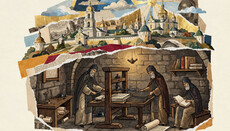
After 1633, the king permitted the brotherhood to maintain a monastery, a school of liberal arts, and a printing house with books in Russian, Greek, Latin, and Polish.
City reference works credit Mogilev printers with publishing a Service Book in 1616 and a Didactic Gospel in 1619, but the first book known with certainty to have come off the brotherhood’s press was published in 1636.
Metropolitan of Kyiv joins the brotherhood
In May 1620, the Mogilev Brotherhood became one of the first to receive a charter in Kyiv from Patriarch Theophanes of Jerusalem. Fifteen years later, in 1635, Metropolitan Peter of Kyiv visited the city and enrolled as one of the brotherhood’s “patrons.” His name now stood alongside those of the mayors and councilmen.
From beginning to end, the Mogilev Brotherhood remained an institution belonging to the city’s townspeople.
The townspeople preserved Orthodoxy in Mogilev during the years when their churches had been taken from them. What had grown out of their modest pooled contributions outlasted the cannons on the ramparts and the court sentences: a free school for poor children and the primer from which generations in Mogilev first learned to read.