A cosmic dream and the geometric vision of a Spanish genius
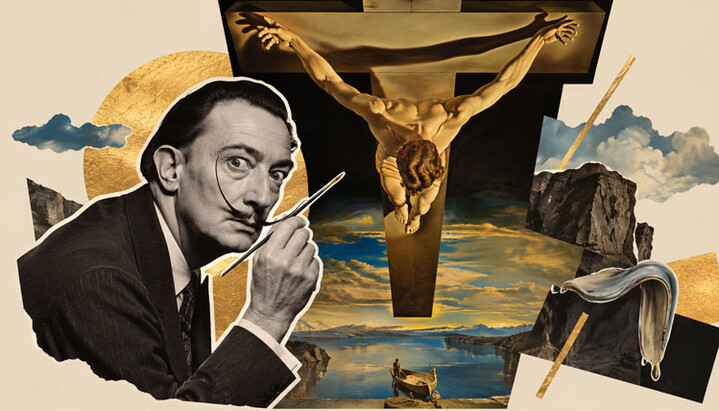
A tiny sketch by a 16th-century Spanish monk inspired a monumental painting in which cosmic silence meets the mystery of true holiness.
In the museum of the Convent of the Incarnation in Ávila, Spain, a simple reliquary of gilded wood holds an extraordinary treasure: a translucent sheet of laid paper no larger than the palm of a hand. A few delicate strokes of ink reveal the contorted figure of the Crucified Christ. We see Him from an unusual perspective – from above and slightly to the right, as though looking through the eyes of One gazing down upon the earth from the heights of heaven.
The drawing was made sometime between 1574 and 1577 by St. John of the Cross, who was then serving as spiritual director to the Carmelite nuns. According to monastic tradition, the saint took up his pen after an intense experience of prayerful contemplation. He left not a single word explaining what he had drawn.
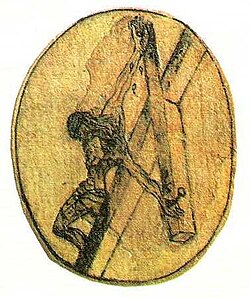
Art historians still debate whether St. John was recording a mystical revelation or simply sketching a small tabletop crucifix from an unusual angle. Whatever its origins, the drawing has survived.
Its spare ink strokes convey the terrible weight of the sagging body, the arms strained against the nails, and the bent knees. Christ's head hangs so low that His face is almost entirely hidden.
The geometry of a cosmic dream
Centuries would pass before that tiny ink drawing inspired an oil painting more than two meters tall.
In the mid-20th century, a Spanish Carmelite priest, Fr. Bruno de Jésus-Marie, showed Salvador Dalí a photographic reproduction of the drawing from Ávila.
The artist was then immersed in what he called "nuclear mysticism" – an attempt to reconcile the discoveries of modern science with the metaphysical mysteries of faith.
Dalí described an extraordinary inner experience:
"In 1950, I had a 'cosmic dream' in which I saw in color an image that, in my dream, represented the NUCLEUS OF THE ATOM. Later, this nucleus acquired a metaphysical meaning, and I came to regard it as 'the very unity of the universe' – CHRIST!"
Studying the reproduction Fr. Bruno had shown him, Dalí discerned an underlying mathematical precision. He later wrote on a preparatory sketch:
"When, thanks to the guidance of Father Bruno (a Carmelite), I saw the CHRIST drawn by St. John of the Cross, I geometrically resolved the triangle and the circle that 'aesthetically' summed up all my previous experience."
The triangle emerged from the lines connecting the top of the Cross to Christ's outstretched hands, while the circle embraced the Savior's bowed shoulders, becoming a symbol of the universe held beneath His protection.
A beautiful Christ without blood or thorns
In 1951, Dalí completed his painting, measuring 204 by 115 centimeters.
Anyone standing before it immediately notices the striking difference between the stark drawing from Ávila and the solemn grandeur of the finished oil painting.
There are no nails, no pierced side, no crown of thorns.
In his early studies, Dalí had considered depicting drops of blood as white jasmine blossoms and crimson carnations. Ultimately, however, he abandoned every visible trace of Christ's earthly suffering.
His aim was to express the victory over death through transfigured beauty.
In a letter to a Scottish art historian, Dalí explained:
"My principal concern was that my Christ should be beautiful, as the God that He is."
To capture the anatomy of a body suspended in midair, Dalí took an unusual approach.
At a studio in Beverly Hills, Hollywood stuntman Russell Saunders was suspended from the ceiling by straps. The professional athlete, who worked as a stunt double in films, posed for $35 a day, allowing Dalí to study the natural tension of the muscles. The contours of the figure were then transferred to the canvas using a charcoal grid.
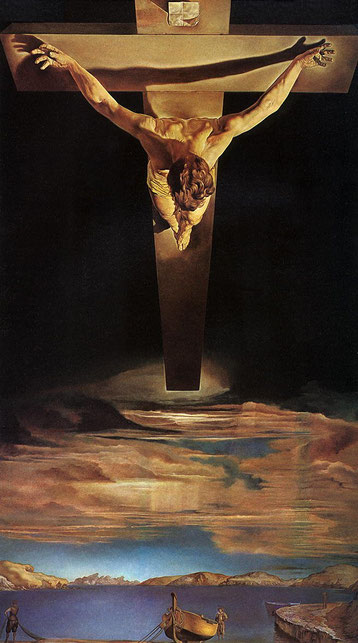
A closer look at the lower part of Christ's body reveals another subtle detail: His feet are slightly smaller than natural proportions would suggest.
Dalí deliberately altered the perspective to heighten the sensation of an immense upward movement, drawing the eye toward an infinity beyond the visible world.
Far below the Cross lies the tranquil Catalan bay of Port Lligat, where the artist made his home.
Near the golden waters stand fishermen modeled on figures from paintings by the Le Nain brothers, while a boat is rendered with the delicate transparency of Velázquez.
The Savior's bowed head is turned toward the very shore where Dalí spent his days.
The sandstone attack in Glasgow
The painting's journey through the art world was anything but peaceful.
In 1952, Tom Honeyman, director of Glasgow's museums, purchased the work directly from Dalí, along with its copyright. Scottish newspapers spent years debating whether the acquisition had been justified. Yet decades later, the painting would be named the nation's favorite work of art.
Then, in the spring of 1961, disaster struck. A 22-year-old visitor climbed over a wooden barrier in the exhibition gallery and hurled a heavy piece of sandstone at the canvas. The stone pierced the painting. The attacker then tore at it with his hands, leaving a jagged gash almost eight feet long.
Restorers faced an extraordinarily difficult task.
They managed to repair the damaged paint layer so carefully that the scars are now visible only under raking light. The painting was subsequently protected behind acrylic glazing.
A meeting four centuries in the making
In the summer of 2024, history came full circle.
At the Church of San Marcello al Corso in Rome, as part of preparations for the Vatican's Jubilee Year, the two works were displayed together for the first time. The tiny sheet of paper from Ávila and the towering canvas from Scotland finally stood side by side.
Pilgrims lined up in long queues to see this silent dialogue.
On one side was the solitary prayer of a monk in his cell, captured in a handful of ink strokes on a scrap of paper.
On the other stood an artist's attempt to comprehend the sacrifice of the Cross through the laws of perfect harmony and the stillness of the cosmos.
In 2026, Glasgow's Kelvingrove Museum introduced a redesigned space for the painting.
There, four minutes of documentary footage alternate with four minutes of complete silence.
And in that silence, each visitor is left alone before the Cross suspended in an unearthly blue expanse – a Cross that brings together a monk's revelation and an artist's lifelong search for the divine.