The invisible sketch of Master Rogier
A 15th-century Netherlandish master reimagined an ancient tradition about the Evangelist, transforming a devotional image into a profound reflection on the artist's craft.
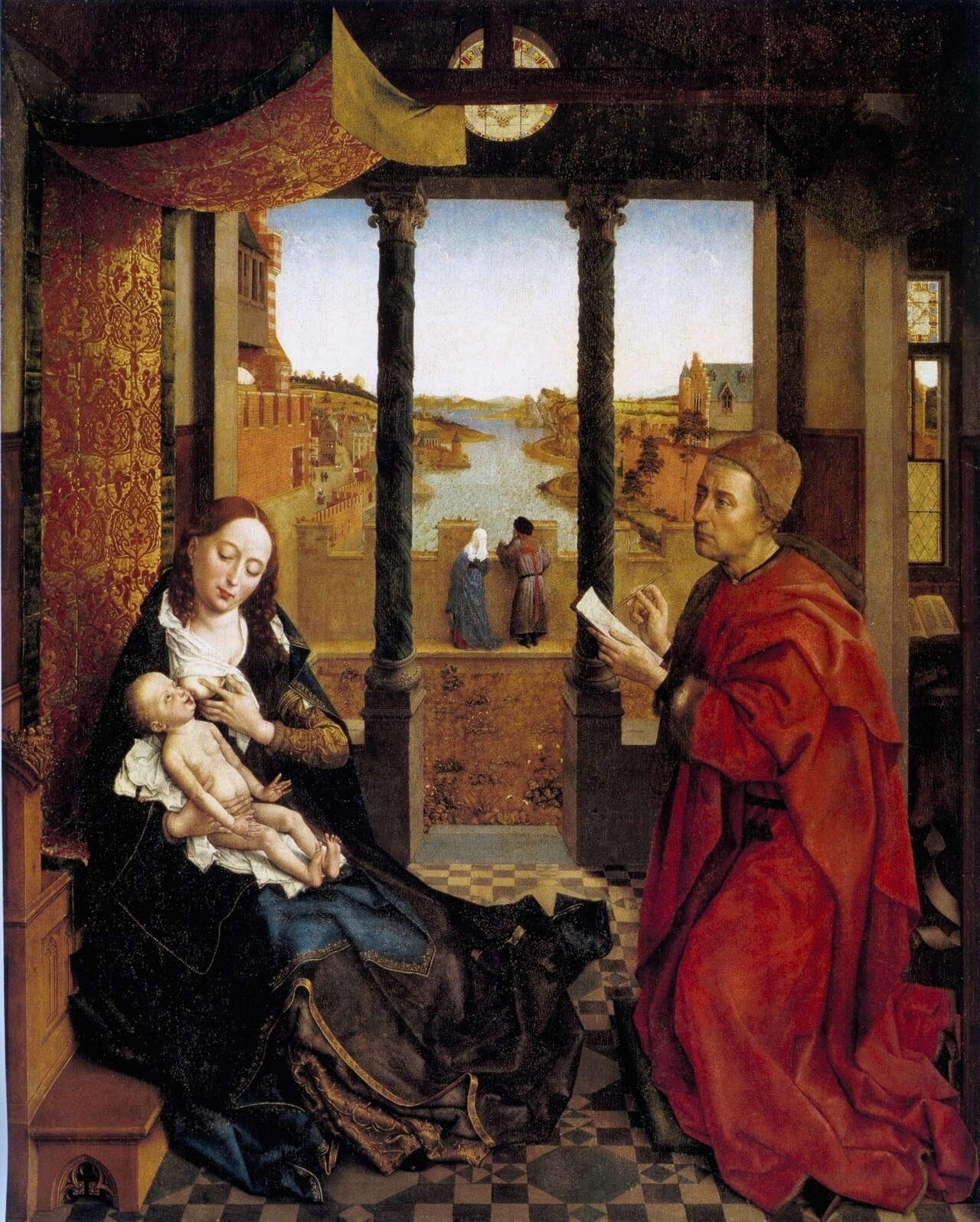
The Museum of Fine Arts in Boston houses an oak panel painted in tempera and oil nearly six centuries ago. At the center of a light-filled room, the Holy Apostle and Evangelist Luke kneels before the Most Pure Virgin Mary. In his hands is no familiar icon painter's brush – only a silverpoint, a metal stylus used for drawing. With it, the saint traces the finest gray lines across a prepared sheet, carefully capturing the Virgin's features from life.
The painting was created between 1435 and 1440, around the time Rogier van der Weyden was appointed official city painter of Brussels. The Brussels master took the familiar tradition of St. Luke being the first to portray the Mother of God and set it in the intimate domestic surroundings of a 15th-century Netherlandish home. The Virgin sits on the lowest step before a throne beneath an elaborate canopy, tenderly nursing the Christ Child, while the holy artist carefully sketches Her likeness.
The panel entered the Boston museum collection in 1893. Research has confirmed its authenticity. Analysis of the wood showed that the oak for the panel was felled around 1410. The timber underwent a long seasoning before reaching the painter's workbench.
Whose face is hidden behind the ancient evangelist?
Art historians have long been struck by the careful rendering of St. Luke's face. Some scholars believe that the artist may have portrayed himself in the guise of the Apostle. For Rogier van der Weyden, who left no signatures on his finished paintings, this would have been an unexpected way of making his presence known.
The artist originally had a rather different composition in mind. In the preparatory drawing, the Evangelist's head was level with the Virgin's face, but Rogier later raised it slightly. He had also planned to include an angel hovering above the Mother of God, only to remove the heavenly messenger from the final composition. None of the later copies of the painting, now housed in museums in Munich and Bruges, show evidence of such revisions.
A secret study and figures by the river
Netherlandish painting always demands slow reading from the viewer. Behind Saint Luke's back, a tiny room can be seen. On the wooden floor an ox lies still – the symbol of the evangelist – and beside it lies an open book. A thin scroll can be seen in the ox's mouth.
.jpeg)
Farther back, beyond a low stone parapet, stand two small figures. A man and a woman, their backs turned to the viewer, gaze silently toward the winding river and the distant city. Their identities remain unknown. In an earlier version of the composition, the hood worn by the figure on the right was scarlet, but the artist later painted over it in black.
This detail – the river, the stone barrier, and the figures seen from behind – is a deliberate artistic homage. Rogier was paying tribute to The Madonna of Chancellor Rolin, painted by the brilliant Jan van Eyck.
But while Jan created his painting for a prominent official, Rogier produced his work for his own guild. In 1520, the celebrated German artist Albrecht Dürer apparently saw the painting in Brussels, leaving behind brief notes about his visit.
The eastern brush and the western silverpoint
In the East, the ancient tradition was recorded as early as the sixth century by the historian Theodore the Reader, who maintained that the first icon of the Mother of God had been painted by the Holy Apostle and Evangelist Luke.
In Byzantine and Orthodox tradition, St. Luke is consistently portrayed as a solemn icon painter. A tall easel stands before him, and he holds a brush, rendering the holy face in tempera and gold. A similar composition appears in a 16th-century Cretan icon and in an early painting by the young El Greco.
In the West, Rogier van der Weyden brought about an artistic revolution. Rather than simply reproducing ancient models, he approached the subject as an artist of a new era, beginning his work with direct observation and a sketch drawn from life.
The Western painter dispenses with the gold background and places the Holy Family inside an ordinary room. Yet this does nothing to diminish their holiness.
Rogier shows that honest labor, the careful line of the silverpoint stylus, and human attention to detail become a form of service to God.
The painting was never signed. For the early Netherlandish masters, humility remained an important personal virtue. Yet Rogier left behind something more revealing than a signature – his unmistakable artistic hand, bringing together the painter's craft, the memory of the Evangelist, and a profound sense of standing in reverence before the majesty of God's creation.