Ukraine: From Christianity to a national religion?
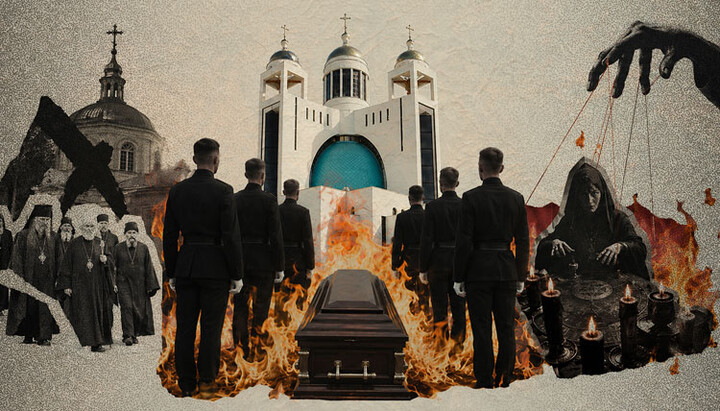
A political religion is emerging in Ukraine. Photo: UOJ
Remember how, as a presidential candidate, Volodymyr Zelensky criticized Petro Poroshenko for his church policy and his “Tomos tour”? Remember how, immediately after winning the election, Zelensky demonstratively distanced himself from public displays of religiosity: “Don’t look for me in church. Look for God!”?
Today, the situation is exactly the opposite. The authorities are paying a great deal of attention to sacred themes. And the picture that emerges is a grim one: on the one hand, the persecution of the UOC and attempts to ban it; on the other, the creation of a national pantheon, preparations for a law on national shrines, elaborate ceremonies involving the remains of highly controversial historical figures, and the use of mysteries that bear an unmistakable resemblance to pagan rites.
Modern Ukrainian mysteries
In August 2026, the remains of Yevhen Konovalets, founder of the OUN, were returned to Ukraine after 88 years in Rotterdam. On August 11, they were exhumed at Crooswijk Cemetery, and on August 13, they were brought to Ukraine. The coffin was then taken to Kyiv, to the main cathedral of the UGCC.
What happened next clearly went beyond Christian burial traditions.
At night, a restored Austin armored car from the era of the Ukrainian Revolution pulled up to the UGCC cathedral. The coffin rested on an artillery carriage. Beside it stood a three-inch gun dating from 1917. Soldiers holding torches lined the road, while bowls of fire burned around them.
The Third Army Corps itself described the ceremony as a “mystery of continuity.” The fire symbolized the passing of the struggle from earlier generations of the Ukrainian nationalist movement to today’s soldiers. Then, outside the doors of a Christian church, the servicemen recited the “Prayer of the Ukrainian Nationalist.”
The “Prayer of the Ukrainian Nationalist” is one of the core traditions of the 12th Azov Special Forces Brigade. But the prayer is addressed not to God, not to Christ, not to the Mother of God, and not to the saints. It is addressed to the nation itself, which is called “holy,” “most holy,” and “life-giving” – epithets that in the Christian tradition are reserved exclusively for God or, in a qualified sense, for the Mother of God.
When the object of worship and glorification is not God but an earthly reality – a people, a nation, or a state – theology defines this as a form of idolatry.
In this “Prayer,” Ukraine is effectively placed in the position of God. And this is not merely our interpretation.
In September 2024, Azov officer and PhD in philosophy Vladyslav Dutchak gave a special lecture at KyivBookFest on the history and meaning of this prayer. He said: “In his prayer, the nationalist addresses not a deity, but the most precious thing he has – Ukraine.”
Nor was what happened outside the UGCC cathedral anything extraordinary in this context. The “Prayer of the Ukrainian Nationalist,” accompanied by the flames of torches, is recited by Azov members every year during a special annual “Day of the Dead” ceremony. Azov’s official website explicitly calls it a “mystery.”
This is an openly pagan rite borrowed from the rituals of ancient Scandinavian epic tradition: Azov members burn a drakkar (a Viking longship – Ed.), in which the fallen symbolically depart for Valhalla (in ancient Norse pagan mythology, the realm of the dead where warriors slain in battle go – Ed.).
While reciting the “Prayer,” participants in the mystery use the Tiwaz/Týr symbol (ᛏ) – an ancient Norse rune associated with the god Týr. They also raise a burial mound topped by a sword driven into the ground – something experts interpret as a symbol of worship of the Scythian god of war, to whom, according to Herodotus, the Scythians offered human sacrifices.
Earlier, in 2017, the “Prayer of the Ukrainian Nationalist” was recited at the Azov Regiment’s base in Urzuf during a rite honoring the ancient Slavic god Perun, whom representatives of the regiment called the “forefather” and protector of the garrison. The press service reported that weapons would subsequently be consecrated at this “sacred place” before combat missions.
On August 18, 2026, the remains of OUN founder Yevhen Konovalets were reburied at the National Military Memorial Cemetery. The memorial service was conducted by UGCC head Sviatoslav Shevchuk.
What is the UGCC’s role?
The ceremonial events surrounding Yevhen Konovalets took place at the main church of the Ukrainian Greek Catholic Church, which makes the question of the pagan forms used in these ceremonies particularly acute.
The prayer addressed not to Christ but to Ukraine, the fiery “mysteries of continuity,” the touching of flags to Konovalets’ remains to receive a blessing – all of this took place within the broader context of a Greek Catholic church ceremony. How compatible is any of this with Christian tradition?
During the memorial service for Konovalets on August 16, 2026, UGCC head Sviatoslav Shevchuk called on the faithful to pray to the Lord for “the forgiveness of his sins.”
But this only makes the contrast more striking: inside the church, people pray to God to forgive the deceased man his sins, while nearby another “prayer” is being recited in which Ukraine itself is called Most Holy, and contemporary military banners receive a “symbolic blessing” from Konovalets’ remains to continue the struggle.
In other words, Konovalets is presented here as part of the deity called “Ukraine” and himself becomes an object of veneration.
Occultism or the sacralization of politics?
The current efforts by the authorities to sacralize the Ukrainian nation while simultaneously persecuting the Church cannot help but raise questions.
Indeed, plans to bury national heroes at the Kyiv-Pechersk Lavra suggest only one thing – an attempt to replace the Venerable Fathers of the Caves and other saints of the Church with these new figures in the popular consciousness. But how could the very idea of such a substitution arise? Who could have initiated it?
Those closest to Zelensky have repeatedly faced accusations of an interest in occult practices. The most substantial evidence emerged in May 2026, when a prosecutor from the Specialized Anti-Corruption Prosecutor’s Office read aloud in court correspondence between Andriy Yermak and a female astrologer saved in his phone as “Veronika Feng Shui Office.” Judging by the messages, Yermak consulted her, among other things, before making personnel decisions involving appointments to senior government positions.
This prompted some bloggers to claim that state decisions in Ukraine are being made by fortune-tellers and sorcerers.
Added to this are less substantiated but widely discussed stories. Former presidential press secretary Yuliia Mendel claimed that people in Yermak’s circle had invited “magicians” from Israel, Georgia, and Latin America and practiced rituals in cemeteries. According to some reports, sand taken from cemetery grounds was also used in the construction of the Dynasty complex associated with this circle.
Of course, all of this remains fairly fragmentary information and does not yet provide sufficient grounds for any definitive conclusions. But the overall picture is, at the very least, troubling.
We are not claiming that the authorities are deliberately transforming Christian Ukraine into a semi-pagan or occult state – there is still not enough evidence to make such a claim. But the picture that has already emerged in the country today does allow us to speak of a deliberate sacralization of state politics.
Emilio Gentile: the sacralization of politics
One of the leading scholars to study the phenomenon of the sacralization of politics is Italian historian Emilio Gentile. In 2003, he received the University of Bern’s Hans Sigrist Prize, and his best-known book on the subject is Politics as Religion.
Gentile argues that politics can acquire a religious dimension even without belief in God. The object of sacralization may be an entirely earthly reality – a nation, a state, a party, or a class. Myths about the past are constructed around this reality, heroes emerge, obligatory texts, symbols, and rituals are created, and loyalty to it becomes a moral absolute for which a person is prepared to sacrifice both himself and others.
Viewed from this perspective, the various mysteries and ideologies described above fit the pattern.
According to Gentile, prayers, rituals, and hero cults are merely the beginning of a process that gradually passes through several stages. Sacralized symbols cease to coexist with other values and begin to displace them. The sacralized community becomes the measure of good and evil, while disagreement with it ceases to be merely a different point of view and becomes heresy – and the dissenter becomes an enemy of the people and an apostate.
The state moves from governing its citizens to molding the “right kind of person” through mandatory myths and rituals, while any doubt about the sacred status of the nation is harshly persecuted.
At its culmination, such a political religion begins to sacralize violence itself: struggle, war, and self-sacrifice cease to be seen as tragic necessities and instead become instruments of “moral purification” and the rebirth of the community.
Conclusion: political religion and the Church
Such a political religion does not necessarily have to destroy churches. According to Gentile, it can coexist with a historical religion by incorporating it into its own mythological system and assigning it a subordinate, auxiliary role.
The Church remains useful as an institution that participates in glorifying the heroes the state requires, supports the national myth, and observes the prescribed rituals. Judging by appearances, both the UGCC and the OCU are quite comfortable with such a role.
But this also points to one of the reasons why the UOC so stubbornly resists the authorities’ attempts to impose their demands on it and remake it according to their own design.
Ultimately, this could force the UOC to agree to become an instrument for promoting and sacralizing the state policy of the day – to accept Ukraine being placed where Christ should be, to accept people living by the Nationalist Decalogue instead of the Ten Commandments of the Bible, and so on.
A Christian can be a law-abiding citizen of his country, but he cannot offer religious worship to anyone other than God.
Christ’s words on this point are uncompromising: “Worship the Lord your God, and serve Him only” (Matt. 4:10).
Read also
Yelensky’s plan: Why is DESS demanding what the UOC has already done?
DESS is demanding that the UOC take steps it has already taken, while offering no assurance that further demands will not follow. What is behind Yelensky’s ultimatum?
Why OCU hierarchy lacks canonical ordination: what Local Churches say
The OCU head refuses to address invalidity of his ordinations. But almost all Local Churches speak of it – even those that recognized the OCU.
Why nation-first advocates do not call for peace
Ukraine’s population is declining by nearly one million people a year, and experts are warning of the nation’s demographic extinction. Yet the leaders of the Orthodox Church of Ukraine (OCU) and the Ukrainian Greek Catholic Church (UGCC) continue to call for war and mobilization.
The deception that decided the fate of the Tomos
In 2008, the "Filaret problem" derailed Yushchenko's plan. In 2018, Poroshenko solved it in just one hour – with a police escort for the Greeks and verbal promises to Filaret.
Lawyers in the crosshairs: How UOC is being stripped of its right to defense
Activists harass UOC lawyers outside courthouses, call them “traitors” on air, and promise them a “warm welcome” at hearings. The Church’s right to a legal defense is at stake.
How to respond to persecution: Lessons from St. Silouan the Athonite
The Church can and should be defended, but without malice. Why love for persecutors is not weakness but the only way to preserve the Spirit of Christ in the midst of the struggle.