
Exarch–martyr: How Nicefor (Parasches) was killed for his courage
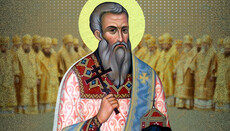
Warsaw, 1597. A Greek is put on trial for espionage. There is no evidence – but he will be imprisoned anyway. He won a church court case, and by doing so signed his own death sentence.
There are moments in history when you realize: a man is killed not because he did something wrong, but because he did something too well. Hieromartyr Nicefor (Parasches–Cantacuzenus) fell into exactly that trap.
He arrived in the Polish–Lithuanian Commonwealth in the autumn of 1596 as protosyncellus – the first deputy of the Ecumenical Patriarch. He did not come to wage war, to intrigue, or to seize power. He came to preside over the Church council in Brest, where the fate of Orthodoxy in that land was to be decided.
He did his work brilliantly. He convened a lawful council, examined the case of the Brest Union, and signed the decision deposing the apostate bishops Potey and Terletsky. The canonical procedure was legally impeccable and theologically precise.
And that signature became his death sentence.
As long as the Orthodox resisted the Union on their own, it could be dismissed as the rebellion of a dark crowd, the mutiny of ignorant peasants who did not grasp lofty political matters. But when a representative of the Ecumenical Patriarch arrives, gathers a lawful council, and issues a ruling – that is a different level altogether. It means the Union is rejected not by “marginals,” but by the entire Orthodox world.
If that signature could not be annulled, the Union would remain what half the country already believed it to be – a church crime.
Legally annulling the signature was impossible. Saint Nicefor had acted strictly according to the rules. That left only one option: remove the man physically. But how? A pretext was needed.
A scheme that works in any age
Jan Zamoyski, Grand Crown Chancellor of the Commonwealth, was a genius of political maneuvering. A gray cardinal of the highest order, a Machiavellian who understood that power is not only about laws, but about knowing how to bypass them when they become inconvenient.
He devised a scheme so simple that one wonders how it ever worked. And yet one does not wonder at all. Because the same scheme works today – only the scenery has changed.
The logic was this: the Patriarch of Constantinople lives under the authority of the Turkish sultan. That is a fact. Since 1453, the Ottoman Empire has controlled Constantinople, and the Patriarch has had to exist within those conditions. Therefore – Zamoyski concludes – the Patriarch is dependent on the sultan. Therefore, he must in some way be a conduit of Turkish interests. And his representative, Exarch Nicefor, came to the Commonwealth not to save the Church, but to spy for Turkey.
Reading this chain of reasoning in the documents of the time, one wonders how anyone could have believed it. Yet they did. Because Turkey was a real threat. The Commonwealth was at war with the Ottoman Empire. Fear of the Turks was justified. Any mention of ties to Constantinople aroused suspicion. Zamoyski understood this and exploited it fully.
The Chancellor ordered all the protosyncellus’s correspondence intercepted. Agents seized his letters to the Patriarch and to the rulers of Moldavia and Wallachia. They were read, scrutinized for evidence – and nothing was found. Absolutely nothing military. No secrets. No ciphers. Ordinary church correspondence: the situation is difficult, we need help, the king refuses an audience, the Orthodox are being oppressed, pray for us.
But Zamoyski did not stop. He began to interpret.
That phrase about “difficult matters” – is it not a hint of Poland’s military weakness? That request for prayerful support – could it not be a coded message about a favorable moment for Turkish invasion? That complaint about the king – is it not an attempt to sow discord within the state?
A modern reader would say: this is madness, paranoid interpretation, where any word can mean anything. Yes – madness. But the scheme works. Because when there is fear, when there is an enemy, when there is a threat – any nonsense can begin to look like proof.
Replace the meaning of words, create the image of an enemy – and you can try anyone you like.
It recalls the Dreyfus affair in late nineteenth–century France – another accusation of espionage, another fabrication, another man broken not for real crimes, but because he was inconvenient. Dreyfus was Jewish – and antisemitism was used against him. Nicefor was a Greek connected to Constantinople – and his connection to the Turks was used in the same way. The scheme is identical: find a vulnerable point, inflate it into a state threat, and do whatever you wish.
But there was a complication. Hieromartyr Nicefor carried a royal safe–conduct from King Sigismund III – a document guaranteeing his personal safety and immunity within the Commonwealth. A serious legal shield.
Zamoyski looked at the document – and simply ignored it. He ordered the protosyncellus arrested immediately after the Brest Council, before the saint could leave the city.
In such moments you understand: laws function only when those in power wish them to function.
The Commonwealth prided itself on noble democracy, on rights and freedoms, on a constitution protecting citizens from arbitrariness. But for an Orthodox Greek, those rights proved empty words. When the state decides to eliminate an inconvenient man, no charter will save him.
The trial: When truth becomes a sentence
Winter, 1597. Warsaw. The Sejm hall.
Protosyncellus Nicefor is brought in chains, as though he were a dangerous criminal. He is accused of high treason, of espionage for an enemy power. The atmosphere is tense. Some senators sincerely believe they are facing a Turkish agent. Others understand perfectly well that this is a show trial – but remain silent, for opposing Zamoyski is dangerous.
Then something unexpected happens.
Hieromartyr Nicefor defends himself. In brilliant Latin.
A graduate of the University of Padua, one of Europe’s finest institutions, he knows Roman law, rhetoric, logic. He speaks the language better than his accusers. Calmly, methodically, he dismantles the charges.
Where is the evidence of espionage? There is none.
Where are the military secrets I allegedly transmitted? There are none.
Where are the Turkish agents with whom I supposedly met? They do not exist.
Where is a single phrase in my letters containing concrete military information? There is none.
The hall grows silent. Zamoyski sees his accusation unraveling. The exarch is not merely denying the charges – he is turning the trial into a lesson in law and logic. It is humiliating.
Then Nicefor utters words recorded in the trial documents:
“I came here not as a spy, but as a physician to heal a schism in the Church. You judge me not for Turkey, but because I did not accept your Union. Had I signed it, you would carry me on your hands, even if I were thrice a Turkish agent.”
Silence.
Because it is true.
If he had blessed the Union, he would have been welcomed as a hero, a peacemaker, a wise man from the East. Instead, he supported the Orthodox and signed the deposition of the Uniate bishops – and for that he is called a traitor.
Zamoyski understands: legally, he has lost. A conviction now would be an open violation of law. So he changes tactics.
The case is moved from the judicial to the administrative sphere. The Chancellor invokes “preventive detention for state security.” There is no verdict. No sentence. Simply an executive decision: imprison a man without proof, because he is “potentially dangerous.” Formally, Nicefor is not even convicted – merely detained indefinitely.
A senator timidly reminds them of the king’s safe–conduct.
Zamoyski rises and replies:
“Better that one Greek perish than the Commonwealth suffer.”
Do you hear an echo of Caiaphas? “It is expedient that one man should die for the people.” There it concerned the Son of God. Here – His witness.
Erase the man for the sake of “higher interests.”
The protosyncellus had an assistant – a young monk named Cyril Lucaris, who would later become Patriarch of Constantinople. He sees the case taking a dark turn and manages to slip out of the city, disguised in secular clothes. The hieromartyr Nicefor stays behind. He understands they will come for him. He could have left – he had contacts, resources, every opportunity to vanish before the arrest. But if an exarch of the Ecumenical Patriarch were to flee the country, it would be taken as an admission of guilt. Then everything he had done at the Council of Brest would lose its force. The Uniates would say: “Look – your representative turned out to be a coward and a spy. We told you so.”
Saint Nicefor makes his choice. He remains – knowing he is walking toward death.
Malbork: a place where people are erased
Marienburg Castle – Malbork in Polish – is not merely a prison. It is a symbol. The former capital of the Teutonic Order, a crusader fortress that carried “civilization” eastward with fire and sword. The most impregnable stronghold in Europe: walls several meters thick, a water-filled moat visible from every window, escape impossible by definition. Now it is the Polish–Lithuanian Commonwealth’s political prison – the place they send those they want the world to forget.
Protosyncellus Nicefor is taken there in the winter of 1597. He is thrown into a stone sack – a windowless cell with nothing but a narrow slit in the door through which food is passed. Total isolation. The guards receive a clear order: no contact with the prisoner, no parcels, no visitors. He is to be wiped from the memory of the living.
And here I stop and ask myself: what did a man feel who spent two, perhaps three years in such a cell? Hieromartyr Nicefor was no desert elder, trained for silence and solitude. He was an active churchman, a diplomat, a scholar – a man who had spent his life among people, papers, councils, and disputes. He was accustomed to intellectual labor, to conversation, to the friction of minds. And then – the stone sack: silence, damp, darkness. Day after day. Month after month. No books. No letters. No prayerful fellowship with the brethren.
The official cause of death was “illness.” The documents say so plainly. But what illness? In a cell with no light, with damp air, with scarcely any food, every sickness becomes mortal. Hunger. Wasting. Tuberculosis. Simple collapse of strength. There is a version, preserved in Uniate sources of the time, that the hieromartyr was strangled on orders, so they would not have to bother with keeping him for so long – but this is not documented. Perhaps they simply stopped feeding him and waited for him to die.
The jailers concealed the exact date of his death. Around 1599, perhaps 1600. The records were destroyed on purpose. They could not allow the Orthodox to possess a precise date – a date that could become a day of remembrance, a feast, a rallying point for the veneration of a martyr.
And the final stroke – the body. The protosyncellus was not returned to family, nor to the Church. He was buried somewhere within the fortress. Under the floor of the cell, or in the moat – no one knows, because it was kept secret. The Orthodox were not to be allowed to take the relics. They were not to be permitted to turn a grave into a place of pilgrimage.
Saint Nicefor was simply erased – as though there had never been a man who came to a foreign land to defend the faith and gave his life for it.
A Uniate bishop wrote to a friend – and the quote has survived: “The old fox is finally in the trap.” Gloating. Triumph. Problem solved.
Zamoyski is satisfied. The exarch is dead. No one formally annulled his signature beneath the deposition of the Uniate bishops – but neither can it be raised like a banner of resistance, because a “Turkish spy” cannot be a hero for the Orthodox. Everything is calculated. Everything works.
The paradox that will not let go
But this is what stuns me about the story. Hieromartyr Nicefor was a Greek. Constantinople was his city, his patriarchate, his homeland. Ukraine, Belarus, the Rusyns for whom he fought – these were not his people by blood. He could have done his duty at Brest, signed what was required, and gone home, saying: I have completed my mission – the rest is your concern. No one would have condemned him. Canonically, he had done everything that was asked.
But when the arrests began, when it became clear Zamoyski would not stop, the protosyncellus did not flee. He stayed. He accepted arrest. He went to trial. He entered prison. He died alone – for a people not his own, for a flock not his own.
Why?
Because for Hieromartyr Nicefor the Church was not an ethnic club, not a national organization where a Greek defends Greeks and a Rusyn defends Rusyns. The Church is the Body of Christ. And if one part of the Body suffers, another part cannot say, “Not my problem – I have enough troubles of my own.”
For the saint, canon stood higher than nationality. Truth stood higher than safety.
Modern historians write: “Nicefor won the Council of Brest canonically – and therefore he had to be killed physically. The Union had no other arguments left.”
Let that sentence sink in. When legal arguments run out, physical elimination begins. The pattern repeats in every age. If you cannot win the dispute – remove your opponent. If you cannot refute the document – remove the one who signed it.
What it means for us
I look at the story of Hieromartyr Nicefor and I see the same mechanisms. The Ukrainian Orthodox Church is accused of working for the enemy. The logic is identical to the sixteenth century: you have ties to the “wrong side” – therefore you are an agent. The substitution of concepts does its work.
Churches are taken not by court verdicts, but by administrative decisions – just as Protosyncellus Nicefor was imprisoned not by sentence, but through “preventive detention.”
Laws exist – but they do not function when power has decided that you are the enemy.
And in this situation, the story of Hieromartyr Nicefor gives us hope. He lost on every count. He was imprisoned, killed, buried like refuse. His name was meant to disappear. The Uniates celebrated.
But three hundred years passed – and the protosyncellus’s signature beneath the deposition of the Uniate bishops remained in history. It preserved canonical Orthodoxy, provided a foundation for resistance, and proved that the Orthodox struggle was not the rebellion of the ignorant, but the defense of Truth, acknowledged by the Ecumenical Patriarchate.
The relics of Hieromartyr Nicefor were found only in the twenty-first century, in 2005, during excavations in Malbork. The body that had been hidden like garbage was discovered incorrupt. Today his relics are in Poland, in an Orthodox church – and pilgrims come to venerate them.
Zamoyski died in 1605 in glory and honors, surrounded by wealth, recognition, and power. He was buried with solemn ceremonies. He is remembered as a great chancellor, a reformer, a commander, the creator of the Polish army. Yet in eternity he remains the man who killed a saint for a political calculation.
Hieromartyr Nicefor died in obscurity, in a stone sack, forgotten by all except God. But his signature stands beneath a document that preserved Orthodoxy for centuries.
History truly has the last laugh. Only that laughter is not always heard at once. Sometimes centuries must pass before we understand who, in the end, actually won.