Volyn priest's hideout and a saved icon
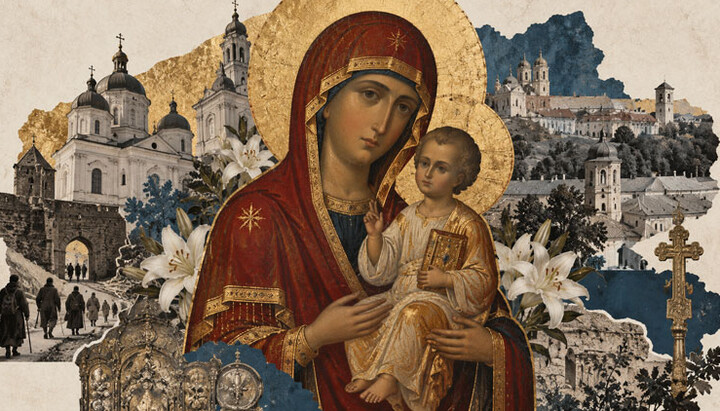
The biography of a Byzantine relic shows where the line lies between a dry document and living folk tradition.
In late November 1996, Anatoliy Kvasiuk, an art restorer in Lutsk, received a mysterious bundle. Its owners had brought him an object wrapped in traditional embroidered towels and plastic sheeting. When the protective layers were removed, the restorer found a badly damaged panel made of three cypress boards.
The object was in a sorry state. A thick layer of oil paint covered its ancient surface.
Kvasiuk later described his reaction as one of professional shock: “I felt as though someone had poured ice-cold water over me.”
The painstaking process of uncovering the original image began under the supervision of experts from the National Research and Restoration Center. As the restorers removed the later layers of oil paint, Byzantine iconography began to emerge.
According to tradition, the icon was painted by the Evangelist Luke. A rigorous examination of the historical evidence, however, points to other possibilities.
Following their research, experts at the Volyn Museum of Local History dated the artifact to the late 11th century. Other scholars suggested the late 12th or early 13th century. Both scholarly assessments support the icon's Byzantine origins, while leaving the traditional account within the realm of pious legend.
The silence of the medieval chronicle
To separate historical fact from later retellings, we must turn to the Hypatian Codex. It describes in detail how Prince Daniel Romanovich of Galicia–Volhynia built churches in Kholm (now Chełm, Poland) and adorned the sanctuaries he founded. The chronicler describes the decoration of the local Church of St. John Chrysostom: “He adorned the icons he had brought from Kyiv with precious stones and golden beads.”
Later, under the year 1260, the chronicle mentions a large church dedicated to the Most Holy Theotokos.
The chronicle also gives a detailed account of a devastating fire that swept through Kholm in 1259, reportedly caused by the carelessness of a local woman.
Yet the ancient manuscript says nothing about the Kholm Icon. The dramatic story of enemy soldiers throwing the sacred image to the ground and believers discovering it a century later beneath a pile of construction debris belongs to folk tradition. Written sources from the 13th century are silent on the matter.
The books of the Uniate bishop
The icon reappeared in the historical record during the early modern period.
In 1596, Bishop Dionysius Zbiruysky of Kholm accepted the Union of Brest. The cathedral passed into the hands of the Greek Catholic administration, which sought to strengthen the authority of this ancient religious center.
The task was taken up by Uniate Bishop Jakub Susza, a member of the Basilian Order. He wrote a detailed study of the local relic that went through three editions. The book was titled The Resurrected Phoenix. In his preface, the author acknowledged that he possessed no reliable information about the earliest centuries of the icon's history.
Orthodox writers also collected accounts of the sacred image.
In December 1665, a collection titled The New Heaven by Ioanikiy Galiatovsky was published in Lviv. The book contained hundreds of accounts of miracles associated with icons, including material concerning the Kholm Icon.
The icon's standing was further enhanced by Pope Clement XIII, who signed a decree authorizing its coronation in January 1765.
The solemn services during which crowns were placed on the image took place in September 1765 and lasted four days.
The relic's religious affiliation, however, was about to change once again.
In 1875, the Kholm Eparchy returned to Orthodoxy, bringing the ancient cathedral and its icon back into the Orthodox Church.
The divided panel
The 20th century turned the relic's history into something resembling a historical mystery.
In 1915, as the front lines of World War I approached the region, the icon was evacuated to Moscow. In 1918, it was transferred to a monastery in Kyiv.
In the late 1920s, Soviet authorities launched a campaign to confiscate church property in Kyiv.
Those carrying out the seizures stripped the icon of its precious metal covering.
Desperate to save the ancient painting from confiscation and destruction, believers took an extraordinary step: they separated the three cypress boards and entrusted them to different people for safekeeping.
It was not until the fall of 1943 that the rescued fragments were reunited with the assistance of Archbishop Ilarion (Ohienko) and solemnly returned to Kholm Cathedral.
The hiding places of the Korobchuk family
The period of relative peace, however, was short-lived.
In 1944, population deportations began, and the family of Father Havryil Korobchuk, a priest from Kholm, took the sacred image to Volyn.
The priest's family safeguarded the relic for more than half a century. They kept the icon in ordinary living quarters, transported it in concealed compartments, and carefully shielded it from outsiders.
Only in 2000 did the priest's daughter, Nadiya Horlytska, entrust the family treasure to a museum, on the condition that the icon remain permanently in Lutsk.
A thirteen-year restoration
The restoration proceeded under the scientific supervision of specialists from the National Research and Restoration Center.
Anatoliy Kvasiuk worked on restoring the painted surface, while fellow restorer Viktor Holub cleaned the enamel plates.
The extraordinarily complex undertaking was finally completed in December 2009.
The public unveiling of the restored icon had to be postponed for several weeks because of a flu quarantine imposed in the city.
The sacred wooden panels, having survived fires, deportations, and half a century of life in hiding, quietly waited a little longer.
Today, the restored original of the Kholm Icon of the Most Holy Theotokos is housed in a museum in Lutsk, while a copy painted in 1938 remains in Chełm.