
Can one Local Church declare war on another?
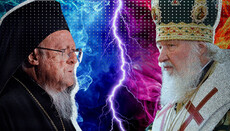
A representative of the Church of Constantinople said the Russian Orthodox Church had declared war on it. How does that fit within Orthodox ecclesiology?
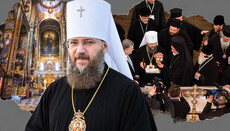
Metropolitan Emmanuel of Chalcedon – the same hierarch who presided over the “unification council” that created the OCU – has stated that the Russian Orthodox Church has declared war on the Ecumenical Patriarchate of Constantinople. Not merely war, but total war. Quote: “We are confronted with the realization of what institutionalized barbarism is and what a total war declared by the Moscow Patriarchate truly means.”
The pretext for such a harsh statement was an equally harsh statement by Russia’s Foreign Intelligence Service (SVR), which accused Patriarch Bartholomew of continuing “schismatic activity in the Orthodox ecclesiastical space.” The SVR wrote that after вмешательство in Ukraine he is pushing “Russian Orthodoxy out of the Baltic states” and also “intends to grant autocephaly to the unrecognized ‘Montenegrin Orthodox Church.’” In that statement, Patriarch Bartholomew was called “the devil in the flesh” and “the Constantinopolitan antichrist.”
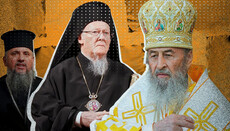
In response to these accusations, the Ecumenical Patriarchate issued an official press release calling the SVR’s message “fake news” and reaffirming the constancy of its “universal mission.”
Insults of this kind directed at Patriarch Bartholomew are, of course, unacceptable. And SVR staff would do well to know that calling the same person both the devil and the antichrist at once is theological illiteracy. The devil is the highest angel who fell away from God, while the antichrist is a concrete human being who will live on earth in the last times. According to the Bible, these are two different persons.
But as for the “fake” nature of the Russian text – questions remain.
Fake news?
Much has been said about how Patriarch Bartholomew intervened in Ukraine’s church situation and legalized schismatics (whose lack of recognition he himself had repeatedly acknowledged). There is also no need to remind anyone that, “thanks” to this intervention, Ukrainian authorities unleashed a real campaign of persecution against the Ukrainian Orthodox Church. These are well-known facts. In the Baltics, Constantinople is also creating parallel church structures and attempting to bring Orthodox communities under its control. We will not dwell on that in detail here.
But the situation with recognizing the “Montenegrin Orthodox Church” (MOC) has lately become especially acute and deserves particular attention.
On January 14, 2026, Metropolitan Emmanuel (Adamakis), in an interview with Παραπολιτικά 90.1, stated that the Ecumenical Patriarchate had never had any contact with the schismatics in Montenegro. Quote: “I’ll say it plainly: we have never had anything to do with this issue. It is not even a church structure – just some kind of group that cannot even be called schismatic. We have never had any contact with this group in Montenegro. This is simply informational noise on their part (the SVR – Ed.).”
The MOC in Rome
Yet already on January 19, 2026, the Montenegrin news agency Aktuelno published an extensive report on a visit by an MOC delegation to Rome. By the way, why would an official delegation of an unrecognized MOC suddenly appear in Rome? You might be surprised – it took part in a solemn liturgical ceremony dedicated to the 148th anniversary of the founding of the National Institute of the Honor Guard of the Royal Tombs of the Pantheon.
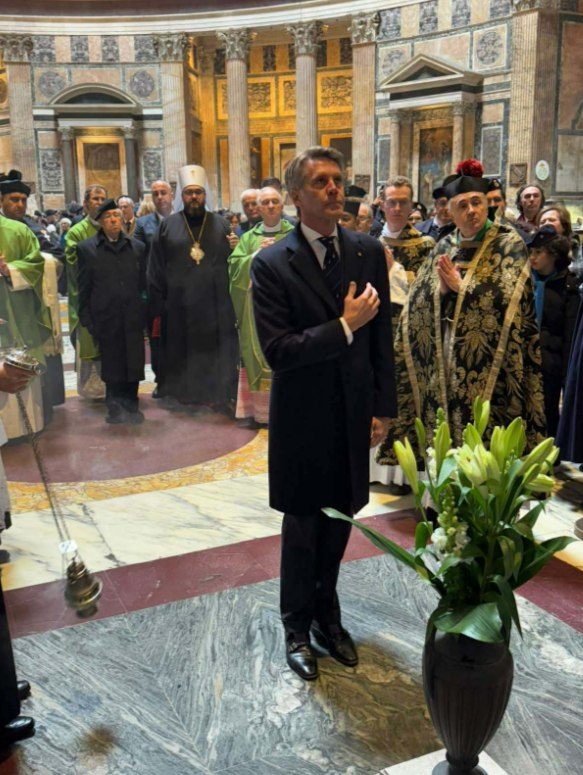
We will not presume to judge how important the event was – important enough, apparently, to justify sending an official delegation to Rome. But during the visit, the head of the MOC, “Metropolitan” Bojan Bojović, held two very telling meetings.
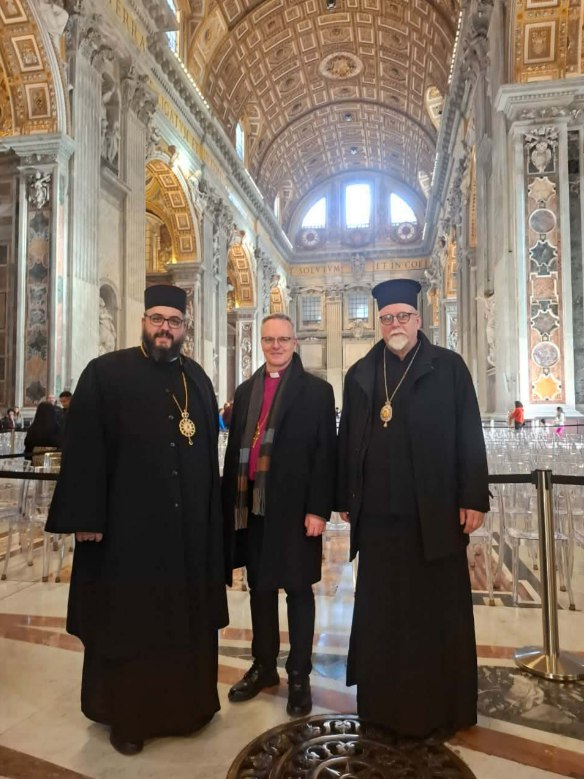
First, he met with the Archbishop of Helsinki and All Finland of the Orthodox Church of Constantinople, Elia (Vallgren).
Second, he met with the secretary-referent of the Kyiv Metropolis of the OCU, “Archpriest” Ivan Sydor – who in January 2019 traveled to Patriarch Bartholomew on the Phanar as part of the official delegation receiving the Tomos for the OCU.
There was no meeting?
One can only guess what Bojan Bojović discussed with Archbishop Elia and Ivan Sydor. But it is telling that, as soon as information about his meeting with Bojović entered the public sphere, the Finnish primate began to offer emotional justifications. Moreover, he accused UOJ’s American branch of “disinformation.” On January 22, 2026, on his Facebook page, he stated that the meeting with Bojović was purely accidental. Quote: “There were no negotiations. There was no meeting. What happened was a two-way, two-minute encounter – the kind that happens at any large gathering where people cross paths.”
According to the archbishop, it was “a fleeting meeting in Rome with someone dressed as a bishop who introduced himself as being from Montenegro.” He believes that such a meeting and a shared photograph in which he poses with Bojović are not grounds to “spin an entire story out of it.”
These are rather unusual explanations. Archbishop Elia cannot be unaware that there is a schism in Montenegro and, accordingly, a schismatic “hierarchy.” Even in a случайная encounter with someone wearing episcopal vestments and presenting himself as a Montenegrin, any hierarch of a Local Church would, quite obviously, clarify the person’s ecclesiastical affiliation before taking a photo together.
Moreover, in the MOC’s own statement, the meeting is presented as official: “During his stay in the Vatican, Metropolitan Bojan together with the delegation of the Montenegrin Orthodox Church met with an ecumenical delegation from Finland, which included <…> Elia Vallgren, Archbishop of Helsinki and All Finland, head of the Finnish Orthodox Church operating under the jurisdiction of the Ecumenical Patriarchate. <…> The visit to Rome and the Vatican confirms the Montenegrin Orthodox Church’s commitment to international dialogue, cooperation, and active participation in contemporary European church trends.”
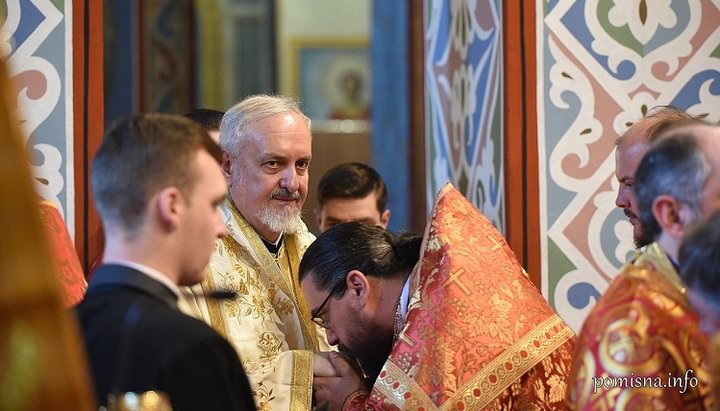
In any case, Archbishop Elia is not the only hierarch of the Ecumenical Patriarchate to have denied contacts with the Montenegrin schismatics. In 2019, Metropolitan Emmanuel of Chalcedon (then still of Gaul) concelebrated in the OCU’s St. Michael’s Cathedral in Kyiv with Bojan Bojović – at that time still an MOC “archimandrite.”
In addition, back in May 2024, Bojan Bojović stated that “the Ecumenical Patriarchate sent observers to see what the internal organization of the ‘Montenegrin Church’ looks like,” and that he hopes “soon we will be able to travel to the Phanar to communicate with representatives of the Ecumenical Patriarchate.”
It is also worth recalling that in 2019 Archbishop Daniel of Pamphylia, one of the Phanar’s exarchs in Ukraine, said openly in an interview with the BBC: “I support the thesis that every nation that wants to have its own Orthodox Church should have the right to establish it and ask for its recognition… including when we are talking about Macedonia and Montenegro.”
Thus, developments around the “Montenegrin church” may indicate that the Ecumenical Patriarchate is preparing to implement the same model of action it used earlier in Ukraine. The strategy includes several stages:
- public denial of contacts while those contacts in fact exist;
- shaping public opinion through statements by high-ranking hierarchs about the “right of nations to autocephaly”;
- a sharp shift in position at the moment political expediency demands it.
This raises a question – why take such steps if Montenegro is the canonical territory of the Serbian Church, not the Russian (with which Constantinople is allegedly “at war”)?
Apparently, the Ecumenical Church perceives the Serbs as an opponent against whom “military actions” simply have not yet been declared. There is just no suitable political moment – of the kind that arose in Ukraine. Still, the ground is being tested, little by little. And in that connection, several questions emerge.
Questions and answers
Unfortunately, in relations between parts of Christ’s Church we are observing “hostilities” whose intensity is often comparable to the rhetoric and actions of warring states. The sides develop strategy and tactics to gain an advantage over the opposing side – both in the short term and in the long term.
Undoubtedly, by supporting the war in Ukraine, the ROC has handed Constantinople powerful trump cards for criticizing its opponent. At the same time, does the Ecumenical Patriarchate have the right to assume the role of a moral arbiter? The facts suggest that it was precisely Constantinople that intervened in Ukraine, after which the UOC faced genuine persecutions in a Bolshevik spirit. Exploiting the moral vulnerability of the “enemy,” Constantinople creates parallel church structures in Latvia, Lithuania, and Estonia. In parallel, contacts are being cultivated that, in the future, may weaken the Serbian Church as well.
In the end, we arrive at the central question of this publication: can one Local Church actually declare war on another? How is that even possible if Orthodox ecclesiology teaches that all Christian communities throughout the world are one Body of Christ? How can members of one body declare war on one another?
The Apostle Paul wrote about this long ago: “But now there are many members, yet one body. The eye cannot say to the hand, ‘I have no need of you’; nor again the head to the feet, ‘I have no need of you’” (1 Corinthians 12:20–21). And if Local Churches do declare war on one another, then a question inevitably follows: are they truly Christ’s?
Sadly, we must acknowledge that Local Churches sometimes behave not like members of the one Church of Christ, but like rival worldly organizations. They fight one another for churches, for power over the faithful, for canonical territories, for property, for primacy, and so on. In the heat of this struggle, they do not shrink from any worldly means – lies, intrigues, coercive pressure through secular authorities, and the like. They act not as Christ commanded, but in the opposite manner. And in this struggle they destroy themselves, discredit themselves, and act exactly as the Apostle Paul wrote: “For the name of God is blasphemed among the Gentiles because of you” (Romans 2:24).
Church hierarchs can speak beautifully, urging people to come to the Church and find God there. But if people see those same hierarchs declaring war on one another – tearing at each other for mercenary interests – will people come to the Church at all?