
“Picasó”: Church Hymnography and Fr. Lavr’s Lecture
Excerpts from Andrey Vlasov’s book “Picasó. Part One: The Slave.” Episode 21.
Time: 1992
Place: Kyiv
Characters: Misha Kaminsky, Fr. Lavr, seminarians
Misha Kaminsky carefully carried out the obedience given to him by Fr. Lavr. Every day, before going to bed, he would say forty times on his prayer rope: “Lord Jesus Christ, save, have mercy on, and enlighten Thy servant Georgiy.”
Soon one of his roommates, Alyosha Okhrimenko, asked:
“So who exactly are you praying for?”
“For Georgiy. You know – the one who went into schism.”
“Ah…” Alyosha nodded knowingly.
Everyone felt sorry for Georgiy. He had been a good friend – kind and responsive. And if the guys from Lviv Region could somehow be understood, his departure came as a shock and was especially painful.
A few days later Alyosha suggested:
“Listen, maybe we could pray together?”
“Sure.”
They began to pray together.
Before long Alyosha remarked:
“No, forty prayers is too little. Let’s at least do a hundred.”
“No,” Misha replied, “Fr. Lavr only blessed forty.”
“Oh come on, brother. You won’t pray him back like that. I’m telling you, forty isn’t enough. And Lavr… what does Lavr have to do with it?”
“Whether he does or not, everything should be done with a blessing.”
But Okhrimenko disagreed and soon began adding extra prayers on his own. After some time, Gena Golovanov joined them, then Tolik Stadnitsky, then others… Soon about fifteen people were saying this small rule before bed for the servant of God Georgiy. Some even developed an unhealthy азарт – would the prayers “work” or not?
One day all this was discovered by the seminary inspector – also known as Helicopter, also known as Archpriest Viktor. He would sometimes drop into the dorm after lights-out to check if everyone was in place. Seeing a group of prayerful seminarians in the red corner, all making synchronized bows, he abruptly interrupted:
“All right! What’s this unauthorized gathering you’ve got here?!”
They had to explain: this and that, with Fr. Lavr’s blessing we’re saying forty prayers for the return of the erring Georgiy.
“I find it hard to believe Fr. Lavr blessed all this,” the inspector said.
“Well, he only blessed me,” Misha admitted. “You see, Georgiy is my best friend.”
“Ah. That sounds more like it. And the rest of you joined in for company?”
Everyone nodded.
“All right then, you enthusiasts,” Fr. Viktor waved his hand dismissively. He headed for the door, then turned back from the threshold. “If that’s the case, pray for all of them. He wasn’t the only one who left.”
So they began to say: “Lord Jesus Christ, save, have mercy on, and enlighten Thy servant Georgiy and those who went into schism with him.” It was practically turning into church hymnography.
At the beginning of November, a long-awaited notice appeared on the bulletin board near the seminary refectory: “On the 5th of this month, an additional class on Holy Scripture will be held in the self-study classroom. Hegumen Lavr.”
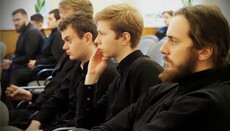
The class began with Fr. Lavr asking one of the seminarians to briefly recount the main points of St. Basil the Great’s “Hexaemeron,” which had been assigned at the previous lesson. Three students retold it – not quite as briefly as Fr. Lavr had hoped. After that, he said:
“Unfortunately, brethren, we do not have the opportunity to discuss all the events of the creation of the world and of man, or the main events of Sacred History. We have touched on some of it… In our classes, we will speak about what seems to me most essential in Holy Scripture – the very core. Again, I do not mean that what we cannot cover is unimportant or may be omitted. Not at all. I simply want to dwell in greater detail on those points that have practical significance for a person’s spiritual life. Again, I do not mean that the other things are unimportant…” Fr. Lavr fell silent, realizing he was repeating himself. “In any case, you will study all this in your courses on Sacred History, in catechism, and in other subjects. And in the senior years you will return to it more than once.”
“The topic of today’s lesson is the Fall of man. It is a subject of exceptional importance – both for all humanity and for each of us in a very practical sense. This event – the fall of Adam and Eve in Paradise – we will, with God’s help, try to examine as thoroughly as possible. Again… Understanding what the Fall was, how the temptation occurred, and what man must do in his fallen state – all this is essential for our daily life. At every step we encounter the consequences of this event, and many times a day we experience temptations akin to those faced by Adam and Eve.”
“In our reflections we will rely on Holy Scripture and on the writings of two holy fathers who most thoroughly interpreted the opening chapters of Genesis: St. John Chrysostom and St. Ephrem the Syrian. Of course, we will also mention others.”
“I will say at once, brethren, that almost the whole world – nearly all religions and philosophical systems – consider man’s present condition to be natural. Only Christians recognize man as fallen, as sick, as needing healing. And only the one who acknowledges his illness can be healed. Just think, brethren,” Fr. Lavr paused and raised his index finger, “almost the entire world ignores the fact that people die. All people are mortal. There is nothing more ordinary than death – and nothing that is experienced so tragically. The soul resists with all its strength when it sees the death of a loved one, a relative, a friend. Within ourselves we cannot accept the fact that this person is gone and will never return. And yet, there is nothing more common in the world than death. And death is the primary consequence of the Fall, crying out to us: ‘People, come to your senses! You were not created this way!’”
“So, before we read the third chapter and examine the Fall itself, we must understand what Paradise is, how God created man, and what man was meant to do according to God’s design.”
Fr. Lavr asked one of the first-year students to sit at the teacher’s desk and read the verses about Paradise. Meanwhile, he walked slowly around the classroom, stroking his beard.
The seminarian began to read: “And the Lord God planted a garden eastward in Eden, and there He put the man whom He had formed. And out of the ground made the Lord God to grow every tree that is pleasant to the sight and good for food: the tree of life also in the midst of the garden, and the tree of the knowledge of good and evil.” He read about the rivers of Paradise, where they flowed, and at the words: “And the Lord God took the man, whom He had formed, and put him into the garden of delight to till it and keep it,” Fr. Lavr raised his hand and stopped him.
“That’s enough. What is Paradise?”
To be continued…
The previous episode of the book is available here.