
The broken seal: why Rome failed to close the case of Christ
The Sanhedrin sealed Christ's tomb to put an end to His story. But the state seal became evidence that even emperors could not refute.
Saturday in first-century Jerusalem was a time of absolute silence. Trade came to a halt, the streets emptied, and life was confined within the limits of the Sabbath journey. Yet on that day, people appear at the praetorium of Pontius Pilate who are far from seeking rest. The chief priests and Pharisees come to the representative of Roman authority with a specific request. They remember Jesus’ words about rising on the third day and fear deception. In their view, the disciples might steal the body in order to claim that the prophecy had been fulfilled.
Pilate responded briefly: "You have a guard." This phrase in the Greek text allows for dual interpretation. Some historians see in it permission to employ the temple police, others believe it referred to providing a Roman detachment. In any case, guarding the tomb transforms from a private matter into a task sanctioned by authority. The tomb in Joseph of Arimathea's garden becomes a guarded object.
For the Sanhedrin, this was a necessity. They required not simply the presence of armed men but official confirmation that the body was inside. The soldiers took their posts. From this moment, any actions around the cave fell under the observation of those who bore personal responsibility for preserving the contents.
Legal boundary
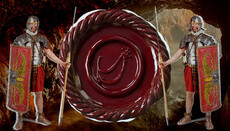
It was decided to secure the tomb by sealing the stone. Judging by the practice of that time, this was a standard legal measure. A cord was stretched across the massive boulder blocking the entrance, and its ends were fastened to the rock with wax or special clay. A signet ring imprint was then placed on top. This was an official state seal.
Breaking such a seal in the Roman world was considered a serious offense. For a civilian, it could end in severe punishment. For soldiers, the loss of a guarded object almost always meant a tribunal. Military discipline was harsh: for sleeping on duty or losing entrusted property, a unit could be subjected to the death penalty. The soldiers standing in the garden understood the seriousness of the situation.
By sealing the entrance, Christ's opponents created a point of reference.
They themselves confirmed the presence of the body, documented this with their action, and imposed a legal prohibition on opening the cave. They sought to definitively close the case of Jesus of Nazareth. In the end, their actions became crucial evidence confirming that, on Saturday morning, the tomb was intact. They became unwitting witnesses to what they would later strive with all their might to deny. Every detail of their precautions would later work against their own version of events.
Stone and light
Early Sunday morning, women headed toward the garden. They were troubled by the question of who would help them move the stone. In typical tombs of wealthy Jews of that period, the entrance was closed by a massive disc-shaped monolith. It was rolled along a groove specially carved in the rock. The construction was arranged so that closing the entrance was relatively easy – the stone rolled down under its own weight. But to lift it back up the inclined track required the efforts of several strong men. This task was beyond an ordinary woman's strength.
The version that the disciples stole the body that night faces a number of practical difficulties. Jerusalem followed a lunar calendar, and Passover always coincides with a full moon. The night was bright. Joseph’s garden was in plain sight.
The disciples, crushed by recent events, would have had to not only approach the tomb but also silently perform heavy physical work right under the nose of an armed guard. Any sound at the rock in the night silence would echo for hundreds of meters.
The very fact of the stone, seal, and guard makes the version of secret theft extremely unconvincing.
Those who sealed the tomb had foreseen everything. They created conditions under which any interference would be immediately noticed and stopped. The physics of the process and legal control excluded the possibility of fraud.
Testimony of the sleeping
Sunday morning's events unfolded rapidly. The earthquake, the angel's appearance, and the moved stone left the guard stunned. Matthew writes that the soldiers "became like dead men" – probably referring to a deep faint from the shock they experienced. When the soldiers came to their senses, they headed not to the praetorium to their command but to the chief priests.
For a military man, this was the only chance to survive. Reporting to a Roman tribune with a confession that the seal was broken and the object had disappeared meant a death sentence. The chief priests, however, were as interested in concealing the fact as the soldiers themselves. As a result, an official version emerged: "His disciples came by night and stole Him while we slept."
The logic of this claim falls apart at the first test. In legal practice, the testimony of a sleeping person carries no weight. Someone who was asleep cannot know who came, how many there were, or what exactly was taken. If the soldiers were asleep, they could not have seen the disciples. If they did see the disciples, then they were not asleep and allowed the theft voluntarily, which is even more implausible for that time.
The attempt by the Sanhedrin to construct a coherent narrative only highlighted the scale of what had happened. The very absurdity of the explanation became indirect evidence that something had occurred which does not fit within earthly frameworks.
The empire's reaction
The story continued at the state level. In the mid-twentieth century, a marble slab with the text of an imperial edict was discovered in Nazareth. The document dates to the first half of the first century and establishes the death penalty for opening tombs, moving stones, and stealing bodies. Notably, previously only a monetary fine was imposed for such offenses.
Many historians connect this sharp tightening of legislation with the reign of Emperor Claudius. There is a possibility that Rome was forced to react to unrest caused by news of Christ's Resurrection.
The empire always fought against what threatened the peace of the provinces. If in Judea there arose a need to introduce capital punishment for moving tombstones, then the precedent was extremely serious.
The Nazareth inscription serves as an important background for understanding the era. The authorities tried to deal with news of the empty tomb through familiar methods – through the criminal code. This indirectly confirms that the story of the disappeared Body went far beyond the narrow circle of Jesus' followers and became a matter of state investigation. Rome tried to keep the situation under control, but legal prohibitions could not stop the spread of the good news.
Conclusion
In summary, we see a strange picture. Christ's opponents did everything possible to document His presence in the cave. They initiated posting a guard, controlled the presence of the body, and imposed a state seal. They transformed a private burial into a guarded imperial protocol.
When the seal was broken, it was precisely their precautions that became the main arguments against themselves.
The stone was not removed so that Christ could leave the tomb. He rose in the closed cave, passing through the stone just as later He entered to the disciples through locked doors. The stone was rolled away for people. They needed to go inside and confirm that the cave was empty.
All attempts by the authorities and Sanhedrin to explain what had happened only strengthened the fact of the Resurrection. Bribing the guard, fabricated stories about theft, tightened laws – all these were attempts to extinguish a fire they themselves had helped kindle with their excessive vigilance. The tomb remained empty, and this fact became the beginning of a new history that Rome could not stop with either seals or executions.