
The road to Emmaus: why God walks beside us when we give up
The disciples are fleeing Jerusalem, crushed by grief. But Christ does not stop them – He simply walks beside them, all the way to supper, where a piece of bread will change everything.
It is Sunday in Jerusalem. The sun presses down mercilessly, the air thick with dust, the roar of the crowd, the smell of festival sacrifices. A few women have already come running from the tomb – breathless, frightened, speaking in broken bursts about an empty cave and angels. Peter himself ran there, saw the abandoned linen cloths, rubbed his forehead, unable to make sense of it. Within the community – noise, arguments, cautious whispers, and wild theories.
And these two simply pack their things and leave. Ahead of them lie twelve kilometers to Emmaus. It is an escape from a reality too frightening to face. Emmaus – some quiet nowhere, a forgotten corner, a dot on the map where one can sit, stare at a wall, and say nothing. Where no one tugs at your sleeve and asks, “So what now?”
Luke and Cleopas heard the women’s accounts. Saw the confusion of the apostles. Knew the tomb was empty.
And still – they left.
They were simply exhausted beyond words. For three years, they had lived at the edge of a miracle. Three years at the summit, believing the world was about to turn, that truth would finally prevail. They left their homes, their boats, erased their former lives for the sake of the One who promised a Kingdom.
And then came Friday. A rushed trial. Nails. The terrible silence of Saturday. Inside them, everything went dark. They can no longer wait. Faith requires movement, effort – and they do not even have the strength for a deep breath. When hope dies so loudly, the silence that follows becomes unbearable.
On the road, they chew on their pain, retelling the events of the past days. In the Gospel there is a phrase that carries the chill of a grave: “But we had hoped that He was the One…” (Luke 24:21).
“We had hoped.” Past tense. Conditional. A final, irrevocable end.
They have already buried Christ in their memory, sealed Him beneath a heavy stone, and now they are trying to get as far away as possible from the place where their dreams shattered against the hard reality of Roman justice.
The stranger who joins the road
Christ does not stop them. He does not block their path with a flaming sword. He does not cry out from heaven, “Where are you going, you of little faith?” He does something far stranger, far deeper: He simply falls into step beside them. His sandals raising the same dust, His breathing matching theirs, His pace adjusting to their slow, heavy walk.
The text says their eyes were “kept from recognizing Him” (Luke 24:16). But this is not some magical blindness. It is simpler: when you have locked someone in the past, you do not expect Him in the present. You do not expect living breath in the image you have already mourned.
For them, He is the One they have lost forever. A living man walking beside them does not fit their world, where death always draws a thick final line.
The first thing Christ does is ask a question: “What are you discussing so sadly as you walk?” (Luke 24:17). He knows the answer. He knows every fragment of their disappointment. But He lets them speak. He walks beside them and listens – to their confusion, their bitterness, their helpless outrage at how everything ended. And they pour it all out, in detail, in fragments. They speak of a prophet mighty in word and deed – and how He was betrayed and crucified.
Only after they have emptied their grief does Christ begin to open the Scriptures to them. He does not silence them with correct answers. He does not heal their pain with a dry lecture. He lets them speak to the very last drop. Understanding comes second. First – compassion and presence.
He walks with them – in fact, in the wrong direction. Jerusalem is the center, the place of Resurrection, the community. They are leaving it, heading into their own dead end. And God walks into that dead end with them. At their pace. Along their dusty road.
It is a startling image: God does not drag a person back into the light by force. If you choose to leave, He walks with you into your darkness – until you yourself are ready to turn.
Stay with us
They approach Emmaus. The sun sinks behind the hills; shadows stretch long and cold. The air grows chill. Christ “acted as if He would go farther.” He does not impose Himself. He does not enter the house uninvited. He preserves their freedom to the very end.
They must ask Him themselves. And they do.
Not because they recognize Him. Not because His words impressed them. Simply because, over those hours on the road, it became warm with Him. Human closeness, born of shared journey, came before the recognition of God.
“Stay with us, for evening is coming on” (Luke 24:29).
They think they are offering shelter to a weary traveler. Ordinary hospitality – a cup of wine, a piece of bread, a roof for the night. They enter the house.
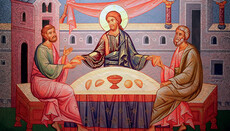
Inside, the air smells of smoke, dried herbs, and stew. The flame of the oil lamp trembles against rough walls. They sit at the table. And suddenly, the Stranger takes the place of the host. He takes the bread. Gives thanks. Breaks it.
In the stillness of the room, the crust cracks.
And in that moment, their eyes are opened.
Not during a long analysis of ancient prophecies. Not in an intellectual argument. But in a simple, almost ordinary gesture. They had seen it hundreds of times – the way He held the bread, the movement of His hands in the half-light. Yet here something unmistakable, personal, living breaks through. In that broken bread – His whole life, given for them. And they finally know Him.
And He vanishes.
The room is empty. On the table – only the broken bread. Outside – the night.
The turning point
The rest of the story takes only a few lines in the Gospel. But in them – everything.
They have just walked twelve kilometers under the burning sun. Their legs ache, their backs are heavy, they are drained. They have only just sat down to eat. Outside – deep night. In the first century, no one walked Judean roads at night without need: wild animals, robbers, unseen pits.
And what do they do?
They rise immediately. And run back.
Not in the morning. Not when it is safe. Now. The same twelve kilometers, in complete darkness, back to the place they fled in fear and despair just hours before. They are no longer afraid. They no longer need to hide.
Something in that broken bread has changed their very nature.
They were walking away from the community – now they are flying toward it. They sought to disappear in Emmaus – now Emmaus is no longer needed. The place of retreat becomes the starting point of a new life.
Christ did not appear to them in Jerusalem when they were still among the others. He did not intercept them at the beginning of the road. He waited until they reached their limit. He shared their fatigue, their evening, their bread.
This is perhaps the most personal story in the Gospel. It is not about heroes who stand firm beneath the Cross. It is about those who gave up. Those who said, “It didn’t work. I’m leaving. It was all a mistake.”
We often think God waits for us in the “right” places – at the center of faith, in moments of spiritual clarity. But He walks dusty roads that lead away from Him. He adjusts to our faltering steps. Listens to our endless complaints. Patiently waits until we invite Him to supper in our own small, disappointed corner of the world.
Sometimes a person must walk away in order to return with new eyes. Must reach his own Emmaus – the farthest edge of disbelief – so that in a simple gesture, in the crack of broken bread, he can suddenly feel: “Did not our hearts burn within us?” (Luke 24:32).
The road to Emmaus runs both ways. Twelve kilometers of despair – and twelve kilometers of ringing, luminous joy.
And all that time, God simply walks beside us. Not preventing our mistakes, not overwhelming us with His majesty – but not allowing us to disappear into the dark.
The day is drawing to its close.
And He is still here.
Beside everyone who today has decided that everything is over.